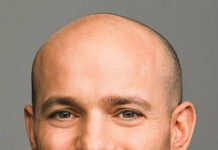
After 30 years at GM and playing a role in the development of the first Volt, Tony Posawatz is working on using EV energy to help power the overall grid.
If anyone was destined from birth to end up pursuing a career as a “car guy,” look no further than Tony Posawatz, CEO of Fermata Energy.
“My folks came over to this country as immigrants from Austria,” he says. “They met on a boat to the United States in 1955. Dad was 20, Mom (was) 18. They both had relatives in the Detroit area. My father was a skilled tradesman — the auto industry was ripe with opportunities — and he worked for Fisher Body and General Motors.”
The family ended up settling in Warren.
Posawatz was the first in the family to be born in the United States, at what used to be called Bon Secours Hospital in Grosse Pointe.
“My family’s home was on Fina Drive in Warren, and I was outdoors all the time, playing all sports imaginable,” he says. “I have the knee surgeries to prove it. But that’s what we did back then, from season to season. I was one of the few soccer players back in that time frame of the 1970s and ’80s; as the son of an immigrant, that’s what my father taught me.”
Soccer wasn’t the only thing young Tony learned from his father.
“I just fell in love with the auto industry,” he says. “What attracted me to it in general was how unique it was, providing you with freedom and independence. And coming from modest means, all the cars we had were used. So they broke down a lot, and I had to learn how to keep them going so I could experience cruising Gratiot or Woodward, which was the culture and lifestyle that we embraced.”
Posawatz attended Woods-Tower High School in Warren, and when the time came to choose a college, there was no decision to be made.
“I had a full ride to Wayne State University,” he says. “They had a great automotive program. I had a number of other scholarships away from Detroit, but my father had kidney disease and I was a donor candidate, so I wanted to be close by.”
Posawatz attended Wayne State through GM’s Scholar & Engineering Intern program. “I worked two summers for GM’s Truck & Bus Group,” he adds. “It was a great experience for someone who was destined to be a car/truck guy.”
After earning a bachelor’s degree in mechanical engineering, he was selected for the GM Graduate Fellowship.
“They would take promising young professionals and pay for the entirety of their business school experience — tuition, computers, everything,” he explains. “And I got half my salary. They don’t do it anymore.”
While Posawatz stayed close to home to attend college, business school was a different story. His father’s successful kidney transplant gave him the freedom to explore options far beyond his hometown.
“I was very fortunate to get into every business school I applied to,” he says. “I visited Harvard University, but I wasn’t sure I could trust a lot of the people I’d be going to school with, you know? And I was drawn to the Tuck School at Dartmouth because I felt (that) for my development, I needed a different experience.
“After growing up and spending all my time in the Midwest, I wanted something that was very different from what I would experience in being part of a business in a big city. I selected Dartmouth because it’s the oldest graduate business school in the world. Smaller, very team-oriented, not cutthroat at all. I had a wonderful experience there.”
When he returned home with his MBA, Posawatz had a life-changing conversation with his father.
“I was beginning my career in a white-collar, salaried environment,” he says. “He was an hourly union guy, so we had some interesting discussions and debates. To his credit, my dad said, ‘You’ve never really spent a lot of time working in a plant.’
“He told me, ‘If you’re going be a player in the car business, it’s important to see how (vehicles are) built.’ And so my job, after coming back from Dartmouth College with a fancy Ivy League MBA, was a production foreman in the plant — and I just loved it.”
Posawatz eagerly immersed himself in all aspects of the job. He started as a general supervisor and became an area manager at what was Pontiac East Assembly, which produced GM pickup trucks.
“I didn’t just have production responsibility in that role,” he relays. “I had tooling, I had maintenance and material, and it gave me the first sense and feel of what it was like to run my own business, albeit part of a bigger business.
“At the end of the day, you knew you built so many vehicles out of your department, you had 50 or so people working for you, and you dealt hands-on with real-world problems, whether they (were) problems of engineering, mechanics and physics, or psychological problems, because a couple of your operators came in late or half-drunk.”
Bill Krzisnik, a longtime friend and GM executive who first crossed paths with Posawatz in 1981 at the Pontiac plant, says his colleague was “Uncanny with his ability to select the right team members, and then also motivate them. Just a straight-shooter, a high- integrity guy, and a great communicator.”
Posawatz’s career at GM took off from there as he continued to, in his words, “realize a lot of cross-functional experiences” within the company, which was atypical for most ambitious executives. “Usually they want you to specialize in finance or purchasing, or engineering, manufacturing, and marketing.”
Posawatz did manage to move around, even getting some experience in GM’s corporate finance department before he was chosen to help manage the full-size truck vehicle line.
“The whole thing was a Fortune 25 company by itself,” he says. “It was Tahoes, Silverados, Suburbans, Yukons, and Escalades — the lifeblood of GM that, frankly, has carried the company for years. And we had a lot of success.”
Posawatz and his team went on to develop the Avalanche, a hybrid between the Suburban SUV and Silverado pickup truck, which won Motor Trend’s Truck of the Year honors and ushered in the era of four-door, short-box pickup trucks, which is still a predominant model today.
“I still laugh when I remember what the Chevy Truck guy told me at the time,” Posawatz recalls. “ ‘A short-box, four-door pickup will never sell.’ Today it’s the only version they have.”
Posawatz was already established as one of GM’s most accomplished executives when the Prius was being produced and marketed by Toyota as “the car for the 21st century.”
That prompted a visceral response from GM’s vice chairman, Bob Lutz.
“Bob said it’s an efficient appliance, but it’s not a great car, and they’re getting all this credit,” Posawatz recalls. “And the leadership of the company said, ‘We need to do something.’ Bob tapped me in mid-2006, and by the Detroit Auto Show that January we had developed a concept car for the Volt, which gave you 40 to 50 miles of range — enough for everyone’s usual daily drive.
“And when you went on vacation or a long road trip, you’d use the gas tank. We responded to a need with a fantastic team and got it production-approved, which was a great achievement, and it won the Motor Trend Car of the Year.”
But the good times didn’t last, and in 2009 GM found itself in bankruptcy.
“I worked with the Obama Auto Task Force and others to provide briefings on GM’s technology in the Volt because they thought the Volt was a reason to save GM,” he says.
The company survived, and Posawatz retired from the automaker in July 2012 after 30-plus years with the company.
“A whole new team came in,” he says, “and there was a question about whether we should be doing any plug-in or electrified vehicles.”
That wasn’t happy news for the innovator who already was widely known as “the godfather of EVs,” although the accolade makes Posawatz uncomfortable to this day.
“I’m not sure that’s accurate,” he demurs, “but I did coin the term ‘range anxiety,’ which is still used all the time now.”
A month after leaving GM, Posawatz had a short-lived stint as CEO of Fisker Automotive, a California-based company making an early iteration of a luxury plug-in hybrid electric

Fermata Energy ‘s V2X bidirectional platform both charges and discharges an EV battery, creating revenue opportunities.
vehicle. He also helmed an automotive and technology innovation consulting company, and at one time served on as many as seven different corporate boards.
Last July, after serving for 10 years as an adviser, he was named CEO of Fermata Energy. Headquartered in Charlottesville, Va., the company’s V2X bidirectional platform both charges and discharges an EV battery, which not only creates revenue opportunities, but also more sources of resiliency for the grid.
“We have an auto industry that’s been reliant forever on internal combustion engines and on oil and gas,” Posawatz says. “We know that’s not the future. The idea of making money for customers when their EVs were parked was a compelling idea to pursue.
“Now we have this electric vehicle technology, with a really high-end battery or energy storage system. But how often do most people drive their cars? Maybe 5 percent of the time? So that expensive asset sits there 95 percent of the time being unused.”
When the battery in the car isn’t being used to drive it, Posawatz and his team at Fermata want to return the dormant energy to the grid.
“It’s like an Airbnb,” he says. “Instead of a home, you have this asset of energy storage, and when it’s not being used, you rent it out with minimal wear and tear. All those cars sitting there could be plugged into bidirectional chargers, to collect that energy and then

Fermata Energy’s platform could improve the grid.
deploy it when it makes the most economic sense.”
As part of the offerings, “We have a software platform that tells you when is the best time to discharge your vehicle and can make the most money. We’re talking about thousands of dollars a year for most any customer. That’s like your car payment, while your car sits there parked, making money.”
Listening to Posawatz and hearing his passion for this new endeavor, it’s hard to believe he’s a grizzled 40-year veteran of the car business — but it’s not in the least bit surprising to his old pal, Bill Krzisnik.
“He’s been talking about this vehicle-to-grid idea for years, and his enthusiasm for anything he works on is contagious,” Krzisnik says. “When we were working together at GM and times got tough with whatever innovation we were working on, Tony would be adamant that we could get there. And we did, and we accomplished his vision. To this day, people call me up and say they’d go back to work for Tony.”
Posawatz shrugs off the praise, saying, “I’m going to turn 64 in April, and when you get to be my age, if I can help a little bit to make things better for generations to come, that’s pretty important to me.”
He pauses briefly, then adds, “My birthday is April 22, which is Earth Day, and the media has always gotten a kick out of that. ‘No wonder you’re doing what you’re doing,’ they say.
“And I always tell them: Hey, if you can’t remember how to pronounce my name, it’s Posawatz. Like kilowatts.”