H.W. Kaufman Group
PROFILE: Offers brokerage, distribution, and underwriting insurance
GROUP CHAIRMAN AND CEO: Alan Jay Kaufman
HEADQUARTERS: Farmington Hills
FOUNDED: 1969
EMPLOYEES: 2,000
REVENUE: $3.6B
SUBSIDIARIES: Burns & Wilcox, RB Jones, and Atain Insurance Cos.
Alan Jay Kaufman’s path to the top of one of the country’s largest family-owned insurance businesses began with his childhood love of animals.
Upon graduation from high school in Detroit, he was attracted to Michigan State University in East Lansing because of its nationally acclaimed veterinary school. Kaufman enrolled at MSU in 1970 with ambitions of becoming a veterinarian.
A subsequent change of heart, however, made him switch to MSU’s Eli Broad School of Business, where he earned a degree in finance, accounting, and insurance.
From there, it was on to law school at the University of Notre Dame, where at one point he took a year-long hiatus to study international law at the London School of Economics.
His interest in London had been kindled by his father, Herbert W. Kaufman, who had a fondness for the city and the opportunities it offered for his Southfield-based insurance business.
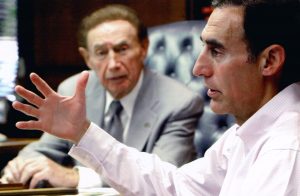
Notre Dame’s law school also had a unique link to the capital city of England. It offered a specialized course of study: the London Law Programme, the oldest year-long overseas study program offered by an American law school. The course was also approved by the American Bar Association.
“I was exposed to London by going (there) with my father when I was young, when I was in school,” Kaufman says. Herb was already doing business in London, and when Alan had dinners with his visiting father, the gatherings often included British brokers who doubled as friends.
That early exposure to international law and the prospects for the insurance business in London would later fuel the expansion of his father’s H.W. Kaufman Group, now in Farmington Hills, into a national and worldwide insurance empire.
From its inconspicuous headquarters, a contemporary modern brick-and-glass building along Northwestern Highway, the footprint of the third-generation family insurance business extends across the United States, Canada, the United Kingdom, Europe, and the Middle East.
Through its three subsidiaries — Burns & Wilcox, RB Jones, and Atain Insurance Cos. — the Kaufman Group offers brokerage, distribution, and underwriting insurance to companies in 90 countries via 60 offices worldwide.
Kaufman Group’s London office is its key overseas hub. It oversees other offices in Amsterdam, Dubai, and in Abu Dhabi in the United Arab Emirates (UAE). The company’s 2,000 employees generated revenue of $3.6 billion last year, according to available data.
The spectacular multibillion-dollar skyscrapers and other developments in the UAE, and their owners’ need for insurance, is reason enough for a metro Detroit-based company with connections to Lloyd’s of London to set up shop in Abu Dhabi.
“We thought the UAE was the best friend to the United States, and friendly to Europe,” Alan Kaufman says. “They’re one of the safest. We’re big on that spot.”
Kaufman says another benefit for his company is that India, another high-risk client, does a lot of business in the UAE. Until the U.S.-Iran war broke out in early April, which caused some disruption in their operations, Kaufman says he’s always felt comfortable doing business overseas.
Unlike the Farmington Hills headquarters building that blends in along Northwestern Highway, Kaufman’s London office houses 300 employees in one of that city’s most spectacular and controversial structures. The 41-story blue glass tower located next to Lloyd’s in the financial district (City of London) is known as The Gherkin because of its shape, which resembles a pickle.
Overall, Burns & Wilcox is the group’s dominant and most prominent arm as a wholesale broker and distributor of specialty insurance. It’s the group’s most public-facing entity, as well. Professional golfers Webb Simpson, Harris English, and Jimmy Walker represent Burns & Wilcox on the PGA Tour, while Sophia Schubert represents the firm on the LPGA.
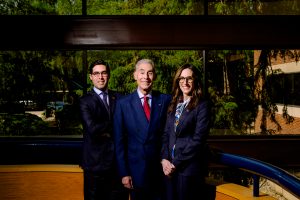
addition to being co-presidents of the overall
company, run its subsidiaries, Burns & Wilcox, RB Jones, and Atain Insurance Cos. // Photo by Nic Antaya
As for the other companies, RB Jones focuses on property, marine, energy, and professional liability; Atain Insurance, meanwhile, provides property and casualty insurance in high-risk or unusual cases involving government or non-government-backed markets.
The businesses have deep family connections. Alan Kaufman is chairman and CEO of H.W. Kaufman Group. His daughter, Jodie, and his son, Danny, are co-presidents of the overall enterprise. All three family members serve on the board of directors.
In addition, Jodie is vice chair of Atain Insurance, oversees RB Jones, and is responsible for businesses outside of North America, while Danny is president of Burns & Wilcox, with responsibility for its brokerage and Canadian divisions.
The trio share similar academic backgrounds as lawyers. Jodie and Danny each earned undergraduate degrees at the University of Michigan before attending law school at Michigan State University and Chicago’s Loyola University, respectively.
Alan Kaufman says just as his father didn’t pressure him to join the business, he allowed Jodie and Danny to find their own path to the family boardroom.
For example, Alan Kaufman practiced insurance law for 15 years and founded his own firm, Kaufman, Payton, which later added Chapa. The firm continues to thrive, with offices in the Kaufman Group headquarters complex.
“I had been on the board of the company, so I knew what was going on and I saw opportunities there,” Kaufman says. Still, his entrepreneurial bent was suppressed by the confines of a law practice.
“I wanted to build up the business to where I thought it could go. That’s how I started thinking about it,” Kaufman says.
Like her father, Jodie Kaufman says her career goal was to be a lawyer. After obtaining her law degree she moved to Canada, married a Canadian, Jamie Davis, began raising her family of three children, and practiced law in Toronto for eight years.
“I never had a plan to join the family business until I actually joined it,” she says. When she became eligible for partnership in the Toronto law firm, she had doubts that she wanted to take that next step and began exploring other options.
“Fortuitously, our business had recently expanded to Toronto, and my father always told us that if we wanted to take advantage of opportunities in our business, we certainly could. So I decided to lean on that,” she says.
Jodie says she took a part-time role in January 2014 to explore and learn about the business the Kaufman Group acquired in Toronto. She says after three or four months, she realized she couldn’t contribute without being fully committed to the company.
At the time, the Kaufman acquisition wasn’t moving the dial in Toronto, she says, nor did it have any name recognition.
“It became very clear that this wasn’t a part-time role. This was going to be a full-time commitment of mine, and I just dove right into it,” she says.
Jodie spent the next seven years building Kaufman’s Canadian operations while getting more involved with other parts of the company.
“Eventually in 2020, with my husband and our three kids, we moved back here to Detroit. Since that time, I’ve been working closely with my father and my brother on many other things beyond my start in Canada,” she says.
Danny, however, took no such detour to his role in the family business. From childhood, he seemed destined for an insurance executive career.

“I went to law school. I passed the bar. But I always knew I wanted to get into this business. I always knew I wanted to work in insurance in our business, so I didn’t go into practice,” he says.
“Our father always encouraged law school. He thought it would be a great background to have, and it helps every day. It gives you a great way to frame issues and look at the world differently.”
In a profile story in Insurance News in 2023, Danny recalled his growing up around the business, which sometimes meant going to his grandfather’s office to have lunch with him.
“Back then, we were very formal. I’d put on a suit and tie to visit,” he says. “I fell in love with the industry. It was a people-first industry built on relationships, handshakes, and friendships.”
Danny served as an intern with the company at age 16 and worked his way up to head the Chicago office after law school, before returning home.
As CEO of Burns & Wilcox, he supervises sales, marketing, and technology. He also sits on the boards for the London Group and Atain Insurance. In addition, Danny is the point man on H.W. Kaufman Group’s $100 million digital investment that came out of the COVID-19 shutdown in 2020 and now powers the overall company’s operations and growth.
“In five years, the goal certainly is to be substantially larger, perhaps twice the size or so,” Danny says. “It’ll continue to always be a people-centric business built on relationships, but certainly using technology to a greater degree to be more efficient, to provide greater services and data analytics to our clients and partners, and, of course, assist our team.”
Herb William Kaufman, the family patriarch who founded H.W. Kaufman Financial Group in 1969, didn’t take the lawyer route to the insurance business.
He began his professional career handling the financial side of his father’s plumbing and real estate business, including maintaining insurance.
That early insurance experience stuck with him. After building his own successful business — Six-Mile Hardware Store — in the 1960s, Herb Kaufman sold it and bought an insurance agency in Detroit.
With an accounting background from Wayne State University in Detroit, a knack for finances, and a trustworthy personality, Herb expanded his holdings by purchasing other agencies in the state.

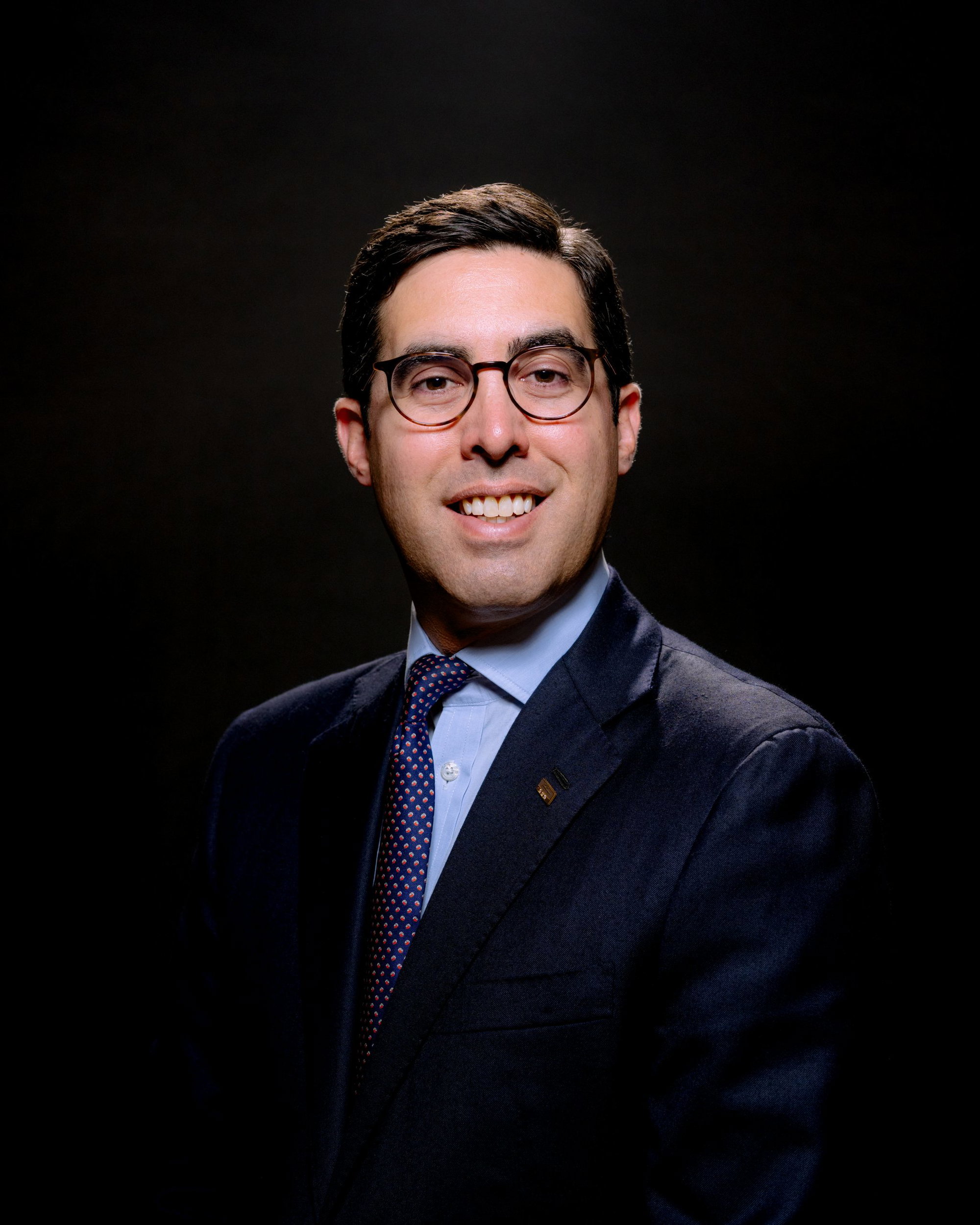
The late Gary Batten, a former business rival who would later join the Kaufman Group as an adviser, described in a company publication the personal charm and trust Herb exuded.
“When I met him, we were competitors and sat on an advisory board together,” Batten recalls. “When my partner wanted to sell the business, I approached Herb after an event. The same night I approached him on buying the business, we shook hands and the business became his.”
Soon, Herb’s expansion outgrew Michigan, and Kaufman-owned agencies sprouted up around the Midwest in Indiana, Illinois, Wisconsin, and Ohio, as well as Puerto Rico. Others came aboard in Florida and Alabama, and even the far West, in Oregon and California.
In 1983, Herb sold off the retail insurance side of the business to concentrate on the specialty wholesale market. He also needed a name for the new organization. In a company publication, Alan Kaufman described his father’s almost whimsical approach to that process. Herb wanted a name that sounded British.
“He liked the London market, he liked the English, and London is the center of the insurance industry in the specialty world, so that’s how he came up with Burns & Wilcox,” Alan says.
Kaufman recalls that his earliest exposure to his father’s business was during the holidays, when he was tasked with delivering Christmas presents to clients.
“It was great because I got to meet people and talk with insurance brokers, so I had a lot of exposure to what was going on in the insurance world just by doing that, and I enjoyed it,” he says. “I enjoyed spending time in the business and with my father, and I liked the business world.”
In 1990, with Burns & Wilcox leading the way, the Kaufman Group broke the $100 million mark when it recorded $115 million in premium volume.
In September of that year, Herb took the company public, joining the American Stock Exchange, the forerunner of today’s New York Stock Exchange.
Five years later, Alan Kaufman began exploring the possibility of regaining control of the company. He witnessed how the demands of running a public company wore on his father, especially as he grew older.
Alan says he was motivated to take the company private because he enjoyed working with clients and helping them create lasting value while building perpetual wealth. He says his father was on board with bringing the business back under family control.
To make it happen, however, Alan was strictly on his own. Under federal regulations, his father couldn’t offer any assistance, financial or otherwise.
“I had to pay him for his shares like I paid for everyone else’s shares, and he couldn’t loan me money, and everything had to be arms-length,” Kaufman recalls. “He had a separate law firm and a separate accounting firm. Everything had to be separated. In fact, the board had to have a separate accounting firm.”
Kaufman says his experience as a lawyer made it easier to craft the deal and handle the preparation,
“I bet the ranch on it,” he said in a company publication. “I mean, I had to refinance everything.”

He obtained a $20 million loan from the National Bank of Detroit (today JPMorgan Chase & Co.), placed a mortgage on his home, dipped into his own finances, and bought the publicly traded company in 1995.
“I paid more per share than what the company was trading for, so I paid a premium,” Kaufman said in the company’s publication. “I thought the company still had greater value or could have greater value, and I had some ideas of what I wanted to do. Maybe I was overconfident, but I was confident for sure. You have to take chances … as an entrepreneur. You’re taking a risk.”
Kaufman admits to the angst of the moment.
“I didn’t have a mortgage at the time. It certainly was a lifestyle change for a while,” he recalls. Once the Kaufman Group returned to family control, he moved quickly to expand the business abroad.
The acquisition also came with an irreplaceable bonus. He could now spend more time learning from and working with his father.
The most enduring advice Herb shared, according to the company publication, is this: “Look at the big picture. Don’t get crunched by the small details. Think as way ahead as you can. Don’t think about only today, think about the results of what your decision’s going to be down the road, one year or 10 years from now.”
His father’s mantra dovetailed nicely into Alan Kaufman’s own vision for the future of the company.
“I knew that to compete in the future, we couldn’t be regional; we had to be bigger than the United States,” he says. “Insurance is a global business. People (everywhere) have risks.”
Detroit, Kaufman says, is a very international city for insurance, with business spread all around the world.
“They’re all here — the auto industry, engineering. This is all around the world,” he says.
Kaufman adds his father was one of the earliest and most significant U.S. insurance brokers in London.
Expanding that program was a top item on his to-do list. London, he says, not New York, is the center of the insurance world. It’s also home to Lloyd’s of London, the center of international insurance activities.

As the expansion continued, today 200 employees at Burns & Wilcox and RB Jones are working adjacent to their counterparts at Lloyd’s. The Kaufman brokers are accredited with Lloyd’s to write and place complex specialty risk policies directly into its syndicates.
Kaufman says the secret sauce to his company’s success is acquiring superior talent, which means hiring and training the best people available. The company’s laser focus on training is reflected in the year-round educational sessions for employees conducted at its Farmington Hills campus.
Management Essentials was the topic of the latest course for a class of 25 attendees in a week-long session at what’s known as the Kaufman Institute.
To promote insurance curriculum and more graduates in that field at Michigan State, Kaufman funds an endowment for a professorship at the Broad Business School. He says with the major role insurance plays in the economy, he’s disappointed that the University of Michigan doesn’t offer similar studies.
Teamwork, relationships, and extra effort are the ingredients of the company culture that Herb Kaufman initiated, and they’re principles that Alan Kaufman continues to stress today.
Employees and company visitors are constantly reminded of that history through a handsome 296-page coffee table book, “Legacy of Excellence,” that recounts in expansive detail and pictures the history of the company, from its founding to the present. Jodie and Danny Kaufman came up with the idea as a surprise for their father.
“We wanted to honor our father’s and our grandfather’s legacy,” Jodie says. “We had my father do a series of interviews, which we told him were for a new website, to get him talking about the history of our organization.”
Knowing that their father would want more input, the younger Kaufmans had one copy of the book produced and with their sister, Emily, who works in the educational field, they completed their surprise by presenting the tome to him at an annual company leadership meeting.
“After he reviewed it and (gave us) feedback, we distributed it to all of our Kaufman leadership meeting attendees in all of our offices around the world,” Jodie says.
Alan Kaufman says the word team is important in the company’s culture, as employees work together to make each colleague better.
“We’re not going to do anything that’s average — that doesn’t work with us,” Alan says. “We want every aspect of the company to be the best, so that’s part of the culture. We don’t care what other companies do. We don’t follow the pack.”
“(INSURANCE WILL) CONTINUE TO ALWAYS BE A PEOPLE-CENTRIC BUSINESS BUILT ON RELATIONSHIPS, BUT CERTAINLY USING TECHNOLOGY TO A GREATER DEGREE …”
— DANNY KAUFMAN