Like many a singer-songwriter of the late 1950’s, Jack Scott grew up on Hank Williams records but did an about-face when he heard Elvis Presley.
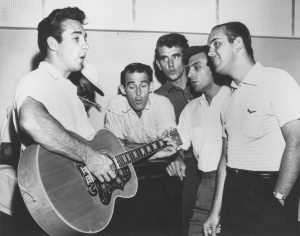
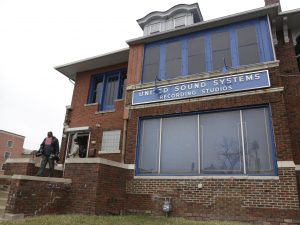
Recording his first single in 1957, Scott wrote lyrics and his band improvised a rocking arrangement at United Sound Systems, the former recording studio along Second Avenue in Detroit near Wayne State University.
Scott’s manager, Carl Thom, who opened his first Harmony House record store in Hazel Park where Scott lived, then persuaded ABC-Paramount to release “Baby She’s Gone” as side one of a 78-rpm disc.
“I was riding in my car, listening to the radio,” Scott later recalled. Mickey Shorr, the DJ and eventual car stereo entrepreneur, debuted the tune. “He played my record three times in a row.”
Scott kept writing, his band played on, and the astonishing result was 19 songs charting on the Billboard Hot 100 between 1958 and 1961.
“Jack Scott started it all for Detroit,” Motown Records founder Berry Gordy said.
Scott exemplified two aspects of the formula laid out by critic S.R. “Boris” Boland in the book, “Heaven Was Detroit: From Jazz to Hip-Hop and Beyond.”
“Generally speaking, rock ’n’ roll was birthed by the four groups that mainstream, middle-class America didn’t want (or at least didn’t want to acknowledge): Blacks, hillbillies, Italian Americans, and Jews,” Boland wrote.
Scott was born Giovanni Domenico Scafone Jr., but he learned to sing like a hillbilly. At the suggestion of WEXL radio host Jack Ihrie, who had scouted a Hazel Park High School show, young Scafone changed his name to Jack Scott.
En route to his biggest hit, “The Way I Walk,” Scott drew on the Detroit Sound that had been coalescing since 1946, when Jack and Devora Brown scraped up $3,000 and launched Fortune Records at 11629 Linwood St. (A decade later, they moved to 3942 Third Ave.) Already, in 1945, Joe Battle — who added “Von” as his middle name — started selling records in his store at 3530 Hastings St. in the original Paradise Valley. His recording enterprise, JVB Recording Co., not only offered the strong-selling sermons of the Rev. C.L. Franklin of New Bethel Baptist Church, but also waxed the first sessions with his daughter, Aretha.
Besides gospel tunes, the song list for the Detroit Sound drew from the jazz, blues, and R&B music that flourished in venues such as the 606 Horseshoe Club, the Paradise Theatre (formerly and now Orchestra Hall), and the Blue Bird Inn at 5021 Tireman Ave.
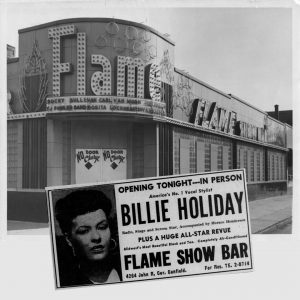
One of the most popular venues was Morris Wasserman’s Flame Show Bar, located at 4260 John R St. It had a neon façade and “black-and-tan” clientele, meaning Whites and Blacks mingled. The renown of these clubs spread to the Deep South through the letters sent home from those who migrated to Detroit.
National acts as distinguished as Billie Holiday came from New York City to play the Flame, but locals also appeared. One was Dinah Washington — “The Incomparable Queen of the Blues,” according to a 1956 Flame ad — who settled in Detroit and was married to Dick “Night Train” Lane at the time of her premature death in 1963.
Beyond musical traditions, an obvious inspiration of the Detroit Sound was the auto industry. Music had long come from the cotton fields and coal mines, but an industrial setting was something new. All it took was a sensitive ear to take in the rhythms of the assembly lines.
One who broke down the din was bluesman Bobo Jenkins, who arrived from Alabama in 1944 and worked for Briggs Manufacturing Co. in Detroit. “The whirrin’ of the machines gives me the beat,” Jenkins said. “Every song I ever wrote that’s any good came to me on the assembly line.”
“The Birth of the Detroit Sound 1940-1964” also reveals a 1942 innovation by Illinois Jacquet, who urgently “honked” his tenor saxophone on Lionel Hampton’s “Flying Home.” After Jacquet went solo, he sometimes played the Paradise Theatre, and the sonics pulsed across Detroit.

Paul Williams first blew his sax in school orchestras at Northeastern and Cass Technical high schools, and he adopted Jacquet’s honking style. Williams scored his first R&B hit, “Thirty-Five Thirty,” using the Hastings Street address of Joe’s Records in homage.
In 1949, Williams’ tune “The Hucklebuck” appropriated the name of a dance craze and spent 14 weeks as the No. 1 R&B song during 32 weeks on the charts. “Hucklebuck” stuck as Williams’ nickname.
Over time, the synergies between industry and music diversified, putting the “beep” in bebop and adding some “bam.” An essay in “Heaven Was Detroit” describes how drummer Roy Brooks could lay down a “thunderous, rock-steady tom-tom barrage with the intensity of a 1950s auto-factory stamping plant.”
A different pathway found Fortune Records naming a subsidiary label Strate-8; despite the irregular spelling, it clearly referred to Buick, Oldsmobile, or Pontiac engines of that configuration.
Automotive themes even interfused with songcraft, and one refinement came via Motown’s imprint Gordy Records.
“On ‘Nowhere to Run,’ by Martha and the Vandellas (led by Martha Reeves), somebody’s banging tire chains — the snow chains,” musician Marshall Crenshaw says in an interview. “That’s the percussion sound you hear.”
The girl group once even took their act to a Ford factory in Dearborn, posing for unforgettable photos on the rear cowl of a Mustang convertible amid amused line workers; the scene can be found in a YouTube video.
In 1961, it was the Marvelettes — straight out of Inkster High School — who sang “Please, Mr. Postman” and delivered the first Motown chart-topper on Tamla, the company’s original label. Analyzing the song, Crenshaw cites the general consensus that Marvin Gaye plays drums on the 1961 smash.
“What’s striking to me about that is, all the fills he plays, it almost sounds like it could be the regular Motown drummer, Benny Benjamin,” he says. “It leads me to wonder if Benny Benjamin used Marvin’s performance on ‘Please, Mr. Postman’ as a template for the style on all those later records. Marvin Gaye was a really good drummer.”
It’s different from the “Phil Spector thing” that Crenshaw used on his own 1982 hit “Someday, Someway,” released on Warner Brothers Records. The Berkley High School graduate starts the wistful number with a rockabilly riff but explains, “You’ll hear how the percussion is just like a white noise all the way through the track.”
The formula for Motown’s bountiful success saw songwriting proceed on a weekly schedule. The talent stayed busy recording, or they performed at the likes of 20 Grand, located at 14th Street and West Warren Avenue. The Motown hit factory at 2648 W. Grand Boulevard even had its own trim shop in the form of twice-weekly artist development sessions, wherein Maxine Powell taught presentation skills.
For talent, Gordy drew on well-trained products of the local public school music programs and showed the world what Blacks could achieve.
A complaint, after the company finalized its move to Los Angeles in 1972, was that Detroit officials had overlooked the achievement of a Black-owned startup company that grew to employ more than 450 people, including administrative staff at the Donovan Building (since demolished) on Woodward Avenue. Motown had already grossed $20 million in 1966.
Before the move to L.A., Motown’s sound was shifting along with society, and protest songs entered the vocabulary. “Ball of Confusion” by the Temptations and “War” by Edwin Starr (both in 1970), along with “What’s Goin’ On” by Marvin Gaye (1971) remain powerful today.
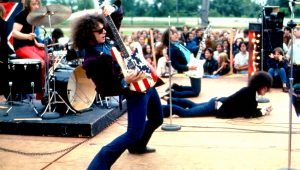
Back in Detroit, these artists had handed an evolving version of the Detroit Sound to the MC5. Their 1969 debut album, “Kick Out the Jams,” was recorded live at Russ Gibb’s 2,000-seat Grande Ballroom on Grand River Avenue, and the Detroit Sound now incorporated certain four-letter words that weren’t readily accepted.
In fact, the manager and clerk at the Dearborn Music Shop were arrested and charged with furnishing obscene materials to a minor after selling “Kick Out the Jams” ($3.98) to a 13-year-old boy.
Condensing their name from “Motor City Five,” the quintet with Lincoln Park origins featured the shattering twin-guitar attack of Wayne Kramer and Fred “Sonic” Smith, who matched stage poses in mock doo-wop style. “Motor City Is Burning,” written by former Ford Motor Co. worker John Lee Hooker, was just one track expressing a revolutionary attitude.
Not long before his premature death of a heart attack, frontman Rob Tyner explained in liner notes for a 1991 re-release of “Jams” how the MC5 opened the way for future movements.

“We were punk before punk. We were new wave before new wave. We were metal before metal. We were even ‘MC’ before Hammer,” he said.
The MC5’s Smith passed away in 1994, also of a heart attack. When the surviving members toured a decade later, Crenshaw stepped into Smith’s spot for all the U.S. dates.
“I loved it,” Crenshaw says. “I got more insight on the songs because, at rehearsal, they had the lyrics on big poster boards. Sometimes on the records you can’t hear the nuances. Rob Tyner and Fred Smith were great writers. The music was fun to play, but I did the whole tour with no earplugs. In that way, I did myself no favors.”
The MC5 emerged from a lively scene that fermented large helpings of garage rock with R&B.
Picking up on the latest wave of the Detroit Sound, Mitch Ryder and the Detroit Wheels played high-RPM R&B. The Amboy Dukes pursued psychedelic rock before Ted Nugent went solo.
On Oct. 1, 1966, Cobo Arena in Detroit hosted a benefit show, and the big lineup included Del Shannon, the Temptations, and Terry Knight and the Pack (two of whose members later f

ormed Grand Funk Railroad), and the Mysterians performed “96 Tears.”
Bob Seger and the Heard also joined the benefit’s bill, and from this scene emerges one of life’s consuming mysteries — namely, how Ann Arbor High School (today Pioneer High) managed to produce both Iggy Pop and Bob Seger.
While Pop hit the road, it was Seger who stayed home and kept grinding.
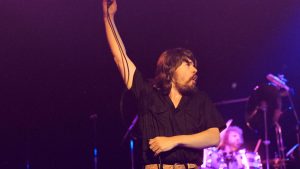
Seger cruised Woodward Avenue in “Horizontal Bop” and saluted factory hands in “Makin’ Thunderbirds.” He put all the traditions together ever so vividly in “Night Moves,” which reached No. 4 on the Hot 100 and charted for 21 weeks.
Like a Motown song, it started with a simple strum, told the story of a boy-girl relationship in a passionate voice, and received affirmation from the backup trio’s gospel-like singing. A bluesy organ and jazzy piano took turns enlivening the breaks.
And who couldn’t relate to the backseat of a ’60 Chevy? Ultimately, Seger took a long ride with Chevrolet trucks when “Like a Rock” led an ad campaign from 1991 to 2004.
Crenshaw’s self-titled LP of 1982 was like a station sign-off for the Detroit Sound. Maybe there was a curse after Jack Scott’s signature song, “The Way I Walk,” was sardonically covered in 1983 by the Cramps.
Two years later, Aretha Franklin rode down the “Freeway of Love” in a pink Cadillac. For a time, Eminem, funkmaster Don Was, and techno composer Derrick May became prominent ambassadors during an era when the Detroit Sound otherwise was back in the garage for retrofitting.
Dressing in mod attire, the Gories emerged with a new primitivity and delivered three raw albums before disbanding. By 1997, Gories alumni Mick Collins and Danny Kroha supported former Fortune artist Andre Williams on his comeback LP, “Silky.”

Among sessions at Ghetto Recorders, they laid down “Bring Me Back My Car Unstripped,” with a churning, cacophonous rhythm section of clanging car parts serving as a general 1990s Detroit metaphor.
“At the very least, one can rest assured that, without the influence of the Gories, there would be no White Stripes,” critic Dustin Krcatovich wrote in 2021.
Without the unprecedented artistry of the White Stripes, football stadiums nationwide wouldn’t institutionalize the Detroit Sound in the form of “Seven Nation Army,” yet another song that starts with simple guitar picking, this one rendered on a vintage Kay Archtop semi-acoustic mated with a whammy pedal.
A point of interest returns this story to 1965, when a different element of the Detroit Sound was expressed by Joni Mitchell. The native of Canada’s prairie came to Detroit after marrying Rochester High School graduate Chuck Mitchell.
She played more than 60 times at Morrie Weidenbaum’s Chess Mate, a 200-seat coffeehouse on Livernois Avenue near the University of Detroit Mercy. Mitchell called it her “proving ground.”
Living at the Verona Apartments in the Cass Corridor, she composed “The Circle Game” in response to Neil Young’s “Sugar Mountain.” Young knew Mitchell from Canada and stayed with the couple on a visit to Detroit.
The coffeehouses and nightclubs have since faded from the scene, but their legacies live on. Talent still emerges from events like the monthly Brain Candy programs at Green Brain Comics in Dearborn, where impresario Dan Wickett welcomes musicians, poets, and artists. Singer-songwriter Audra Kubat, a veteran Brain Candy performer, has issued a skein of albums since “Stunning Amazon” in 1999.
“I learned to sing by listening to Joni Mitchell records,” she says. “Folk is in the same vein as blues and country. What they have in common is they’re stories about people.”
She signals agreement with Boris Boland on the origins of pop music coming from marginalized people. “It’s those with the smallest platform that often have the most important things to say. When someone comes along that has that special voice or that ability to really reflect what’s happening in those underserved or marginalized communities, they often are speaking with a deeper authority.”
For 12 years, Kubat has worked with young writers in the Detroit Institute of Arts’ Inside|Out project, using art on the walls to create songs. Additionally, she’s the early childhood educator for the Detroit Symphony Orchestra.
Her Northwest Goldberg home, dubbed A Detroit House of Music, opens to “people-powered” music. Yet, she strikes a despairing note about the overall picture.
“We have some of the greatest songwriters right now in the city of Detroit, but I don’t see a pathway forward for myself and for them,” she laments.
Still, any new song posted on social media may, indeed, go viral, bringing the Detroit Sound back to the forefront.