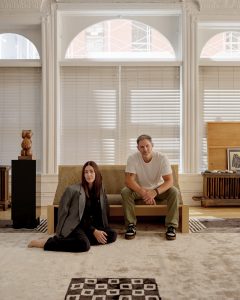
Jeremy Levitt, founder of Parts and Labor Design in New York City, which specializes in creating hospitality, commercial, and retail spaces, didn’t start life off on the best of terms.
Levitt is the first to admit he’s come a very long way from his early days growing up in Huntington Woods and West Bloomfield Township.
“My mom saw a psychic while she was pregnant with me,” he says. “The psychic said I was going to be a total pain in the ass.”
The ominous news came after the psychic also predicted Levitt’s older brother was going to be what Levitt describes as a “by-the-book type of kid.” And, sure enough, his brother went to an Ivy League college and currently works in finance.
Before Levitt’s mother left her reading that day, the psychic had a few final parting words of advice about her next child.
“She told my mom, make sure whatever you do, keep him in the art world,” Levitt says. “So, I guess what I’m doing now was sort of like predestined to some degree.”
Perhaps, but Levitt’s parents clearly played a significant role, although they may have kept the advice of the psychic in mind as their little boy developed.
“My dad’s a lawyer, he’s retired now, and my mom is a psychologist,” Levitt says. “When I was little, holding pencils and building things with blocks, they realized I had some degree of creativity, however young I was, and they went with the flow.
“Some parents say, ‘We want you to be a lawyer or a doctor, and you’re not going make any money in the art world.’ But my parents looked at it differently. It was more of do what you’re good at, and what you naturally love.”
Levitt took the usual art classes through his middle school years — and then some.
“My mom always put me in these rooms full of adults, doing things like oil painting and charcoal, and learning about shading,” he says. “I don’t remember not wanting to go, even though I was the youngest kid or didn’t really know anybody. I was just always eager to absorb knowledge and learn new techniques.”
By the time he enrolled at Andover High School in Bloomfield Township, Levitt had delved into sculpting. “I oddly even got into Legos. I would sit in my bedroom and get into these weird creative moments.”
On the surface, all the proper pieces were in place for Levitt to take the next logical step toward a career in the arts that surely seemed to be beckoning.
“But I lost interest at a certain point,” he reveals. “I (was) like, I’m tired of art. What inspires me anymore? I was a wild kid, great in art and English and creative areas, but not others. And part of what was important to me was meeting girls, and partying, and getting as wild as I possibly could.”
During high school, he earned an art scholarship to Eastern Michigan University in Ypsilanti, yet he wasn’t sure where he wanted to go.
“I got a scholarship to Ohio State University (in Columbus) for the same thing, but my parents said, ‘We’re not paying for you to go out of state,’ and they were right. I wasn’t serious.”
Levitt ended up taking the scholarship to Eastern Michigan. His parents promised if he pulled himself together, they’d support a transfer to the College for Creative Studies in Detroit, where he really wanted to be.
“Instead, I never went to class,” he admits. “I lived a really wild lifestyle, and my time there was short-lived. I needed some time to really find myself as an artist, a student, and a professional.”
Levitt returned home and soon connected with David Costa, a lawyer and entrepreneur who was working on an automotive design program and contest for Chrysler in which high school students were competing for college scholarship money.
“I was hired to help promote the program and get schools and additional sponsors on board,” Levitt says. “He really liked my professionalism and wanted to hire me for other ventures he was working on. Once I told him my goal was to get into CCS, he paid me to work part time and finalize my portfolio (so I could) apply there.”
As Levitt was putting the finishing touches on his application to CCS, he was the beneficiary of some unexpected inspiration.
“A friend who was already at CCS showed me a half-scale model of a really cool, well-designed office chair with these formed plastic components that were then covered in leather and stitched,” he says. “It all clicked, right then and there. That’s what I wanted to do — design furniture, design lighting, make sculptures come to life and have them be beautiful, functional objects. That was my lightbulb moment, which became the focus of my discussion with admissions at CCS.”
Soon after enrolling at CCS, he encountered another person who would dramatically influence his life and career. As he explains, “Max Davis was one of the heads in the crafts department — a brilliant sculptor, too — and he saw something in me.”
Professor Maxwell Davis retired in 2018, following a 40-plus-year career at CCS. Living in Ann Arbor and still keeping busy as a design consultant, he has fond memories of his former student.
“He was a little bit of a bad boy, with the tattoos before anyone, but he was one of the most charming people I’ve ever met, and he was driven,” Davis recalls. “You know, you want your design person to be a little bit of a rebel, and that’s kind of how he was, but you also want him to be good.”
The turning point for Levitt was a specific class taught by Davis called Radical Methods of Furniture Design.
“He would just push and push,” Levitt says. “At one point he said, ‘Dude, you’re not doing enough. By the end of the week, I want you to have 100 sketches.’ ”
Davis vows it was “only 50,” but then makes clear the actual number of sketches wasn’t the point of the exercise.
“You have to have something come from within inside of you, you know?” says Davis. “It’s like any writer, musician, whatever — what is inside of you that you can get out and present to somebody else that they can understand?”
Levitt got the message loud and clear.

“It was everything that I wanted and more out of school, out of life, out of everything,” he says. “I mean, honestly, I get a little emotional sometimes thinking about it. It was so life-changing.”
Imbued with confidence in his abilities and a newfound sense of purpose, Levitt was determined to launch his career immediately.
“I went to New York for a summer to intern with an exhibit design company,” he says, “and then while I was still in school, I started my own company doing custom furniture and decorative lighting for people because I wanted to be making money.”
After graduating from CCS in 2003 with a Bachelor of Fine Arts degree in industrial design and crafts, Levitt returned to New York for good. “I knew I’d never get as far as I want in the world without moving there,” he says.
He worked at a number of design firms for several years, learning everything he could about furniture production and decorative lighting.
“And then one day I walked into a restaurant in Little Italy called Public, which was owned and designed by a company called AvroKO,” Levitt says. “Another lightbulb went off in my head.
“As much as I loved designing furniture and lighting, I realized I also wanted to design the spaces they exist in, spaces (that are) open for the public to see and experience. That opened my eyes to what was out there both on the residential and commercial side.”
Levitt spent a few more years working for AvroKO, all the while focused on the goal that initially brought him to New York.
“I moved here to start my own company. I wasn’t sure quite what that was meant to be, but I knew I was going to be an entrepreneur with an interior design company that had a heavy emphasis on furniture and decorative lighting.”
Along with one of his coworkers, Levitt launched Parts and Labor Design on the side in 2009.
Two years later, Levitt and his business partner, Andrew Cohen, were running their company full time, initially specializing in restaurant spaces.
“It’s what we used to call our bread and butter,” Levitt says, “but now that’s only a fraction of what we do. I think we probably do more hotels at this point, where people come to sit in the lobby and then go to a restaurant, a bar, or a cafe. We also do apartment buildings, really high-end multifamily space where (the client) wants people to come through a beautiful lobby and then move on to their apartment.”

Today, Parts and Labor Design has a core group of around 15 employees that can increase based on the number of jobs the company is handling at any given time — which, invariably, is a lot.
“We always have things happening here in New York City, but also in California; Texas; North Carolina; Moab, Utah; and Bozeman, Mont.; and we’re just starting a project in Bermuda.”
Which prompts him to pivot to a recitation of his international work.
“We did a project in Dubai, we have one in Qatar, we’ve got some work in Hong Kong, and aspirationally, we’re really trying to get into the European market more. We’re kind of all over the place.”
He’s clearly busy, but apparently not busy enough. Levitt, along with his design director and partner, Danu Kennedy, recently launched a spinoff company — a furniture design studio called Known Work Perceptions, which is a homage to Levitt’s entrepreneurial business when he was still a student at CCS.
“I’d started a custom furniture and lighting company, and we had some standard products, but my goal was always to have a company that had luxury home goods and luxury products,” he says. “Known Work is a high-end luxury product line with pieces for sale that are specific to our tastes and our interests.”
Now 49 years old, Levitt says he’s flush with success, living and working in the place of his dreams, but never forgetting the place where it all began.
“My need to rise to the top and to have the company I do comes from growing up with hard-working parents in a city that was full of hard-working people, and growing up with the understanding of what it takes to get to where you want to be,” he says, wistfully.
“That is Michigan, and that is Detroit, and I’m always proud to say that’s where I’m from and where my work ethic comes from.”