Every firefighter knows there is one radio transmission they hope they never have to make: “Mayday.”
It is a single word that can mean a firefighter is trapped, injured, or running out of time. In those moments, communication is no longer a convenience. It becomes the difference between coordination and confusion, between rescue and tragedy.
It’s also the reason a company like WZC Networking exists.
John Wierzgac, an RF engineer by training, founded WZC in Novi back in 2006 with a simple conviction: a building is only as safe as its weakest signal. Nearly twenty years later, Nate Wierzgac has helped take that idea and build a company around it. He pushed WZC past its roots as a wireless integrator into one of Michigan’s most trusted names in Emergency Responder Communication Enhancement Systems (ERCES) and Public Safety DAS.
John’s engineering instincts and Nate’s drive to scale the business turned WZC into something bigger than either of them could have built alone: a team that doesn’t just install equipment, but sits at the table with developers, architects, fire departments, and code officials before a single antenna goes up.
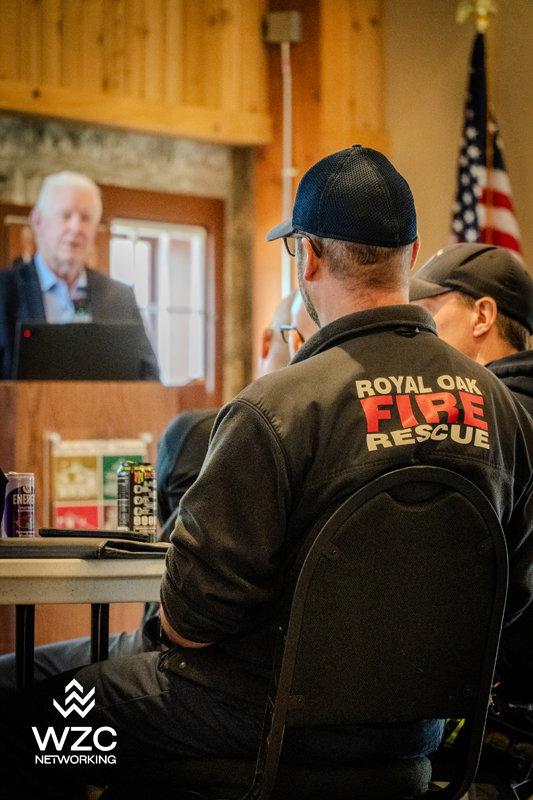
That collaborative instinct was on full display on March 25, when WZC brought together fire chiefs and fire marshals for a workshop built around one thing: ERCES fundamentals. Nobody was pitching equipment. The point was to get people talking openly about what’s actually breaking down in the field.
Jeff Scaife, Assistant Chief of Prevention for the Birmingham Fire Department, was one of the voices in that room. After nearly two decades in the fire service, including more than ten years serving Birmingham, Chief Scaife still carries the memory of a line-of-duty firefighter’s death in Auburn Hills in 1994. At the time, emergency crews lacked many of the communication capabilities available today.
“I don’t want that to happen to anybody else down the road,” he said. “I want to be able to make sure my guys have the tools they need to do the job and be as safe as they can be.”
That statement captures a shift happening throughout Michigan and across the country. ERCES used to be a box on a code-compliance checklist, but now it’s infrastructure for survival. Increasingly, it’s also the line standing between a finished building and an empty one.

Here’s the part developers don’t always see coming: if a building doesn’t pass its ERCES inspection from the Authority Having Jurisdiction (AHJ), it doesn’t get a certificate of occupancy. No certificate, no move-in. Not a single tenant, not a single resident, not a single business. Months of construction, leasing, and planning can stall out over a signal problem nobody thought to test for until the fire marshal couldn’t get a radio call through during final inspection.
Nobody buys a building thinking about radio propagation. Developers don’t assess how Low-E glass, structural steel, or a slab of reinforced concrete might swallow a signal. Underground parking garages aren’t exactly top of mind during design review. These are the kinds of problems that stay invisible right up until a crew walks into a building and finds out, mid-call, that command can’t hear them anymore. Or worse, until an inspector flags it and the building sits dark on opening day.
For fire officials, that possibility is impossible to ignore.
“We’ve had situations where we’ve had firefighters in basements not be able to radio communicate during calls,” Chief Scaife added. “As a fire marshal, one of my biggest fears is not having the opportunity to make sure our guys get out safely.”
Buildings have changed shape over the last few decades: taller, denser, and tighter on energy use. The irony is that a lot of what makes a building greener also makes it harder to talk through. Dense concrete, steel framing, energy-efficient glass, and anything below grade can hinder communication. Firefighters have a word for what these create: shadowing, pockets where a radio signal just stops existing.
“We’re such a small community, but we’re very, very dense,” Chief Scaife explained. “We get a lot of high-rises. We get a lot of shadowing effects from the radio signals. That’s where we have a lot of problems in our parking garages and maybe floors one through three or four.”
That problem doesn’t stop at commercial developments. Schools, healthcare facilities, senior living communities, apartment buildings, and mixed-use developments all carry the same risks. Each of them is its own puzzle: a different mix of materials, layout, and the way people move through the space, all of it shaping whether a radio call goes through when it matters most, and whether that building ever clears occupancy at all.
That’s the exact tangle WZC has built its reputation untangling. Most people treat ERCES as an afterthought. WZC treats it as a chance to make an entire community safer, and to make sure their clients never find out the hard way that the certificate of occupancy was riding on a radio signal.
That mindset doesn’t live only in the blueprints. It shows up off the clock, too, in workshops like the one on March 25, where the goal wasn’t to sell a system but to get everyone speaking the same language before a permit ever gets pulled.

“This process allows us to work with the community and with our municipality,” Chief Scaife mentioned. “Overall, this is a great opportunity for us to learn about life-saving stuff for our firefighters, for our police officers, as well as the residents and occupants of these buildings.”
It’s that instinct to pull people into the same room that’s a trademark for WZC.
While many companies enter a project after problems have already surfaced, WZC prefers to become involved much earlier. Engineers work alongside project teams, fire departments, architects, developers, and AHJs to identify communication risks before walls are closed, inspections begin, or occupancy deadlines approach.
Every project starts the same way: figuring out how responders would actually move through that specific building if something went wrong. From there, engineers run RF grid testing, map out signal propagation, work directly with local fire officials, design the Public Safety DAS, oversee the install, test the finished system, and stick around afterward to keep it compliant as codes change.
That meticulous attention to detail reflects a broader understanding of what ERCES inherently represents.
It’s tempting to file public safety communication under “construction cost.” Firefighters don’t see a line item. They see:
● a family waiting by the door for someone to come home.
● a cop walking into a building they’ve never been inside.
● a classroom full of kids who have no idea any of this is happening.
● the person next to them on the truck, who deserves a working radio every single time the call comes in.
No technology guarantees any of that. However, good planning, real collaboration, and engineers who’ve done this before can tilt the odds a lot further in everyone’s favor.
WZC isn’t just building systems that pass today’s inspection. They’re protecting move-in dates, leasing timelines, and the communities that will eventually call these buildings home. Long after the workshop ends and the inspectors leave, what stays is the relationship. The kind that gets a fire chief on the phone before a problem becomes a headline.
Because when someone presses the radio button and calls for help, nobody should have to wonder whether the signal will make it through. And nobody should have to wonder whether the building will even be open for them to walk into.
To learn more about WZC Networking’s ERCES and Public Safety DAS solutions, visit wzcnetworking.com