BY THE MID-1920S, General Motors Co.’s research and engineering facilities were scattered in small buildings throughout Detroit. But as the growth of the automotive sciences grew under research chief Charles F. “Boss” Kettering, the scope of work expanded far beyond what the original labs could support.
To bring more efficiency to its operations, GM consolidated its research and development footprint in 1928 with the construction of the Art Deco-style Argonaut Building, designed by noted architect Albert Kahn. Located across W. Milwaukee Street from General Motors’ headquarters, also designed by Kahn, additional floorspace for scientific laboratories was added at the Argonaut in 1936. Naming buildings was fashionable at the time, and the Argonaut was a nod to the heroic explorers in Greek mythology, suggesting innovation and engineering prowess.
For the next 20 years, all of General Motors’ engineering and design activities were located in the Argonaut Building, where competition was encouraged. Areas of study included fuels and lubricants, electrical and ignition systems, metallurgy and materials, and paints and finishes.
The use of clay modeling in the design process and the first fully automatic power transmission emerged from research performed in the Argonaut Building.
The 11th story was the domain of Harley Earl, legendary vice president of GM’s Art & Colour Section. Earl considered sunlight an essential design tool, and he used the Argonaut Building’s roof to evaluate prototypes and observe colors in natural light.
Leading into the 1940s, industrial research in the United States was consolidated into large, centralized research campuses — think Bell Labs. General Motors Chairman Alfred P. Sloan, Kettering, and Earl conceived the idea of the company’s own centralized product development campus, guided by the principle that the long-term prosperity of GM was dependent on the orderly planning of product lines based on the collaboration of research, engineering, manufacturing, and design.
Enter the Warren Technical Center.
14.5 million square feet across 38 buildings
24,600 employees
710 acres
38.2 miles of roadways
25 miles of sidewalks and paths
2,640 linear feet of tunnels
38 acres of reflecting pools
35 miles of underground power cabling
23 miles of underground utilities including steam, water, and gas
“This new technical center represents long-considered plans of General Motors to expand — at the right time and on a broad scale — its peacetime research, engineering, and development activities, and even more progressively pursue its prewar policy of continued product improvement,” Sloan said in 1945. “The end objective is more and better things at lower prices, thus expanding job opportunities and contributing to an advanced standard of living.”
A two-page 1945 ad in Life magazine dubbed the concept the “Versailles of Industry.”
Earl was put in charge of finding a location for the Technical Center, and the rural 350-acre tract in what was then Warren Township, north of Detroit, fit the bill perfectly for the realization of Kettering’s and Sloan’s vision. In June 1949, the construction of what would eventually be 25 buildings began on land where dairy cows once grazed.
The Technical Center’s official dedication was held in May 1956 with 5,000 science, engineering, education, and industry leaders on the property and 20,000 people viewing the event at luncheons held in 61 GM plants across the country.
Among the GM inventions on display were the world’s first “free piston” engine automobile, a mechanical heart, air conditioners, jet engines, and the Centri-Filmer, a vaccine-purifying device that helped make large-scale manufacturing of the Salk polio vaccine possible. The “Today” show’s Dave Garroway and radio personality Arthur Godfrey covered the dedication. President Dwight D. Eisenhower addressed the assemblage via closed-circuit television from the White House. Lawrence R. Hafsted, vice president in charge of GM Research, told the assembled dignitaries that in the Cold War era, the U.S. must meet the challenge to its technological supremacy by educating more engineers, scientists, economists, and managers.
“Our choice is brutally clear,” he exhorted. “As a society, we can either learn mathematics and science — or Russian.” He added that he was convinced that “as a people we shall make the right choice.”
There was an internal debate among corporate chieftains as to whom to hire to bring the Tech Center to life. The tried and true Albert Kahn was the odds-on favorite, but in the end the decision was made to take a chance on 38-year-old Finnish American architect Eero Saarinen, who ran a firm with his father, Eliel, in Bloomfield Hills (Eliel designed, among other things, the Cranbrook Educational Community in Bloomfield Hills).
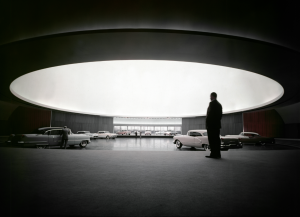
A champion of the International Style, an architectural movement begun in the 1930s characterized by simplicity and functionality, Eero Saarinen’s aesthetics were revealed in every aspect of the project, from glass curtain walls to elaborate staircases, Mies van der Rohe chairs, a ballet of fountains designed by Alexander Calder on a centrally located 22-acre lake, and even the silverware used in the executive dining rooms.
According to Architectural Digest, “Saarinen’s works are not only architectural treasures, but also symbols — they capture an era of technology, of futurism, and of optimism.”
“The Tech Center represented the triumph of a highly rationalized, but also a supremely elegant and optimistic, idea about how we were going to design our way into a better future,” says Aaron Betsky, visiting architecture and design lecturer at the University of Pennsylvania. “Inside the Tech Center people were going to be coming up with cars that would be better, more beautiful, faster, sleeker, more comfortable, more efficiently built, and more powerful.”
The Tech Center added an Aerodynamics Laboratory (wind tunnel) in 1980 and the Cole Engineering Center, which houses 8,000 engineers, was completed in 2003. Design West opened in 2024 and adds an additional 360,000 square feet to the Design Center. The General Motors Technical Center was added to the National Register of Historic Places in 2000 and became a National Historic Landmark in 2014.v