Conventional wisdom says it won’t work.
Start with a multifaceted company that employs 7,000 people and is run by three brothers. What’s more, no one has controlling interest, so there’s no mechanism for two brothers to outvote the other when a decision needs to be made.
Not only does it sound like a recipe for gridlock, but considering the family element, it has the potential for some tense meetings.
But Schostak Brothers & Co. in Livonia hasn’t thrived for 102 years — through changes in markets, ventures into new lines of business (some planned, some not), and the natural challenges of growth — without figuring a few things out. While the company is celebrating its centennial two years late, due to COVID-19, it’s still enjoying the ride as a diverse, prosperous business focused on real estate development, restaurant operations, and venture capital.
Now based at the Laurel Park shopping and office complex the Schostak family developed in the 1980s, the company was headquartered for many years in Southfield. But it started in downtown Detroit — first in Cadillac Tower, a block east of Campus Martius Park, followed by the historic Guardian Building in the financial district.
When the brothers’ grandfather, Louis, started the company as a residential brokerage with his own two brothers in 1920, he certainly didn’t have a plan that would put the company in those specific lines of business a century later. That evolution has been a combination of careful plans and a willingness to seize an unanticipated opportunity when it was staring the family in the face.
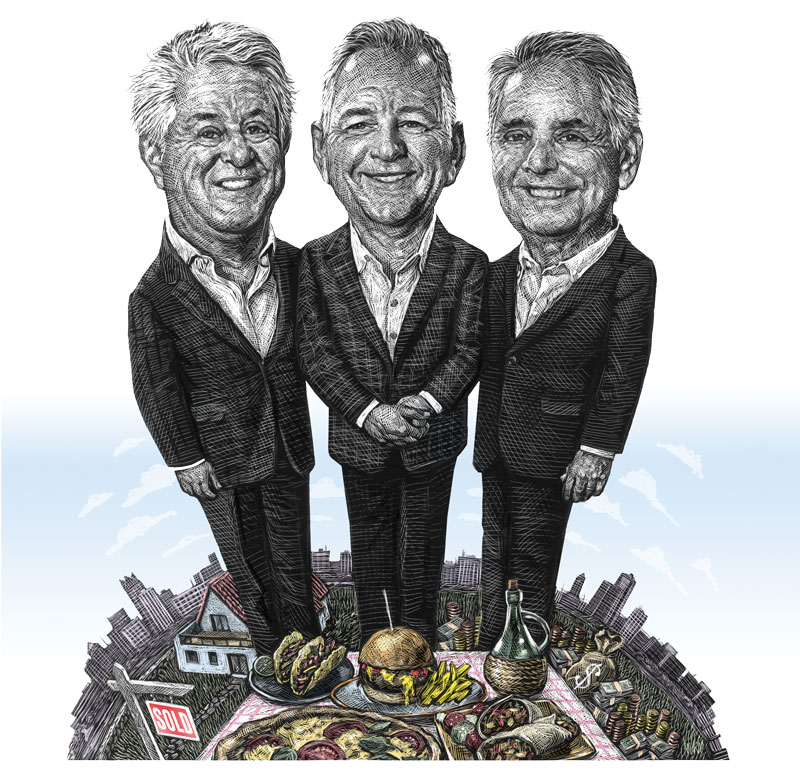
Today, Brothers Bobby, 66; David, 65; and Mark, 60; each oversee an operation — Bobby leads the venture capital side, David runs the real estate portfolio, and Mark manages the restaurant group.
In tandem, 39-year-old Jeff Schostak (Bobby’s son) is president of Schostak Development, where he leads all new projects and acquisitions. He’s being trained by David to eventually take on the leadership role within the company.
The brothers operate by consensus, rather than democratically. There’s no such thing as majority rule. The consensus often takes the form of the brothers trusting the one who’s closest to the issue under consideration, and suggestions are always welcome.

“When David comes to me looking for input, I tell him, ‘You’re close to the action. You’ve got to go with what your instincts tell you,’ ” Mark says. “There are some issues where we all have to come together, and we use each other as sounding boards. But at the end of the day, it usually ends up with, ‘Whatever you think.’ ”
The brothers’ way of running things is based, in part, on their upbringing, as well as what they learned from their father and grandfather. Louis began to gradually retire from the company he founded in the mid-1950s, and his son, Jerome, took over a greater leadership role. “Our dad, for 15 years or so prior to my grandfather leaving, was really running the business, with his father being semi-retired,” Bobby says. “Dad had a vision to take the company into the development business, which is different from the brokerage business, and to a third area of opportunity in leasing.”
After Louis passed away in 1970, his three grandsons began to move into entry-level roles.
Very entry-level.
“Our job was sharpening pencils and stuffing envelopes, and from there we began to learn the business,” Bobby recalls. “In high school, when we had driver’s licenses, we were all messengers or delivering packages.”
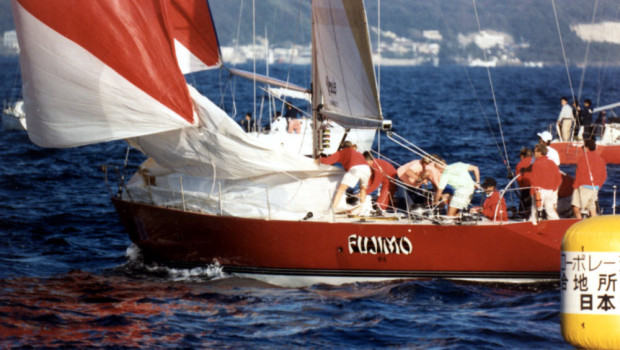
But the greatest teacher of commerce for the brothers wasn’t part of the business world at all. It was being crew members on their father’s sailboat. Jerome was an avid sailor, and that gave the boys some intense lessons in teamwork before some of them had even become teenagers.
SCHOSTAK TIMELINE


“No matter how big the boat is, there’s not a lot of room for a lot of people when you’re operating the sails,” Bobby says. “We learned together how to win races, lose, get frustrated, and get angry. And fight back.”
The three brothers had little choice but to learn under the pressure of a sailboat race. And anyone who didn’t want to cooperate would quickly find there was nowhere to escape.
“For the three of us in particular, it defines how we collectively come together and how we view success,” Bobby says. “To be challenged by the elements in these long, overnight races in multiple parts of the country, and the whole experience with others out there fighting for the same things we were, was inspiring and challenging at the same time.”
Today, their success in running a large, multifaceted company comes from lessons learned working together as a team. The same discipline extends to the company’s culture, which not only serves to attract good people, but to keep them on board over the long term.
“One reason for our success is all the people we’ve associated ourselves with over the years — our teammates,” David says. “And the real tell-tale sign is the length of tenure of the people working for us. We have people who have worked for us 30 and 40 years. It’s a family atmosphere.”
The company has 50 employees on the real estate side; 6,500 workers among the restaurants — Applebee’s, Del Taco, MOD Pizza, Olga’s Kitchen, and Wendy’s; and several dozen more among the portfolio companies on the venture capital side.
One might not expect a real estate development company to get into running restaurants — and the Schostaks didn’t expect to go in that direction, either. But success often means being willing and ready to say yes when an opportunity presents itself.
In 1981, the family developed a shopping center in Alpena. It was anchored by Kmart and JCPenney, along with room on the outskirts of the parking lot for a gas station, a bank, or a fast-food restaurant — “outlots,” in real estate parlance. At the time, Burger King Corp. was particularly keen on putting a franchised restaurant there.

But with interest rates at more than 17 percent at the time, the restaurant chain couldn’t find a franchisee. So they came to the Schostaks with an interesting proposition. “ ‘You folks own the land,’ ” Mark recalls a Burger King official saying. “ ‘Why don’t you become the franchisee?’ ”
Running restaurants had never been part of the family’s portfolio, but the Schostaks were never ones to pass on an idea because it was new to them. “My dad felt it was important that we added more legs to the table,” Mark recalls. “He had three boys who were going to be in the family business — separate but equal tracks — so my dad was creating another track.”
This particular course proved to be a fast one. By 1992, the Schostaks were running a dozen Burger King locations; in 2015 they sold the entire operation.
But today, while running five different restaurant brands, they say they’re still learning.
“The business changes all the time,” Mark explains. “The last few years, through the pandemic, the business has switched pretty dramatically. That change, for us, was understanding how important culture was and how important it is to have the right systems to train and develop people, and to reward achievement and reward the doers.”
While it may be harder to create a family atmosphere among 169 restaurants than it is in a professional office setting, the Schostaks were determined to find a way by mastering the simple things: making sure people had the schedules they wanted, every facet of the operation was clean and well-managed, and there were opportunities to grow.
The restaurant group took a major step forward in 2015 when it bought Olga’s Kitchen out of bankruptcy. The acquisition came 11 years after the brothers had contracted with the company to build a series of Greek American restaurants in the area.
Mark says he and his family took a keen interest in the story of founder Olga Loizon, and what she had gone through to build the company. “She started the business herself and it was difficult for her, or any woman, to get a loan over 50 years ago,” Mark says. “The bank wanted her husband to co-sign the loan, and he wouldn’t do it.”
Eventually, he says, a bank agreed to lend Loizon the money to start the company at a small stand in the former Continental Market in downtown Birmingham (just north of the Daxton Hotel).
Loizon was no longer the owner of the company when it faced bankruptcy in 2015, with more than $4.5 million being owed to creditors. But after the Schostak acquisition, Loizon returned to play a public relations role until her death in 2019 at 92 years old.
In her honor, the Schostaks set up the Olga Loizon Foundation to provide grants to female entrepreneurs. Members of Loizon’s family serve on the foundation’s board.
The restaurant venture is relatively new by Schostak standards — 40 years old — but Schostak Brothers & Co. has long been synonymous with malls and shopping centers. While there remains a great deal of opportunity in that space, the marketplace is constantly in flux due to shifting shopping habits, especially with online sales.
The Schostaks sold their last mall in 2005, but they’re far from finished with commercial real estate. The focus now is on the acquisition of well-located shopping centers. To that end, the company recently acquired more than $300 million worth of real estate parcels in 17 states, with high priority going to centers adjacent to Walmart stores.
The traditional mall may be fading in the rear-view mirror, but new opportunities are presenting themselves in places such as logistics operations, urgent care centers, fitness facilities, and salons.
“Historically, we were shopping center people,” David says. “We had a big shopping center presence. What people would call the death of the shopping center, and the death of malls, has clearly had an impact on brick-and-mortar real estate. But it isn’t the death knell of brick-and-mortar real estate by any stretch.”
The evolution of the shopping center, he believes, will involve giving shoppers a type of experience that transcends the mere purchase of products.
“Has the mall business been the most impacted by the change in buyers’ habits? The answer is yes,” David says. “Eastland Mall in Harper Woods was torn down to build an industrial park. Northland Mall in Southfield was closed and torn down (local officials are overseeing a mixed-use redevelopment). But is the Somerset Collection in Troy going anywhere? No. Somerset isn’t going anywhere.”
Meanwhile, the family’s venture capital operation, led by Bobby, invests and supports cloud-based solutions that are disruptive to the industries they serve such as banking, auto lending, or freight hauling — and founded by an entrepreneur with a track record in that space who’s willing to put his or her own capital at risk.
The venture capital side of the business developed, in part, because Bobby left the family business in 2010 to pursue opportunities in politics. When he returned, he says the real estate and restaurant operations didn’t seem to need him.
“My role in the venture capital space isn’t just to vet a potential investment, but once we make an investment, to utilize my network to help the companies succeed,” he says. “I’m on the board of seven of the nine companies we’re invested in.”
The primary venture is MadDog Technology, which has offices in Birmingham and Pontiac, and where Bobby works closely with Peter Karmanos Jr., co-founder and former CEO and chairman of Compuware Corp. in Detroit, along with a small team of principals.
The Schostaks were also in the middle of one of metro Detroit’s most high-profile redevelopment projects in recent years: the Palace of Auburn Hills. When the Detroit Pistons decided to sell the arena to facilitate a move back downtown in 2017, despite having very recently renovated what was one of the nation’s most successful entertainment venues, the Schostaks saw an investment opportunity.
What most people thought would happen — a demolition followed by plans for redevelopment — didn’t immediately come to pass. But what isn’t as widely known is that it wasn’t a foregone conclusion when the deal closed. “We looked for a while to see if there was another use for it,” David says, “but we didn’t want it to be the Silverdome (that sat empty for years before being demolished and redeveloped).”
In other words, they didn’t want the Palace to sit as a dinosaur as one implausible scheme after another presented itself. Once it was clear that the 110-acre property at I-75 and Sashabaw Road would perform better if it was redeveloped, the venue was imploded in July 2020; it’s now being marketed as the Palace Research and Technology Park.
One of the things no one teaches about long-term success is how to celebrate a century in business. Many companies that turn 100 throw a big birthday party; of the few that reach that milestone, it would be unlikely to find many that didn’t at least have some sort of celebration.
Even two years late, the Schostaks were prepared to recognize their longevity by making a mark in metro Detroit. With the help of employees, the company chose more than a dozen local organizations to receive donations with the money that would have gone to pay for a birthday bash.
“Most people just throw a big party and it’s fun,” David says, “but what have you really done, other than maybe feel good because you threw yourself a party? So we came up with this approach where we would give back to the community — but not what Bobby, Dave, and Mark would choose. Rather, we (looked for) unique causes (that Schostak employees) would choose, and we could have volunteer opportunities for all of us to make an impact.”
Each charity recipient receives, on average, around $100,000. While some donations haven’t yet been finalized, one the brothers were willing to talk about is Life Remodeled, a nonprofit organization in Detroit that repurposes vacant school buildings to serve as hubs of skilled training, community services, reading labs, after-school programs, and recreational and event space.
The organization has special meaning for the Schostak brothers, as their father attended Durfee Middle School (next to Central High School), which Life Remodeled took on and redeveloped into the Durfee Innovation Society. It’s now home to 40 businesses and nonprofit organizations like Beyond Basics.
“We’re pretty proud of the culture,” Bobby says. “It’s something we spent a lot of time on. And the reason we’re in Detroit and investing our 100th anniversary resources is that we wanted people to have the chance to make a difference.”
The Schostaks have also set up an internal fund to take care of employees who may have an unplanned need or experience an emergency in their lives. It started as an informal effort, but the company quickly recognized it required a formal structure in order to take care of such a large group of employees.
“The restaurant business is a very people-intensive business,” Mark says. “Over the years, we would have people come to us with what I would call unexpected, catastrophic events that would happen to them. It could be a sickness, marital problems, or maybe they had a fire or a flood and didn’t have insurance.
“So, we would raise money. The family would put in money and the employees would rally around and put money in, and we would go ahead and give a grant to that employee. That worked out well when we had 13 or 14 employees, but when we grew it became difficult to manage.”

The company responded by creating a care fund that’s supported by employee contributions the family matches. To date, it has awarded more than $800,000 in grants and has taken the form of a 501(c)(3) nonprofit organization, with a board consisting entirely of company employees and no members of the Schostak family.
Just as the three brothers had to learn under their father before taking on company leadership roles, Jeff has worked closely with David to learn the ropes and look for opportunities. In recent years, he’s been bringing the company into the complicated field of global logistics.
One of Jeff’s projects has been to lead an initiative to redevelop older manufacturing buildings around metro Detroit into warehouse and distribution spaces. The effort has met a market need and has given Schostak Development one more avenue for growing its portfolio.
“This whole new logistics, warehousing, and distribution space, and in particular what Jeff has been successful in doing, has been amazing with the construction of the warehouses,” David says. “Because we’re an old industrial town, there are lots of older stock industrial buildings. We’ve been active buyers in that, and we’ve been able to renovate some of them and show them some love — clean them up, make the systems more state-of-the-art.”
David says his prodigy is proving his readiness for a leadership role. “I tell him now, ‘Jeff … it’s your turn,’ ” David says. “Success really comes from having the foresight to realize it’s the next generation’s opportunity. It’s Jeff’s time.”
Where the company will go under the fourth generation is anchored by a solid foundation built over a century of change, but also opportunities. “We need to be flexible and open-minded,” Bobby says.
The enterprise will always possess a risk-taking philosophy, which isn’t for everyone. “We like to think we take measured and calculated risks,” Mark says.
One possible direction going forward is to retrofit former commercial sites that no longer meet their intended use — along the lines of the work Jeff has done in redeveloping or renovating old industrial properties for warehouse and distribution operations.
The move is timely in a red-hot logistics market with tight warehouse capacity, and the company is looking for as many options as possible to help improve the journey of moving goods from place to place for businesses and consumers.
Whatever happens, though, one thing will never change for Schostak Brothers & Co.: People will always need buildings. “We still do our ground-up development,” David says. “If we keep anticipating change, take care of our customers, work as a team, and help our employees and the community, we’ll be successful.”
DBRIEF
SCHOSTAK BROTHERS & CO.
BUSINESS: Real estate, digital enterprises, and restaurants
PRINCIPALS: Bobby, David, Mark, and Jeff Schostak
HEADQUARTERS: Livonia
EMPLOYEES: 7,000
REVENUE: NA