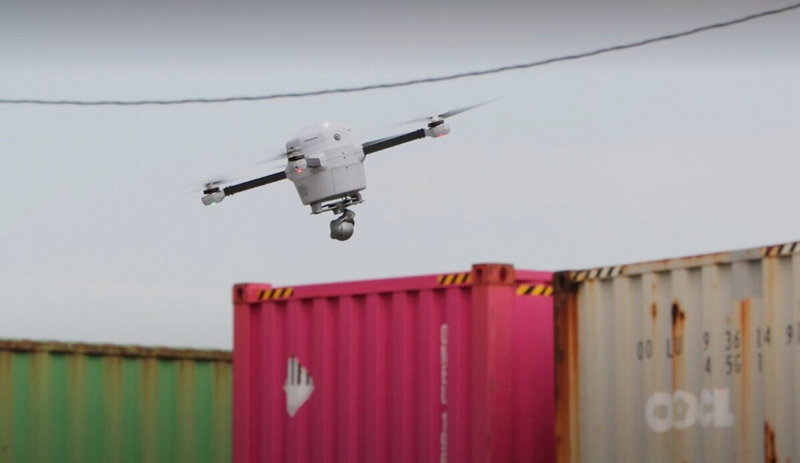
Birdstop in Detroit, a manufacturer of autonomous drones, and Detroit truck parking logistics company TSPS have started monitoring Oasis Parking sites in the Motor City using AI-powered drone technology.
By combining Birdstop’s drone-based sensing with TSPS’s real-time parking platform, the project seeks to deliver real-time intel for persistent challenges across U.S. freight corridors — helping trucking companies reduce search times and improve safety.
Birdstop has deployed drone systems at two Oasis Parking locations in Detroit monitored by TSPS. The system captures aerial imagery and telemetry data, which is processed using AI and computer vision models to detect trucks and identify available parking spaces.
The insights are integrated into a visualization platform developed in partnership with TSPS and made available to end users through the TSPS platform, providing real-time parking availability at these locations.
The initial deployment represents the first phase of Birdstop’s broader effort to validate and scale drone-based infrastructure monitoring across the U.S. The company’s long-term vision is a constellation of drones providing continuous infrastructure monitoring across national transportation networks.
Within this framework, TSPS’s role in deploying and managing truck parking facilities along major freight corridors makes it a natural first application of the system.
The project is expected to evaluate system performance, operational feasibility, and cost advantages compared to traditional fixed-sensor approaches.
By demonstrating a more flexible and scalable model for infrastructure monitoring, the same drone network can support future applications across state transportation systems, including infrastructure maintenance, emergency response, and other roadway operations — while helping reduce time spent searching for parking and improving freight efficiency.
Funded through the Michigan Mobility Funding Platform and administered by NextEnergy in partnership with Michigan’s Office of Future Mobility and Electrification, the project showcases how Michigan is deploying emerging technologies.
With some of the heaviest truck traffic in the nation and longstanding air quality challenges tied to freight movement, Detroit provides a real-world testbed for deploying innovative solutions that improve safety, efficiency, and environmental outcomes.
“Projects like this demonstrate how Michigan is leading by putting advanced mobility technologies to work in the real world,” says Jim Saber, president and CEO of NextEnergy. “As the program manager for the Michigan Mobility Funding Platform, NextEnergy helps evaluate, fund, and support projects like this — bringing together partners like Birdstop and TSPS to deploy and scale solutions that strengthen safe, efficient transportation systems.”
The U.S. trucking industry moves roughly 73 percent of the nation’s freight by weight and generates more than $900 billion in annual revenue.
“America runs on the trucking system,” says Keith Miao, founder and CEO of Birdstop. “Working with TSPS, we’re using autonomous drone technology to help secure and modernize the network that moves billions of dollars in goods every day.”
Truck parking shortages are reported to be a persistent challenge across the U.S., contributing to driver fatigue, inefficiencies, and safety risks across freight corridors. The issue impacts an industry that employs more than 8.4 million people in trucking-related jobs, including approximately 3.5 million professional drivers responsible for moving the majority of the nation’s freight.
Many rural and high-traffic routes lack consistent visibility into available parking, limiting drivers’ ability to plan safe stops.
“We are constantly looking for more scalable and cost-effective ways to gain visibility across America’s parking facilities, especially in areas where traditional fixed-sensor systems are not practical,” says Carl Rundell, CEO of TSPS. “Partnering with Birdstop allows us to extend coverage using a flexible, drone-based approach that delivers real-time operational insight across the entire freight network.”
For more information about Birdstop, visit birdstop.io.
For more information about TSPS, visit tsps.io.