Ever since the celebrated Hudson’s department store was imploded in 1998 after sitting vacant for 15 years, an entire empty city block on Woodward Avenue was a large hole in the heart of downtown Detroit. Built in phases from 1911 to 1946, the flagship J.L. Hudson department store, once the second largest retailer in the world, had been a cherished destination for shoppers. It was fondly remembered for hosting Santa Claus in the 12th-floor toy department, the Thanksgiving Day parades it sponsored, and for annually displaying the world’s largest American flag, which it draped on its façade for Veteran’s Day.
Eight years after ground was broken in 2017, Dan Gilbert and his real estate company, Bedrock, have filled the void with the aptly-named Hudson’s Detroit.
The development comprises a 12 story multiuse building, now home to the world headquarters of General Motors Co. and other businesses across 400,000 square feet of Class A office space. Dubbed “The Block,” one of its highlights is a state-of-the-art event space called The Department of Hudson’s, and street-level stores such as ALO, a wellness-focused apparel brand, and Tecovas, a modern Western outfitter (more retail tenants will be added).
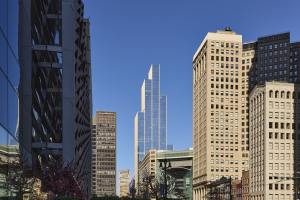
Next door, to the south, is the 685-foot tall, 45-story Hudson’s Detroit tower, the second-tallest building in Michigan and the first skyscraper built downtown in decades. It’s scheduled to open in 2027 and will include the five-star, 227-room Detroit EDITION hotel and 96 luxury condominiums named The Residences at the Detroit EDITION.
The two structures have underground parking and are separated by Nick Gilbert Way, a public plaza that runs from Woodward Avenue to Farmer Street and is named in honor of Dan and Jennifer Gilbert’s son, who passed away in 2023.
The community space offers seasonal décor, events, retail pop-ups, and Un Deux Trois, a French-inspired coffee truck from Midtown-based Café Sous Terre. The selections include pastries, coffee, and espresso.
Designed by SHoP Architects of New York City, in collaboration with others including Hamilton Anderson Associates in Detroit and Kendall/Heaton Associates in Houston, Hudson’s Detroit was built by Barton Malow of Southfield at a cost of $1.5 billion. At any given time, more than 3,500 skilled trades professionals worked on the development.
“I’m incredibly excited about this revitalization of an historic site, which is an amazing addition to our skyline and downtown,” says Eric Larson, president and CEO of the Downtown Detroit Partnership. “It’s (the type of) world-class architecture that the city deserves, and it offers a mix of uses that are responsive to our community and tremendously timely. The ability to have a five-star hotel, an office building that retains GM’s world headquarters in Detroit, along with retail on our main street, is very exciting.”
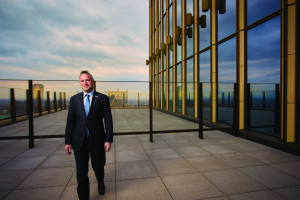
Jared Fleisher, CEO of Bedrock, which borders Woodward Avenue a few blocks south of the development, says, “Hudson’s Detroit literally and figuratively symbolizes the rise of Detroit and the comeback of the city. It’s a physical manifestation of Dan (Gilbert’s) crowning achievement, in what he has accomplished in transforming the urban core. But if you asked him, he would say the achievement has been how Detroit has come back economically and socially.”
Remarkably, Hudson’s Detroit was a speculative project without signed leases before construction commenced. Leading up to construction, the nation’s office market was still recovering from stay-at-home work policies and an uneven economy. And that issue hasn’t gone away; in November, CoStar reported a 14.1 percent office vacancy rate among the 12 largest markets it tracks across the country.
“Some of the biggest developers in America told me, ‘I would never do this,’” says Jonathan Mueller, senior vice president of development at Bedrock.
Gilbert is clearly different. “Most real estate investors don’t like risk and they want to make short-term, highly profitable investments, but Dan is the opposite. It’s about, ‘How can I make the biggest impact?’” Fleisher shares. “He said Hudson’s Detroit will never make a profit in his lifetime. What other real estate developer does that?”
Dan Pitera, dean and professor of architecture and community development at the University of Detroit Mercy, says Hudson’s Detroit figuratively and symbolically represents a tipping point in the central business district. “Approximately 90 percent of Detroit’s tall buildings were built from 1925 to 1929, and then you had the Renaissance Center trying to completely break from them (in 1977),” Pitera says. “I feel the Hudson’s Detroit buildings create a wonderful balance of looking back and looking forward.”
Bill Sharples, a founding principal of SHoP Architects, the lead design company that began working closely on the project with Gilbert in 2013, says the vision for the future of the Hudson’s site began while Detroit was in the midst of the largest municipal bankruptcy in the nation. “Dan emphasized that the new building needed to reimagine what Hudson’s had meant to Detroiters and serve as a catalyst for bringing people back — not just to the site, but to the city as a whole,” Sharples says.
“Dan was deeply involved in the design process, and we went through multiple iterations before arriving at the right program for the site. Seeing a client dedicate that kind of time and care to getting it right was truly inspiring.”

During the early design process, Sharples says Gilbert asked the team at SHoP Architects to visit various downtown structures, including One Woodward Avenue (designed by Minoru Yamasaki) and the Guardian Building (designed by Wirt C. Rowland). “They were big influences,” Sharples says. “For example, when you look at ‘The Block,’ the veil (exterior) references a lot of Yamasaki’s details from One Woodward, and the chevrons (V-shaped patterns) call out the Guardian’s lobby.”
“The use of terra cotta, which is a common material found along Woodward, was adopted for the tower. It wasn’t so much about designing any particular style; it was more about referencing elements that are uniquely Detroit and bringing (them) into the 21st century.”
Gilbert’s commitment to investing in Detroit had its genesis 40 years ago, in 1985, two years after the downtown Hudson’s closed. Then a 23-year-old graduate of Michigan State University in East Lansing and Wayne State Law School in Detroit, he co-founded Rock Financial in a small office in Bingham Farms.
Although others, like the Ilitch family and Peter Karmanos Jr., had previously moved their businesses and made substantial investments in downtown Detroit, Gilbert relocated Quicken Loans and five sister companies from the suburbs to the Compuware Building in 2010 (which he later purchased and renamed One Campus Martius). In 2011, he founded Bedrock and began acquiring and renovating downtown Detroit structures including the Madison Theatre Building, Chase Tower, the First National Building, 1500 and 1528 Woodward Avenue, 719 Griswold, and two garages.
A year later, he broke ground on his first development, a specialty retail and parking structure known as The Z Garage, and continued in subsequent years to acquire numerous other buildings on Woodward Avenue. Other notable acquisitions include One Campus Martius (2014), the Globe Building (2014), One Detroit Center (2015), the David Stott Building (2015), Book Tower (2015), the Detroit Free Press building (2016), and the Buhl Building (2017).

In the meantime, as his empire was growing, Gilbert also acquired and developed properties in downtown Cleveland. Today, the Rock Family of Cos. is a diverse collection of more than 100 entities that are connected by ROCK, the Gilbert Family Office based in Detroit and Cleveland.
However, of all of Gilbert’s Detroit real estate projects and acquisitions, Hudson’s Detroit is the “pièce de resistance” and “the absolute biggest win,” according to Claude Molinari, president and CEO of Visit Detroit, a nonprofit organization that works to bring conventions, events, and visitors to the city.
“To have this empty hole in the ground for decades and then flip the script where I see, from my 10th-floor office (at the 211 W. Fort Street building), Hudson’s Detroit, these state-of-the-art, spectacular, and beautiful buildings that address three major problems — the lack of hotel rooms, residential living, and retail space — is an amazing transformation,” Molinari says.
After ground for the Hudson’s Detroit project was broken eight years ago, progress appeared very slow to observers passing by the site. As it turns out, there were plenty of unexpected challenges beneath the surface, according to Jared Fleisher of Bedrock.
“We had to tear out the underground garage the Detroit Building Authority had built in the early 2000s and, when that (was) gone, we had to excavate to the bedrock — no pun intended — and put in the deep foundations,” Fleisher says. “You’re digging and thinking you have a clear path and, the next thing you know, we run into buried debris from the Hudson’s demolition, the buried foundations, and elevator pits going back to 1911.”
“So, from 2017 through 2019 we were excavating and doing the foundations; we didn’t start going vertical until 2020. Then the pandemic hit, and there were several challenges including steel tariffs, so there was a lot to persevere through. But at the end of the day, it was worth every minute of it.”
Nearly seven years after the project got started, during a six-day span in April 2024, Bedrock made three significant announcements. Four days after the final beam of the tower at Hudson’s Detroit was lifted into place, GM announced it was moving its world headquarters from the Renaissance Center to the top floors of The Block, and Bedrock revealed that based upon a partnership with EDITION, Marriott International’s global luxury lifestyle brand, the 45-story tower would include the five-star Detroit EDITION hotel and The Residences at the Detroit EDITION.
“It was very important to have GM as the anchor tenant of the office building, and it wasn’t a foregone conclusion that they would always be headquartered in Detroit,” says Fleisher, who points out that GM occupies the top four office floors of The Block and has a dedicated lobby, retail space, and showroom at “Entrance One” on the building’s south side along Nick Gilbert Way.
Last March, Bedrock opened a portion of the office building when then-Mayor Mike Duggan delivered his final state of the city address. It was the first large event held at the Department of Hudson’s — a 56,000-square-foot customizable space for seated or strolling events including conferences, product reveals, weddings, symposiums, and corporate meetings — that’s located on floors 2 and 3. Since that time, other events have been held at the Department of Hudson’s.
The Department can accommodate up to 2,000 guests and, thanks to a freight elevator, up to 52 vehicles can be displayed there if need be. Troy-based Forte Belanger, a leading special event design and catering firm, is the exclusive food and beverage provider at The Block. Large windows and a spacious outdoor second-floor balcony provide guests with a view of Woodward Avenue, similar to the vantage point Santa Claus had when he received the key to the city from the mayor at the Hudson’s Thanksgiving Day parades (today America’s Thanksgiving Parade Presented by Gardner White).
“The Department at Hudson’s is a fantastic, multi-use facility with all the modern technology that an event and meeting planner needs, and it’s another arrow in our quiver as we hunt for more business,” Molinari says. “We already have clients booking into the future.”
Trina Anthony, director of sales and marketing for The Department at Hudson’s and The Detroit EDITION, says today’s meetings and events are more than just tables set up in a ballroom. “It’s about bringing people together in an innovative, meaningful, and impactful way,” she notes. During a recent tour of The Department, Anthony pointed out the guillotine doors that can open and keep the space flowing. They also can be quickly closed, to create up to five different areas for hosting events.
“The Department at Hudson’s gives us a completely new playbook of opportunities, from incredible design to technology, and remarkable food and beverage,” Anthony says. “The sonic capabilities in this building are amazing. We had an event with a deejay in one area and an eight-piece band in another and there was no competing sound. It was incredible.”
Anthony also showed off the third floor, a “pre-function space” of 19,000 square feet that has nine rooms ranging from a six-table boardroom to one that can hold 150 people, each equipped with state-of-the-art audio-visual capabilities. “It provides a good, wide range that complements our second floor nicely and allows for one to step away and have more of an executive experience for smaller, intimate gatherings,” she says.

While GM occupies floors 8 through 11, the remaining Class A office space is now “substantially leased and going through interior build-outs,” Fleischer says. As of early December, other signed tenants were Accenture, Ven Johnson Law, ROCK (the Gilbert Family Office), and the Gilbert Family Foundation. This past November, it was announced that JPMorgan Chase plans to relocate its corporate offices from Chase Tower, owned by Bedrock, to the fourth floor of The Block.
“It really is the pre-eminent office space in Michigan,” Fleischer says. “I challenge anyone to find a more inspiring office building in the Midwest.” Still, even as the building was under construction, the future and viability of large office buildings was uncertain.
“We had no tenants (at the start), and we weren’t sitting in a good position,” says Mueller, of Bedrock. “This was about convincing prospective tenants that the building and amenity space would help attract and retain employees who were used to working remotely.”
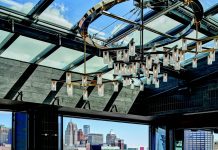
Part of The Block includes an amenity space on the fifth floor, highlighted by a seven-story atrium filled with natural light capped off by a skylight that looks like the metal headlight cover of a 1954 Chevrolet Corvette. The atrium includes natural plants; spacious lounge areas with plush, comfortable seating; and a café with hot and cold beverages, grab-and-go meals, and a television. Walking to the back of the floor, one enters a reception area that will be staffed with concierge services.
“If you need a dinner reservation, perhaps a pair of pants to go to the Detroit Athletic Club because you wore jeans to work that day, or need a grocery delivery, they will provide hotel-level concierge services,” Mueller says.
Behind concierge services is “The Rec Room,” designed by Detroit-based Pophouse. The firm also crafted the atrium’s café and furniture. There’s a living room and library with an attached kitchenette, a locker room, a pickleball court, a room with a sports simulator for golf and eight other sports, and a spacious fitness area filled with the latest workout equipment. Exercise trainers are available, as well.
“(You won’t) have to stop at a gym on your way to work,” Mueller says. The building features a 12th-floor terrace balcony with its own dedicated street-level access, and a future rooftop dining venue to be open to the public and operated by acclaimed restaurateur Danny Meyer, a 28-time James Beard Award-winner who founded Union Square Hospitality Group in New York City.
Turning to the Hudson’s Detroit tower, the Detroit EDITION hotel will occupy floors 1 through 25, while The Residences at the Detroit EDITION’s 96 luxury private condominiums will span floors 26 to 45 (offering incredible views of the skyline, the Detroit River, and Canada). EDITION is the global luxury lifestyle hotel brand conceived by Ian Schrager, in partnership with Marriott International. Its hotels are found in 19 cities around the globe, including London, Tokyo, New York City, Miami Beach, and Rome. The Detroit EDITION is the brand’s first foray into the Midwest.
“We’re extremely excited about the hotel,” Fleischer says. “It was selected because it best fit the ethos of Detroit. It’s their more hip and prestigious brand, and we wanted that kind of energy here in Detroit. I was giving a tour recently and I took some visitors up to a vantage point, and they said, ‘You’d think you were in New York or London and the (other) greatest cities of the world.’ And that’s Detroit’s trajectory, a trajectory of greatness.”
The hotel plans to offer four diverse food and beverage outlets, a pool, a large outdoor terrace, a fitness center, spa, and more than 16,000 square feet of event space. Hamilton Anderson Associates served as the executive architect for the interior build-outs for the tower, working with world-renowned designers Ian Schrager and Yabu Pushelberg on the hotel and luxury branded condos. The firm also collaborated with Surfacedesign Inc. on the landscape, at-grade improvements, and Nick Gilbert Way.
“The entire approach for the interiors was to do something contemporary, but also make it timeless, not trendy, and very straightforward,” says Rainy Hamilton Jr., principal-in-charge and president of Hamilton Anderson. “Looking at the skin (of the building), it’s very elegant, and I think it will age gracefully. The scale and proportions are right for Detroit. For us, it was an honor to be part of this landmark project that demonstrates to the world that Detroit has returned to its glory.”
This past fall, Bedrock started selling the Residences at the Detroit EDITION, which range from one- to four-bedroom luxury condos with 10-foot ceilings, complemented by a private lobby. The prices for the condos will be around $1,000 per square foot. Future residents will have sweeping 360-degree views of downtown and the Detroit River, and enjoy 14,000 square feet of exclusive, residents-only indoor and outdoor amenities, as well as shared services at the Detroit EDITION.
“There’s been a tremendous interest in the residences because they’re truly a differentiated product in the state when you consider the location, views, the quality of construction finishes, and all the amenities that come with them,” Fleisher says.
In early November, Nick Gilbert Way, the public plaza between the two Hudson’s Detroit buildings that extends from Woodward Avenue to Farmer Street, opened with a holiday theme tied to the legacy of the Hudson’s department store. At the dedication ceremony, Gilbert said, “For decades Detroiters and people from all over the state came downtown to Hudson’s, and now they will do so again. It’s not just physical buildings that we’re bringing back but, more importantly, it’s the spirit and energy that’s returning.”
While a skywalk could have been added to connect the two structures, Pitera, from the University of Detroit Mercy, says, “It was important that the buildings aren’t connected above ground, and that you have to go on the street to go to the other building. It sounds small, but it’s very important that Hudson’s Detroit engages the street, and it does it in a wonderful way with Nick Gilbert Way.”
In 2009, a year before Gilbert moved his businesses downtown from the suburbs, and five years before Detroit completed its 16th month bankruptcy, Time magazine published a cover story — “Detroit: The Death and Possible Life of a Great City” — that stated, in part, that the city was a “disaster” and on “life support.” Fast-forward to 2022, when Time declared Detroit was one of the “Top 50 Places in the World to Explore.”
“In 2006, when the Super Bowl was here, storefronts on Woodward Avenue were empty and an effort was made to obscure the vacancies (by putting up first-floor window displays),” Fleisher says. “I don’t think you can express enough how profound a transformation it has been.”