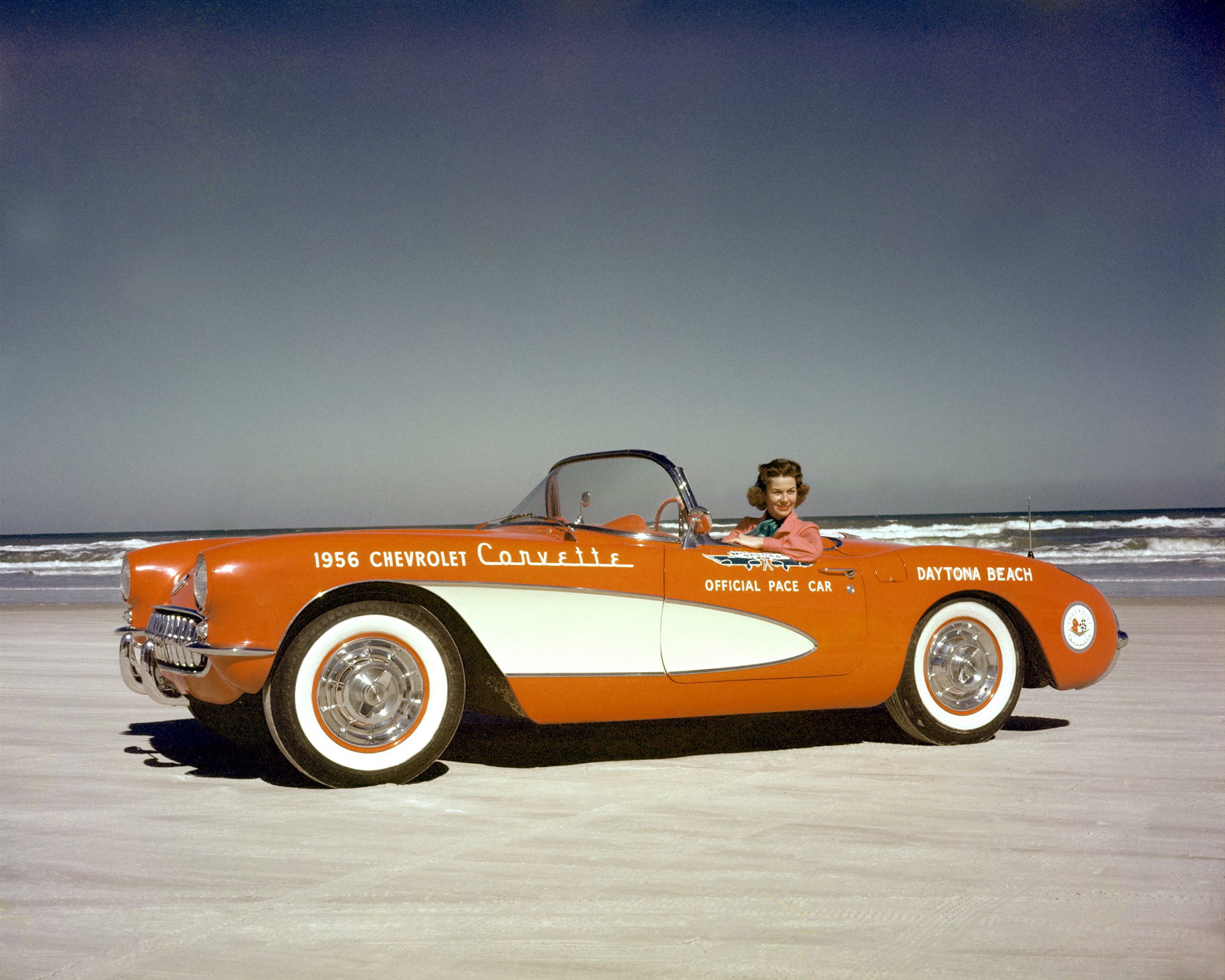
When 27-year-old Betty Skelton guided a Dodge Royal to a Daytona Beach speed record early in 1954, she had already achieved aviation marks and aerobatics championships.
In her auto racing debut, the Dodge roared over the compacted sands at 105.88 miles per hour.
“Whether piloting an airplane, an automobile, or a vacuum cleaner, a woman’s chief concern at all times should be maintaining her femininity,” Skelton quipped.
Born in 1926, she earned a pilot’s license at 16 and bought an aerobatic plane at 22. Her best stunt was buzzing the brains of skeptical reporters, turning media attention and corporate interest to her advantage.
Four months after the Daytona achievement, she participated in opening-day festivities at the Chrysler Proving Grounds near Chelsea, Mich., taking a Dodge Firearrow III dream car to a women’s closed-course record of 143.44 miles per hour.
The auto industry, in the mid-1950s, was awakening to the importance of women as consumers, even tailoring assembly lines for factory-fresh efforts such as the Dodge La Femme.
And for the first time, women became industry insiders. Helene Rother’s interior designs led Nash to the top in that category, and General Motors already had its so-called Damsels of Design on staff. In a complementary push, GM’s Chevrolet Division sponsored Dinah Shore’s weekly television show and commissioned a long-running ad campaign featuring the singer.
Skelton joined Dodge in 1955 as a test driver who lectured nationwide on safe driving techniques. One account says she “proceeded to dazzle some of the grey flannel suit brethren with her own brand of sales and promotion work.”
GM hired her away in 1956, and Skelton left Dodge to join Chevrolet’s ad agency, Campbell-Ewald, in 1956. She thereafter slipped into Corvettes on various speed, endurance, and economy runs, helping to establish a performance legacy for the model that was just coming into its own as a serious sports car.
Her popularity was broad enough to make her a guest on television shows including, naturally, Dinah’s.
In an example of in-person appearances, Skelton brought her glamorous appeal to a Saginaw-Bay City GM Girls Club event in May of 1960 and acted as “powder puff test driver,” as a correspondent wrote, while trying out an experimental system from Saginaw Steering Gear.
Not long before that, Look magazine had put her through the physical training tests given to Mercury 7 astronauts, which earned her a new nickname of 7½. A Saginaw reporter asked about plans for space travel, but Skelton revealed her own limits.
“I’m a little old for that sort of thing. I’m 33 now.”
After two decades with Campbell-Ewald, she retired to Florida. She was married to a Hollywood producer for 36 years. After his death in 2001, she remarried and became a familiar sight in a red Corvette roadster that matched her hair. She passed away in 2011.
Skelton’s red-and-white “Little Stinker” aerobatic plane, meanwhile, is displayed at the Smithsonian’s National Air and Space Museum. In 1977, she published a memoir titled “Little Stinker.”
The jacket cover relays: “The inside story, told by the airplane itself, about Betty Skelton, America’s most famous aerobatic aviatrix.”
In turn, Writer Henry Holden produced a biography, “Betty Skelton: First Lady of Firsts,” in 1994. And her legend was renewed in “Boundless,” a documentary film of 2022.
“It wasn’t just that Betty did all these things,” GM President Mark Reuss said last September during her induction into the Automotive Hall of Fame at The Department at Hudson’s in downtown Detroit. “It was how she did them. She had absolutely no fear.”