AI has moved from “innovation initiative” to embedded reality in marketing. It’s already inside your ad platforms, analytics stack, CRM, creative tools, and even the search experience your customers rely on.
The question for business owners and marketing leaders is no longer whether AI belongs in the function, but rather whether your organization will institutionalize AI as a capability, or simply experiment with it as a set of disconnected tools.
Because the winners won’t be the teams who “use AI.” They’ll be the teams who redesign how marketing works.
The Strategic Shift
For the past decade, marketing performance improvements largely came from better distribution (targeting, channels, automation). In the AI era, the performance gap will increasingly come from decision speed and decision quality:
- Faster synthesis of market and customer signals
- More consistent positioning across touchpoints
- Tighter feedback loops between performance data and creative iteration
In other words, AI’s real value isn’t that it writes a blog post faster. It’s that it can help marketing teams operate with greater precision, if the organization designs for it.
The Common Failure Mode
Many companies are moving quickly, adding AI writing tools, asking teams to “experiment,” and hoping productivity improves. The problem is that unstructured adoption creates predictable risk:
- Brand dilution: content volume increases while voice consistency decreases
- Quality drift: outputs become generic, repetitive, or misaligned with positioning
- Operational friction: teams build parallel workflows that don’t integrate with existing systems
- Data and compliance exposure: sensitive inputs end up in the wrong places
- False confidence: leaders mistake activity for impact
AI is not inherently strategic. Governance makes it strategic.
What high-performing teams are building instead
Organizations getting real lift from AI tend to focus on a few strategic moves:
Define the role AI plays across the marketing value chain.
Where does AI support research, insights, planning, creative development, execution, and measurement? And where does human judgment remain non-negotiable?
Build a repeatable operating system, not a collection of prompts.
The goal is a standardized, documented way of working—clear inputs, defined steps, quality control, and performance measurement. When the approach is consistent, teams can scale output without sacrificing clarity, brand alignment, or results.
Treat brand voice and positioning as protected assets.
AI can accelerate content, but only if the organization has clear definitions of tone, messaging hierarchy, differentiation, and customer truths. If you don’t define and protect your voice, you’ll scale the wrong thing, faster.
Build measurement discipline around business outcomes.
AI should show up in measurable value: cycle time reduction, improved lead quality, lower CAC, higher conversion rates, increased retention, and improved sales enablement effectiveness. If it can’t be tied to outcomes, it isn’t strategy.
A useful framing for leaders right now is: where should AI drive efficiency, where should it drive effectiveness, and where must we preserve human advantage?
This forces an organization to think beyond content generation and into capability-building: systems, workflow integration, decision rights, guardrails, and performance measurement.
Marketing in the Age of AI
If you want a clearer understanding of how AI fits into marketing strategy, without drowning in hype or getting stuck at the tool level, join us for an in-person workshop designed for business owners and marketing leaders:
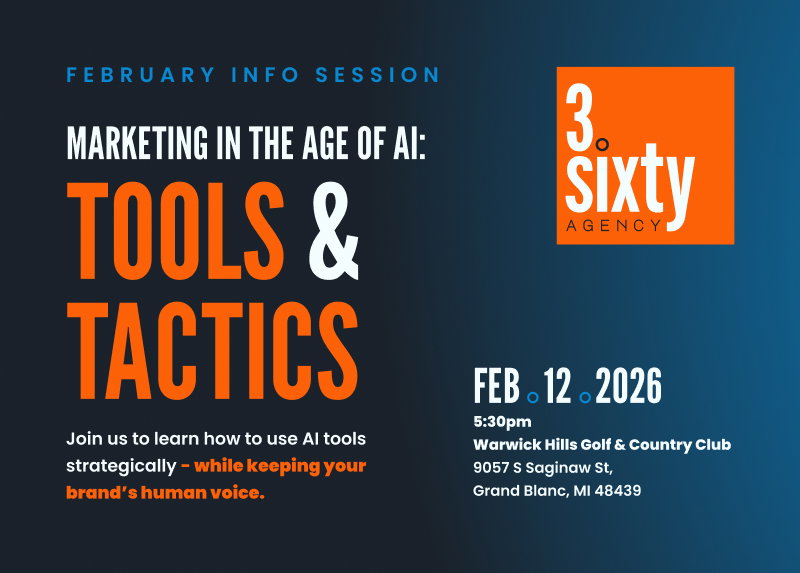 Marketing in the Age of AI: Tools & Tactics
Feb 12th | 5:30pm Warwick Hills Golf & Country Club
You’ll leave with a practical view of what AI can and can’t do, how to integrate it into existing workflows, and how to adopt it without losing the authentic voice that makes your brand credible. Click HERE to register.