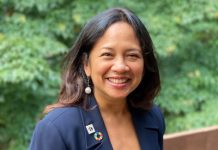
Dr. Hayley Murphy
CEO and Executive Director
Detroit Zoological Society, Royal Oak
Employees: 350 (500 volunteers)
Revenue: $66.7M (2024)
During her 13 years with Zoo New England, Dr. Hayley Murphy once found herself updating the public on a touch-and-go situation involving a newborn Baird’s tapir. Weighing 20 pounds at birth, the burly little mammal that’s related to horses and rhinos had acquired pneumonia. A baby-naming contest that brought in 1,200 entries was put on hold, pending the infant’s survival.
“He’s with his mom,” Murphy told the Boston Globe at the time. “He still looks bright and alert, but it’s a serious condition.”
Being a calming spokeswoman was as much a part of a day’s work as ensuring the proper therapeutic measures were taken.
Murphy flourished in her multifaceted role, and eventually became the zoo’s director of veterinary services — yet the tapir calf’s emergency well reflects the unexpected turns of her own career.
After graduating from Cornell University’s veterinary school in 1992, Murphy — who was born in England but grew up in New York state — went to work at a small-animal and equine clinic in Seekonk, Mass. In her spare time, she volunteered at zoos; a zoo internship eventually led to a career shift.
After rising through Zoo New England’s ranks, she left the Northeast in 2009 and took over vet services at Zoo Atlanta. In the midst of all this, she founded the Great Ape Heart Project, which is concerned with research and the treatment of cardiac disease among apes in managed care.
Meanwhile, looking around for her next step, she focused on the 125-acre Detroit Zoo — irresistible not only for its large natural habitats, but also the institution’s regional impact.
“This zoo stood at the very top of the list, and I was just fortunate that my timing coincided with the former CEO’s (Ron Kagan) retirement plans,” she says (Murphy is the first woman to lead the Detroit Zoological Society).
With 200 species of animals, the zoo states it is the largest paid family attraction in Michigan, and it welcomes more than 1.3 million visitors annually. Just ahead of its upcoming centennial observance in 2028, Murphy says the zoo now has “a game-changer.”
The Fred and Barbara Erb Discovery Trails opened in May as “the capstone of the last 20-year campus plan.”
Carrying a price tag of $49 million, the Trails is the zoo’s biggest undertaking. Funded with $41 million in donations and $8 million from the zoo, the 7-acre reserve showcases nine new habitats and 10 new species.
As a paradigm for sustainable design, there’s also $18 million in infrastructure — namely, rain gardens, separate storm and sewer lines, and underground utilities. Guests can brush a goat, touch a stingray, or feed a chicken.
“It really is designed to get people up close with animals and inspire that connection, that empathy, and talk about how people in their everyday life can help animals and conserve the environment,” Murphy says.
Murphy, who recently had breakfast with Helen Taylor, The Nature Conservancy’s state director for Michigan, explains that a symbiotic relationship exists among conservation organizations whose leaders network together and support one another.
For her own part, TNC’s Taylor cites Murphy’s leadership as one of her best qualities. “Hayley brings deep experience and global perspective not only to the Detroit Zoo, but to her collaborations with conservation groups in Michigan,” Taylor says. “She’s a strategic voice with a practical and applied perspective that’s valuable to the conservation field here.”
Besides the in-state collaboration, another key network developed in 2018 when Murphy went through a yearlong executive leadership program administered by the Association of Zoos and Aquariums. She assessed her personal strengths and weaknesses, and gave a hard look at leadership “from a strategic and visionary level.”
It led to a new motto for herself: “Lead from the balcony.” She elaborates on the thought, saying, “Keep your strategic vision alive and let the people who do their job best, operationally, do it without getting in their way.”
As a side benefit of the year’s experience, the cohort of 10 AZA leadership participants bonded strongly. “We lean on each other, we call each other, we hang out with each other at conferences,” Murphy says. “I like to say we move as an amoeba around the conference.”

Murphy has become director emeritus of the Great Ape Heart Project, which is now based at the Detroit Zoo and run by Marietta Danforth. Keeping in mind that Murphy has performed surgery on gorillas, her motto introduces the question of whether she descends from the balcony to take an occasional surgical case. But even though she stays current with the veterinary science journals, the answer is no.
“Somebody just asked me the other day, ‘Why don’t you let your vet license lapse?’ And I’m like, ‘Because it’s a treasure.’ I worked really hard for it, right? It was my life dream. I don’t even remember wanting to be anything else but a veterinarian. It’s still incredibly important, but I do not practice. I stay in my lane, which is leading this organization.”
Murphy and her husband, Dr. David Murphy, have two adult children. David Murphy is a small-animal veterinarian whose hobby is bonsai art. He used to encourage his hard-working wife to develop her own hobby.
“Really, my hobby is my work,” she says. “I would spend 24/7 doing that and being with my kids.”
An “avid reader of all sorts of books,” she likes to travel and be near the ocean. Her greatest passion, though, is the zoo, and she finds it widely shared.
“It amazed me, when I moved here, how many people talk about the memories they have of the zoo, and they came here with their parents, and their parents came here with their parents,” she shares.
Call it the latest installment in a career of many discoveries. After arriving in Detroit nearly five years ago, she told her university’s alumni magazine “I love what I do and would never in a million years have predicted this when I was at Cornell.”
— Ronald Ahrens
“I am wearing my mom’s original engagement ring and a ring from my father with the birthstones of my two children. I always loved the (engagement) ring growing up, and after he passed she gave it to me. I wear them every day.”