Grinding it out doesn’t always work with robots, until now.
In fact, grinding and surface finishing of fabricated parts is one of the classic 3D (Dull, Dirty, Dangerous) applications that are needed in robot automation.
Unfortunately, automating the grinding of large fabrications means multiple robots and complex part repositioning, which add significant cost and extended cycle times while introducing new sources of variation in the process.
Now Güdel US in Ann Arbor, the US subsidiary of Güdel Group in Switzerland, has designed a system to scale beyond these physical constraints.
The company has overcome the limitations of traditional fixed-robot cells by adding two additional degrees of freedom to heavy-duty grinding applications.
By integrating its TrackMotion Vertical TMV and TrackMotion Floor TMF systems, Güdel allows a single robot to maintain consistent contact pressure and path speed across massive surfaces that would otherwise require multiple robots or complex part repositioning.
Unlike standard stationary setups, Güdel’s multi-axis motion systems provide three key strategic advantages for the shop floor:
- Reduced Capital Investment: A single robot can service an entire large work envelope, eliminating the need for multiple fixed units and simplifying cell design, safety, and controls.
- Enhanced Process Stability: By keeping the robot in a favorable working posture, the system minimizes joint extremes and wear, ensuring repeatability during long, high-force grinding cycles.
- Maximum Uptime in Harsh Zones: Designed specifically for abrasive environments, the track systems protect critical components and position the robot away from aggressive debris zones typical of grinding operations.
“Expanding the robot’s workspace isn’t just a helpful addition; it’s the factor that finally makes automation feasible for large, difficult-to-reach parts,” says Brenda Courim, director of sales and marketing at Güdel US.
“The combination of vertical lift and long horizontal travel provides a practical production solution that can be updated through software as part designs evolve, rather than requiring expensive mechanical rework.”
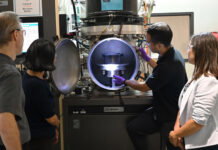
At a recent show demo, Güdel featured a FANUC R-1000 robot equipped with a grinding end-of-arm tool. The robot is mounted on a TMV system, which is itself integrated into a TMF track. This specific application was developed by systems integrator Titan Robotics to solve the challenges of grinding large weldments for a major off-road equipment manufacturer.
“Applications like this show how manufacturers can overcome the challenges of traditional robotic grinding,” says Lou Finazzo, vice president of FANUC America in Rochester Hills. “By combining FANUC’s robot performance with Güdel’s vertical and floor-mounted motion, customers gain the reach, stability, and process consistency needed to automate large, demanding grinding applications.”
Güdel Group, a global manufacturer of robotic automation products, systems, and services. It supplies linear motion modules, robot track motion units, gantry robots, and components to the automotive, aerospace, logistics, heavy industrial, press automation, and power generation industries.
Güdel US is headquartered in Ann Arbor in a dedicated 45,000-square-foot facility, providing North American customers with engineering, design, production, and customer service support.
For more information, visit gudel.com.