


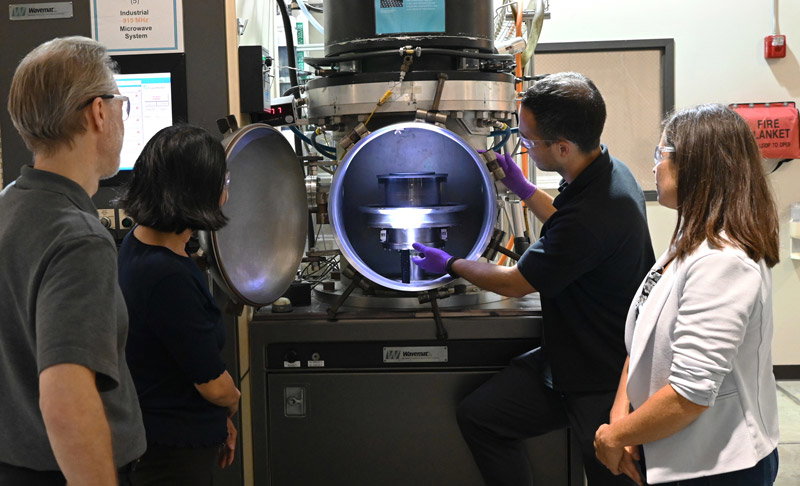
A new $20 million grant from the U.S. National Science Foundation will support Integrated Diamond and Carbon Research in Space Applications, (IDiCaRS), a shared-use research facility at Michigan State University in East Lansing.
The facility is designed to accelerate the development and testing of semiconductor technologies in the extreme environment of space.
“IDiCaRS will strengthen MSU’s ability to bring together researchers, industry partners, and advanced research capabilities to tackle some of the most important challenges facing space electronics and semiconductors,” says John Papapolymerou, dean of the College of Engineering and director of the MSU Space Electronics Initiative.
“Just as important, it will give our students hands-on experience with cutting-edge technologies and help prepare the highly skilled workforce needed to keep Michigan competitive in semiconductors and advanced manufacturing.”
Led by Wen Li, the MSU Research Foundation Distinguished Professor in the College of Engineering and executive director of Fraunhofer USA Center Midwest, the facility is expected to bring together an end-to-end research infrastructure for developing diamond and related carbon materials, fabricating electronic devices, and performing radiation-effects testing with high-energy heavy-ion beams at the Facility for Rare Isotope Beams, or FRIB, at MSU.
“We are building a first-of-its-kind niche facility — a diamond foundry — here at MSU,” says Li. “The goal is to give researchers in space and automotive electronics a place to move more quickly from developing a material or device to testing how it performs under harsh environmental conditions that can damage electronics in space.”
This new facility is designed to improve technology today and protect future space technology.
Diamond is promising for space electronics because of its unique combination of properties, including high thermal conductivity and resistance to high temperatures, radiation, and electrical stress. IDiCaRS will allow researchers to investigate these materials and devices and generate data about how they respond to extreme radiation and temperatures.
Today, development, manufacturing, and severe-environment testing of these technologies can occur at separate facilities and in separate locations. By bringing these capabilities together under one roof, IDiCaRS seeks to shorten development cycles and establish shared testing methodologies and qualification approaches for electronics intended for extreme environments.
The new facility will utilize existing MSU capabilities and partnerships, including FRIB, the MSU Space Electronics Initiative, and the Fraunhofer USA Center Midwest.
“We are excited to bring the FRIB Laboratory’s heavy-ion beam infrastructure to the IDiCaRS initiative to help expand MSU’s reach of cutting-edge research for extreme environments,” says Thomas Glasmacher, director of the FRIB Laboratory. “Joining forces in advanced material science positions us to make a lasting impact on space exploration and semiconductor innovation while preparing the next generation of STEM leaders.”
The research has implications beyond space exploration. More radiation-resistant and thermally capable semiconductor technologies could help reduce the need for heavy shielding and redundant systems on spacecraft, potentially allowing future missions to use smaller, lighter, and more efficient systems.
“This grant represents the culmination of decades of collaborative research between Michigan State University and Fraunhofer USA in advanced diamond and carbon materials science,” says Thomas Schuelke, president of Fraunhofer USA and a professor in the College of Engineering. “What began as fundamental research partnerships has evolved into a shared-use facility that will accelerate the translation of next-generation semiconductor materials from the laboratory to the marketplace, strengthening America’s position in critical materials innovation for years to come.”
Research conducted at IDiCaRS could contribute to high-power electronics and next-generation communications technologies used on Earth and in space, while strengthening the U.S. semiconductor research and manufacturing ecosystem, officials say.
IDiCaRS also is expected to create opportunities for students and the broader workforce to gain hands-on experience with advanced semiconductor materials, manufacturing processes, and specialized equipment central to the project.
The facility includes access to advanced research facilities, equipment training, updated undergraduate and graduate coursework, and plans for a graduate certificate and undergraduate minor related to the facility’s research areas. Education and outreach efforts also include space electronics programs for middle and high school students and opportunities for community college students.
IDiCaRS’ capabilities for researchers could expand from academia, industry, and government, creating a shared resource for advancing technologies designed to operate in extreme environments.
Ultimately, say officials, IDiCaRS is intended to accelerate the development and testing of electronics that can withstand extreme environments while strengthening the infrastructure, technologies, and workforce needed for the future of space exploration and advanced manufacturing.




, a shared-use research facility at Michigan State University in East Lansing.)