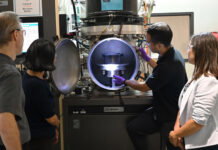
Ann Arbor-based Coherix is developing quality-control technology that it says can improve EV-battery safety, service life, and quality while reducing production costs.
The company develops 3-D machine vision, artificial intelligence, and proprietary process-control software to manage processes that seal battery cases and covers to assure performance and safety.
More than 3,000 Coherix systems currently are in use on battery- and automotive-assembly lines worldwide. Juergen Dennig, the company’s president, says that Coherix expects that number to nearly double over the next two years.
Global manufacturers are in the race to improve battery quality, safety, and performance while reducing weight and cost. Mass production of electric-vehicle batteries is still in its infancy and many companies continue to develop quality-control processes on a trial-and-error basis.
“The automotive industry is moving at light speed in its development of battery technology,” says Dennig. “The growth in EV sales puts a spotlight on battery-manufacturing processes needed to properly seal lithium-ion battery cases and covers to achieve optimal performance, safety, and quality.”
The application of adhesive sealant to properly close battery covers and packs is a major challenge. Coherix 3-D vision systems are engineered to help manage and inspect the exact amount and placement of sealant during the battery-assembly process.
The company also has developed software capable of automatically adjusting the application of adhesives at line speed for batteries and battery covers to improve quality, cut downtime, and reduce labor and material costs.
Adhesives can cost up to $180 or more per gallon. The use of Coherix technology helps reduce the amount of sealant used in the assembly of battery packs and covers by up to 30 percent. For an assembly line producing 300,000 batteries per year, the annual savings could total up to $4 million, the company says.
Many battery manufacturers today rely on 2-D camera systems to monitor the application of adhesives for battery packs and covers. These 2-D systems are affected by ambient light, unable to detect adhesive volume and cannot monitor other critically important sealant-application data (such as bead shape, center height, or cross-section measurements).
Unlike 2-D and other adhesive-inspection systems, Coherix 3-D quality-control systems are engineered to measure and adjust the amount of sealant used in robotic dispensing processes and ensure that critical center-height and volume specifications are met.
In addition, the use of the company’s adaptive process-control technology also helps eliminate unscheduled downtime and allows sealant-application robots to run at maximum speed.
“Adaptive process control and 3-D-vision technology will be the quality-control standard for sealing battery closures in the not-to-distant future,” says Dennig. “Our technology is rapidly gaining acceptance not only in North America, but in the Asia Pacific region and Europe as well.”