Blue Arbor Technologies Inc., a medical device company in Grass Lake developing novel neuromuscular interfaces and next-generation prosthetic control solutions for people with limb loss, has announced the close of its $10.5 million Series A financing round.
The company develops next-generation robotic control systems for people with limb loss so they can intuitively, accurately, and reliably control a prosthetic device with unparalleled degrees of freedom.
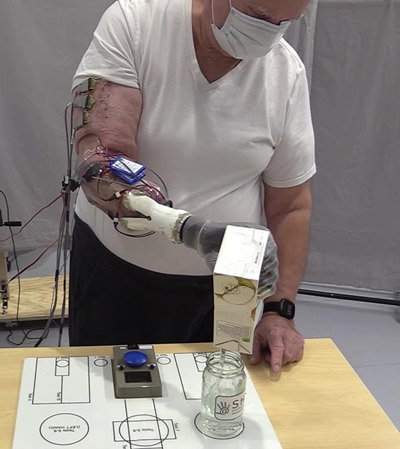
The RESTORE System is a neuromuscular interface system that provides a direct connection between the patient’s peripheral nervous system and their robotic prosthetic limb.
The Series A was led by Blue Arbor’s strategic partner Ottobock, a global leader in prosthetics, neuro-orthotics, and wearable human bionics.
The financing will be used to advance progress on the RESTORE Neuromuscular Interface System, a first-of-its kind platform that has the potential to fundamentally transform how people with limb loss control their prosthetic devices.
Proceeds will be used to complete feasibility studies and to pursue FDA Investigational Device Exemption (IDE) to support clinical studies in the U.S. for the RESTORE ESU. In tandem, Blue Arbor also will begin development of the RESTORE ISU.
“Blue Arbor’s technology has the potential to set a new standard in prosthetic control,” says Oliver Jakobi, CEO of Ottobock. “This investment reflects our approach to deploying capital in areas that complement our core business and offer significant long-term growth potential. Together, we aim to translate pioneering research into scalable solutions that deliver meaningful value for people with limb loss.”
The RESTORE System is designed to enable independent and simultaneous control of the fingers, wrist, and elbow — unlocking levels of dexterity, speed, and reliability that approach natural limb movement and provide unparalleled control of today’s most advanced prostheses.
Blue Arbor is developing two versions: an external sensing unit (ESU) interface and a fully implantable, next-generation internal sensing unit (ISU) interface that seamlessly integrates into the RESTORE System platform.
“This funding is a testament to the team, the science, and the patients driving this work,” says Tod Borton, CEO of Blue Arbor Technologies. “With two successful human implantations thus far, we are looking forward to helping more patients through our collaboration with Ottobock. This is a pivotal moment for Blue Arbor and for the field of prosthetic control — we are closing the gap between where the technology is today and where it needs to be for the millions of people living with limb loss.”
Feasibility studies continue to advance, highlighted by a successful second-in-human procedure using the RESTORE ESU at the Medical University of Vienna, one of Europe’s foremost centers for reconstructive and prosthetic surgery.
“We have been extremely impressed with the results of these initial surgeries, particularly how quickly and naturally patients have adapted to the technology,” says Prof. Oskar Aszmann, director of the Center for Bionic Extremity Reconstruction, Medical University of Vienna. “As doctors, it is our onus to provide solutions to improve our patients’ lives and with the RESTORE System we have been able to bring intuitive hand movement back to those who never thought they’d experience it again.”
Blue Arbor’s RESTORE System technology was recently selected to support a clinical study led by the University of Michigan, funded by a UG3 grant from the National Institutes of Health.
The study will compare the effectiveness of surface electrodes against implanted electrodes for prosthetic control. The RESTORE System received FDA Breakthrough Device Designation and has been accepted into the FDA’s Total Product Life Cycle (TPLC) Advisory Program (TAP) Pilot.
For more information about the RESTORE System and Blue Arbor Technologies, visit bluearbortech.com.