The City of Detroit and Midtown Detroit Inc. are advancing coordinated planning efforts to help ensure Detroiters benefit from the city’s growing investment and development, with a focus on strengthening neighborhoods, supporting residents and businesses, and creating long-term economic opportunities.
Midtown Detroit is launching the Greater New Center Growth and Investment Initiative, a 10-year planning effort designed to guide infrastructure, housing, public spaces, small business development, and neighborhood connectivity in an area experiencing unprecedented growth and more than $4 billion in development.
At the same time, the City of Detroit’s Planning and Development Department is preparing to launch the Linwood/Joy Neighborhood Framework.
Together, the initiatives are said to reflect a shared commitment to connecting large-scale investment with the needs and priorities of the neighborhoods surrounding it, ensuring that growth strengthens existing communities and creates opportunities for Detroiters to stay, return and move to the city.
“Neighborhood investment must be about more than new development,” says Detroit Mayor Mary Sheffield. “It must be about making sure residents see and feel the benefits in their everyday lives.
“We are committed to working alongside residents to shape the future of their neighborhoods, improve quality of life and create a Detroit where every neighborhood can thrive. The Linwood/Joy Neighborhood Framework is an important first step in that work, and our partnership with Midtown Detroit and their planning work in New Center will help ensure that growth and investment are connected to the people who call Detroit home.”
Officials say that Greater New Center is entering a period of significant growth, anchored by a $3.3 billion transformational development underway between Henry Ford Health, Michigan State University, and the Detroit Pistons and approximately $1 billion in additional nearby projects.
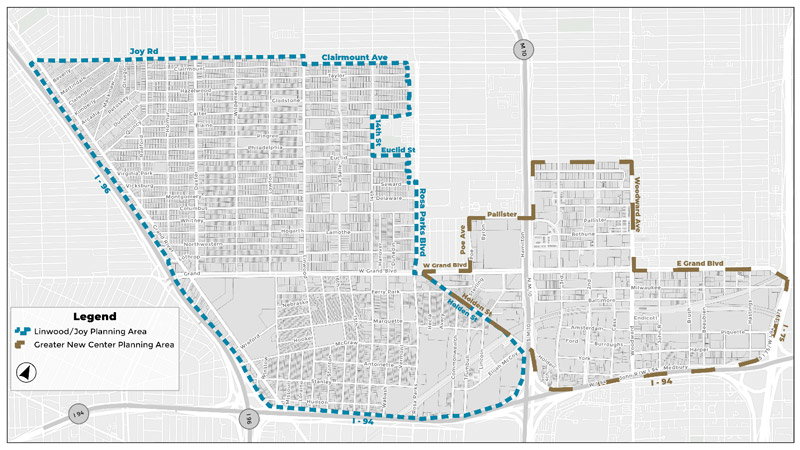
The Greater New Center Growth and Investment Initiative is designed to help guide how this investment translates into lasting benefits for Detroit residents, businesses, and the broader regional economy. The initiative encompasses New Center and surrounding neighborhoods, extending from the Henry Ford Health campus west of the Lodge Freeway to I-75 on the east, and from the Virginia Park community to I-94 on the south. The area includes major institutional campuses, residential neighborhoods, and commercial corridors.
“New Center is going to grow. That is no longer in question,” says Melanie Markowicz, executive director of Midtown Detroit. “The question is how it grows, who benefits, and who gets to shape its future.
“We have a generational opportunity to leverage billions in private investment to strengthen neighborhoods, attract and retain talent, and drive economic growth. Our priority is ensuring Detroiters help shape that future while positioning New Center as a major economic engine for Detroit and the state of Michigan.”
Led by Midtown Detroit in coordination with the city of Detroit, the initiative will bring together major institutional partners, including Henry Ford Health, Wayne State University, Pistons Sports & Entertainment, TechTown Detroit, Michigan State University, and the College for Creative Studies, alongside residents, businesses, developers, and community organizations.
Beginning in 2027, the initiative will develop a 10-year growth and investment strategy identifying priorities for infrastructure, transportation, housing, commercial development, parks, and public spaces. The strategy will include investment recommendations, potential funding sources, and an actionable implementation roadmap, helping align public, private, and philanthropic resources across institutional campuses and surrounding neighborhoods.
Community engagement is expected to be central to the initiative, with an emphasis on preserving neighborhood identity, strengthening existing communities, and expanding opportunities for residents and local businesses to benefit from new development. Midtown Detroit’s initiative is supported by the Hudson-Webber Foundation, with additional public, private and philanthropic partnerships being developed to support planning and long-term implementation.
“Henry Ford Health has been a proud and vibrant anchor of the New Center neighborhood since our organization was founded more than a century ago,” says Jerry Darby, senior vice president of campus planning, development, and design for Henry Ford Health. “Along with our partners, our Future of Health development — including a brand-new 1.2-million square foot hospital facility — stands to firmly position New Center as a regional epicenter of growth, creativity, development, and opportunity.”
Donald Rencher, president and CEO of the Hudson-Webber Foundation, says, “The transformational investments underway in Greater New Center present a generational opportunity to strengthen surrounding neighborhoods, many of which are historically Black, while positioning the area as a major economic engine for Detroit.
“Our support for this initiative reflects our belief that coordinated investment can create lasting prosperity by expanding housing opportunities, supporting small businesses and connecting residents to quality jobs. Equally important, is ensuring that residents and local businesses have a meaningful role in shaping the priorities that will define the future of their neighborhoods.”
Complementing the Greater New Center initiative, the City of Detroit’s Linwood/Joy Neighborhood Framework is designed to establish a community-driven vision for improving quality of life and strengthening neighborhoods across its planning area. The effort advances Sheffield’s Rise Higher framework and supports the city’s Master Plan of Policies, which provides a foundation for future development and neighborhood investment.
The Linwood/Joy planning area encompasses seven neighborhoods, with Joy Road and Clairmount Avenue forming the northern boundary, Rosa Parks Boulevard and Holden Street the eastern boundary, and Interstate 94 and Interstate 96 defining the southern and western boundaries.
The framework will focus on six pillars for successful, stable neighborhoods:
- Connecting residents to people-based services and identifying gaps in access to needed resources.
- Developing a community vision for neighborhoods through meaningful resident engagement.
- Identifying opportunities for commercial and mixed-use development that support neighborhood vitality and economic opportunity.
- Creating welcoming and safe streetscapes that improve the experience of moving through neighborhoods.
- Expanding access to parks and open space to support quality of life.
- Advancing housing stabilization to help residents remain in their neighborhoods and strengthen community stability.
The planning process is designed to seek neighborhood priorities, identify opportunities for investment, and coordinate strategies that address both immediate needs and long-term goals. The framework also will build on the city’s broader neighborhood planning efforts and the ongoing update to the Master Plan of Policies.
“Strong neighborhoods are built by listening to the people who live in them and creating plans that reflect their priorities, aspirations and everyday experiences,” says Dara O’Byrne, interim director of planning and development at the City of Detroit. “The Linwood/Joy Neighborhood Framework gives residents a meaningful role in shaping a shared vision for their neighborhoods, from housing stability and access to services to safer streets, parks, and opportunities for local business development.”
The city currently is in the internal planning and procurement phase for the Linwood/Joy Neighborhood Framework, with consultant selection and scope development planned as the next steps. The first community meeting is anticipated for late fall 2026, with continued engagement this winter 2027 and implementation planning in subsequent years.
The two planning areas sit in close proximity. Neighborhoods along the Linwood/Joy area’s eastern edge are near the Future of Health development and the heart of New Center. Coordinated planning between Midtown Detroit and the city is expected to help ensure that neighboring communities share in the benefits of new development and investment, and that residents gain stronger connections to services and amenities across both areas.