Ford Motor Co. in Dearborn has established a new end-to-end organization called Product Creation and Industrialization to deliver what the automaker calls “one of the most intensive product, software, and services rollouts” in its history.
The new structure, which integrates Ford’s Electric Vehicle, Digital and Design team with its global Industrial System, is designed to be a key lever in achieving the company’s Ford+ objectives, including its target of an 8 percent adjusted EBIT margin by 2029.
“This is the culmination of years of work and progress to create the modern Ford – a talented, unified organization capable of scaling high-quality, software-defined vehicles with a choice of propulsion, distinctive digital experiences and features, and a personalized ownership experience that improves over time,” says Jim Farley, president and CEO of Ford.
By creating the Product Creation and Industrialization team, Ford says it will be able to turn its highest‑volume vehicles into platforms for digital growth. This includes:
“Massive” Portfolio Renewal: By 2029, Ford expects to refresh 80 percent of its North American portfolio by volume and 70 percent of its global portfolio by volume. This includes the first vehicle on the Universal Electric Vehicle (UEV) platform, a mid-sized pickup, and the next-generation F-150 and F-Series Super Duty.
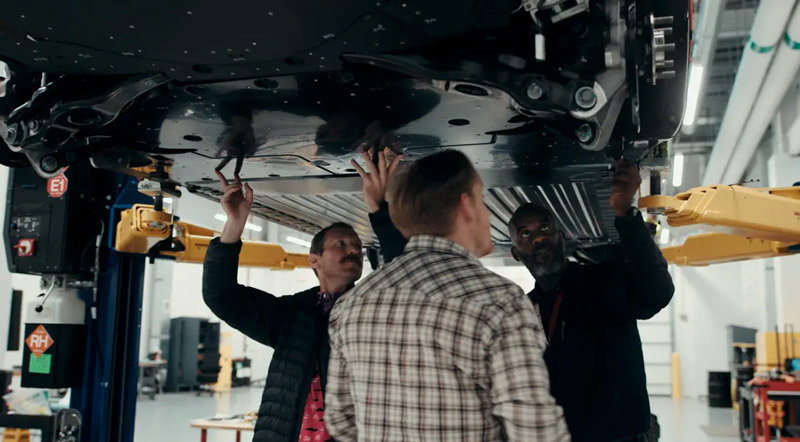
The “Skunkworks” Breakthrough: The UEV platform represents a step-change in efficiency, affordability, and digital experiences, according to Ford. It features an “ultra-efficient” powertrain and a fully zonal architecture with in-house software controls and ADAS that supports a wide range of vehicle types and battery chemistries.
Its design utilizes “unicastings” to reduce weight and complexity, enabling a new, more efficient assembly process. The UEV project also is a laboratory for modernizing Ford’s global development systems – from advanced CAD tools to physics-based cost modeling that are being applied to reduce expenses across Ford’s highest volume product lines. The program also has brought in new suppliers from outside the traditional auto industry.
Always-Improving Experiences: By 2030, 90 percent of Ford’s vehicles by volume will feature updated electrical architectures, in-house developed user experiences and hardware, and next-generation over-the-air capabilities for continuous improvement in experiences and services. This foundation enables the rapid rollout of BlueCruise and the Ford Digital Experience, providing a scalable path toward future Level 3 autonomous driving, Ford says.
Electrification: Nearly 90 percent of Ford’s global nameplates will offer electrified powertrains by 2030. This will include advanced hybrids, extended-range electric vehicles, and fully electric vehicles. The UEV platform has already yielded breakthroughs such as high-efficiency motors that will improve future hybrids and established the Lithium Iron Phosphate (LFP) battery engineering capability that now serves as the foundation for Ford’s stationary energy storage business, Ford Energy.
Ford COO Kumar Galhotra will lead the unified Product Creation and Industrialization organization. The team will be responsible for scaling Ford’s digital, design, and electric vehicle breakthroughs across its global industrial system, ensuring that innovative technologies are integrated with world-class engineering, purchasing, and manufacturing.
“The progress our teams have made in the past few years – from quality and cost to software delivery – has fundamentally reshaped the way we work and positioned Ford for a new era,” Galhotra says. “By uniting advanced technology with industrial execution, we can make decisions faster, eliminate complexity, and deliver great vehicles and digital experiences with the quality and efficiency our customers and shareholders expect.”
Doug Field, who joined Ford nearly five years ago to lead the company’s shift to electrified, connected and software-defined vehicles, has elected to leave the company after a transition over the next month. During his tenure, Field embedded high-tech capabilities into the company while building a world-class team and culture. Field also helped foster collaboration between the Electric Vehicle, Digital & Design and Industrial System teams that made this full integration possible.
Alan Clarke is promoted to vice president, Advanced Development Projects. Clarke will continue to lead the Advanced Electric Vehicle Development team. This “skunkworks” model — small teams of world class engineers given the autonomy to innovate before industrialization — has proven to be a highly effective engine for breakthrough products, and Ford will leverage it for select future programs.
Kieran Cahill, Ford vice president, manufacturing, Europe and IMG, is retiring effective May 1. During his 37-year career at the company, Cahill has been a champion for manufacturing and continuous improvement, overseeing some of Ford’s most innovative and best-performing plants.