


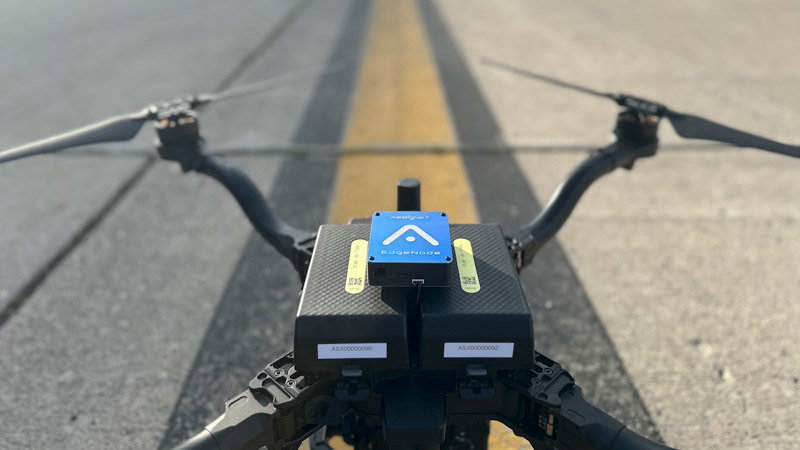
Airspace Experience Technologies at Detroit City Airport, a developer of the AeroNet Universal Traffic Management platform, will debut the AeroNet EdgeNode at XPONENTIAL 2026 (Booth 36035) that runs today through Thursday at Huntington Place in downtown Detroit.
For the first time, the AeroNet EdgeNode enables multiple autonomous vehicles to share airspace safely at sub-100 millisecond timescales.
The announcement is backed by a Michigan Economic Development Corp. One-Mobility Grant that supports AeroNet Universal Traffic Management platform infrastructure deployments at Detroit City Airport, the Detroit Smart Parking Lab, and Michigan Central Station.
Airspace Experience Technologies, or ASX, has partnered with NextEnergy, Bedrock Detroit, and Michigan Central in making Detroit a proving ground for autonomous mobility.
Most Universal Traffic Management platforms today are Low Altitude Authorization and Notification Capability (LAANC) providers — they authorize flights but do not separate aircraft in real time.
Some add strategic deconfliction, reserving airspace blocks per operator, but at the cost of shared-corridor efficiency.
Neither solves the fundamental constraint — the one-pilot-per-drone requirement. A truck driver delivers 100 packages a day with one operator; matching that with single-package drones requires either 100 trips per pilot or an impractical number of concurrent operators.
Unlocking the Universal Traffic Management platform at scale demands multiple drones, one supervisor, and shared airspace, which is only safe with autonomous tactical deconfliction that AeroNet EdgeNode enables.
The AeroNet UTM uses V2X (Vehicle-to-Everything) radios — originally developed for safety-critical automotive applications — that offers deterministic latency, direct device-to-device transmission, and operation without cellular dependency.
The AeroNet EdgeNode, debuting at XPONENTIAL, is 50 percent smaller and 75 percent lighter than its prior generation. It delivers the sub-100 millisecond reaction times required for safe autonomous separation in shared corridors.
“The UAS industry doesn’t have a regulation problem — it has an infrastructure problem,” says Jon Rimanelli, founder and CEO of Airspace Experience Technologies. “LAANC (Low Altitude Authorization and Notification Capability) tells you that you’re allowed to fly.
“AeroNet UTM tells every vehicle in that airspace exactly where everything else is, right now, and keeps them separated in real time. That’s the difference between authorization and actual safety at scale.”
Police, fire, and EMS agencies are expanding DFR (Drones as First Responder) programs nationwide, but the airspace infrastructure to support safe concurrent first responder operations in shared corridors has not kept pace.
AeroNet EdgeNode V2X is designed to directly addresses this gap — delivering the real-time vehicle awareness and sub-100 millisecond deconfliction that DFR operations require.
ASX deploys the same V2X hardware for airport safety: real-time ground vehicle monitoring that reduces runway incursion risk and enables coordinated autonomous runway inspections.
This summer, the AeroNet EdgeNode system will serve as featured technology at the Michigan National Guard’s Northern Strike exercise at the National All-Domain Warfighting Center (NADWC), validating AeroNet in a demanding multi-domain environment alongside 7,500-plus military participants from the U.S. and allied nations.
Detroit’s MEDC-backed deployments at Detroit City Airport, the Detroit Smart Parking Lab, and Michigan Central Station are building the real-world V2X infrastructure footprint that future drone corridors and DFR operations in the region will depend on.
“Airports are one of the most safety-critical environments on the planet with 1,700 recorded incursions annually,” Rimanelli says. “That’s exactly where we’re proving this platform first — because if it works here, it works anywhere. Every deployment we do in Detroit builds the infrastructure layer that autonomous flight in this region can run on.”
ASX is currently seeking between 10 and 20 partners to evaluate and test the AeroNet UTM and EdgeNode in real-world environments. Potential parters include airport operators, autonomous fleets, and UTM service providers as well as partners among public agencies, private operators, and industry partners.
At XPONENTIAL 2026, Booth 36035, ASX Will Demonstrate:
- AeroNet UTM Common Operating Picture — Real-time Situational Awareness of all traffic.
- AeroNet EdgeNode — 50 percent smaller, 75 percent lighter, 5C Module for deconfliction in real time
- Ground Station Node — the V2X mesh infrastructure backbone
Note: AeroNet EdgeNode V2X units are pre-production prototypes. FCC authorization is in process; devices are not offered for sale or lease pending authorization.
In Related News, on May 13 ASX will be part of the AUVSI Great Lakes Chapter’s XPO Underground event at Michigan Central Station from 6 p.m. to 10 p.m. Tickets are $125 and include a strolling dinner, open bars, live music, immersive activations, and a Firefly Drone Show at 9:45 p.m. For tickets, visit here.
Other sponsors include uAvioni, Airspace Link, Wing, BlueFlite, Cobra Aero, Beyond Visual, Detroit Smart Parking Lab, Urban Tech Exchange, Michigan Office of Defense and Aerospace Innovation, and the Michigan Office of Future Mobility and Electrification.
For more information about AeroNet EdgeNode, visit AeroNetUTM.com.



 that runs today through Thursday at Huntington Place in downtown Detroit.)