


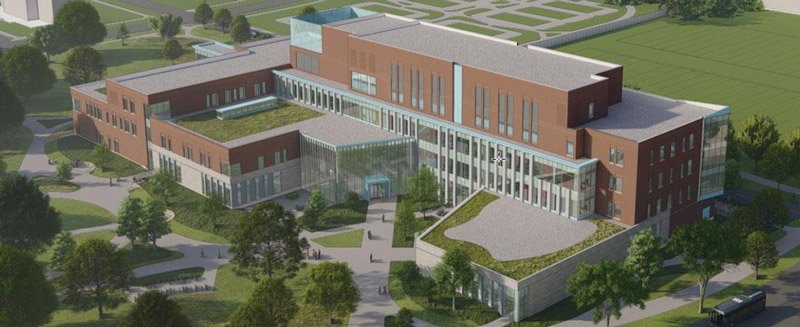
Michigan State University in East Lansing has received a $30 million grant from the National Science Foundation (NSF) to establish a new center to study turbulence and an $11 million donation from alumnus Kirk Faber that will benefit the Leinweber Center for Engineering and Digital Innovation, the Plant and Environmental Sciences Building, and Spartan Athletics.
The NSF grant will establish the Transformative Explorations in Multi-Physics and Engineering of Scientific Turbulence or TEMPEST, a new science and technology center bringing together physicists, mathematicians, engineers, and AI researchers to focus on one of science’s most difficult problems: understanding and controlling turbulence.
“This National Science Foundation grant is a tremendous vote of confidence in Michigan State University and an investment in the strength of our faculty to understand some of the most complex scientific challenges facing our world,” says Kevin M. Guskiewicz, president of MSU. “This is exactly the kind of ambitious, collaborative research that defines our role as a national research university.”
“TEMPEST represents the kind of collaborative, impact-driven research that defines Michigan State University’s research enterprise, uniting faculty, students/postdocs, and world-class partners from academia, government and industry around a problem that has challenged scientists for more than a century,” says Shashank Priya, vice president for research and innovation at MSU.
“Learning to understand and, one day, control these complex, ever-changing systems could reshape how we fly, how we power our world, how we forecast the weather, and how we protect public health.”
A better understanding of turbulence — from tiny, microscopic interactions to massive atmospheric jet streams — could help researchers around the world address myriad challenges in science and engineering.
MSU faculty and students from the colleges of Engineering and Natural Science will work with researchers from Auburn University, Baylor University, Georgia Institute of Technology, San José State University, Texas A&M University-Corpus Christi, University of Rochester, and Yale University to combine theory, computation, AI techniques and experimentation to build trustworthy predictive models of real-world turbulence for high consequence applications.
Unfunded partners include Los Alamos National Laboratory, Pacific Fusion, Sandia National Laboratories, and Lawrence Livermore National Laboratory.
Researchers in the College of Engineering will focus on applications for energy, transportation, aerospace and advanced manufacturing.
The center will make its data and software broadly available and engage the public through museum exhibitions, immersive media and educational programs that are expected to reach more than 10,000 K-12 students annually. TEMPEST also will help train an AI-fluent scientific workforce prepared to tackle complex problems across disciplines.
The center is expected to have a significant impact beyond MSU, strengthening Michigan’s economy through federal research investment, workforce development and innovation.
The TEMPEST STC will be housed in the Engineering Building until MSU’s new Leinweber Center for Engineering and Digital Innovation opens in 2028.
MSU’s $11 million gift from alumnus Kirk Faber that will benefit the Leinweber Center for Engineering and Digital Innovation, the Plant and Environmental Sciences Building, and Michigan State Athletics.
“Kirk’s generosity reflects what is so powerful about philanthropy at Michigan State — the ability to invest in people, possibility and the future all at once,” says Kim Tobin, vice president for university advancement. “His commitment reaches across the university, creating places where Spartans will learn, discover, compete and come together for generations. It is an extraordinary expression of what Michigan State has meant to Kirk and of his belief in what Spartans can accomplish together.”
Faber graduated from the MSU College of Natural Science in 1969, where he studied zoology, before continuing his education at the University of Michigan where he earned his DDS. He eventually settled in Greenville, where he began his general practice at Flat River Family Dentistry.
Faber has been generously supporting Spartan athletes and scholars since 1977. Now, in retirement, he has made the gift of $11 million, with an additional eight-figure planned donation to the College of Natural Science and to the MSU Capital Projects Endowment to continue supporting the university for years to come.
“What I gained here at Michigan State allowed me to be where I am today,” Faber says. “A lot of what you learn in athletics will apply later on in team situations, in work and in play. The same principles apply to business as they do to athletics. No matter where you are, whether you’re at the top of the game or if you’re just supporting the game, you work as a team.”
Spartan Athletic Foundation President Tim House emphasized the impact Michigan State Athletics has on the entire Spartan community and how Faber’s gift will enhance that impact across generations.
“Every time Spartan teams compete, we have an opportunity to promote the values of this amazing community to the world,” House says. “Kirk fell in love with those values while cheering on our teams as a student, and now he’s made the tremendously generous decision to provide that experience for generations of Spartans for years to come with this gift. We are extremely grateful and excited to be great stewards of his support.”
Faber’s gift will specifically be used for developing a lobby entrance and a plaza at new campus buildings — spaces that are designed to foster collaboration and teamwork.
“The Plant and Environmental Sciences Building was designed to bring together researchers from different disciplines, all focused on tackling some of today’s most pressing challenges in the plant sciences,” says Eric L. Hegg, dean of the MSU College of Natural Science. “The Kirk and Celeste Faber Lobby is the gateway to those collaborations, welcoming students, faculty, and visitors into a space built for discovery.”
Additionally, Faber’s support of the Leinweber Center for Engineering and Digital Innovation plaza will create even more space for community innovations. The Leinweber Center is a visionary development, to be completed in 2028, dedicated to digital learning, laboratories supporting experimental and computational research and vibrant community spaces.
At the heart of Faber’s passion to enhance the Spartan community is the memory of his wife, Celeste. The lobby at the Plant and Environmental Sciences Building and the plaza at the Leinweber Center will be named in her honor. Additionally, the exterior commons area at the Leinweber Center will be known as the Faber Family Commons.
“The Faber Family Commons and the Kirk and Celeste Faber Plaza exemplify the idea of bringing people together to work on common problems,” says Hegg. “Used by hundreds of students and faculty every day, these spaces will become the starting point for exciting research, learning and innovation.”



 to establish a new center to study turbulence and an $11 million donation from alumnus Kirk Faber that will benefit the Leinweber Center for Engineering and Digital Innovation, the Plant and Environmental Sciences Building, and Spartan Athletics.)