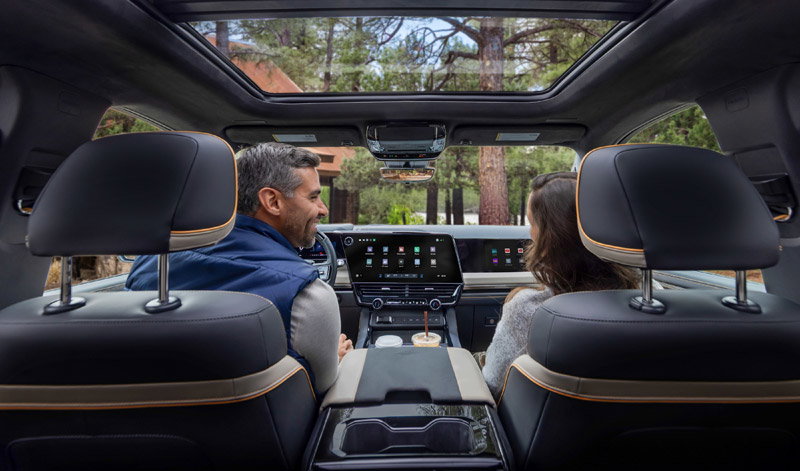
General Motors Co. in Detroit today introduced a new user interface for its 2027 Chevrolet Silverado and 2027 GMC Sierra light-duty pickup trucks.
The new interface is designed to bring “state-of-the-art graphics, intuitive layouts, and deeply integrated intelligence directly to the cabin,” according to GM. It unifies software, hardware, and design to deliver fast access, clear information, and control.
Built as a single scalable foundation across electric, gas, and diesel-powered vehicles, the interface is meant to “transform time spent behind the wheel into an effortless, personalized journey,” says the automaker.
Among the features of the new interface are:
High-contrast displays: Designed to deliver deeper blacks, richer colors, and sharper visual depth across navigation, vehicle status, and entertainment applications.
Re-imagined multi-view home screen: Features a default split-view layout with a large, fully interactive map, and information, such as trailering metrics, fuel efficiency data, or media side by side.
Mode-aware cluster layouts: The digital driver display offers different views of the driving task at hand — such as trailering, offroad, and Super Cruise — with fluid animations that stay in sync with vehicle activity.
Next-gen 3-D driving visualization: The new 3-D visualization is intended to give drivers greater confidence when available Super Cruise driver assistance technology is active by letting them see what the vehicle sees in real time — rendering surrounding traffic, lane markings, and road objects with crisp visual depth.
Streamlined hands-free activation: Driver assistance controls are streamlined, allowing drivers to engage Adaptive Cruise Control and Super Cruise with a single button press.
Personalized and quick-access controls: Drivers can organize the quick-access view around the apps and controls they use most often. Frequently used controls like climate, audio, and camera views remain where customers expect them. Key vehicle settings are one tap away through a Quick Access window, while key physical controls remain available for customers who prefer tactile feedback.
Non-Intrusive calls: To help keep driving focused, incoming calls and messages are designed to fit into the experience rather than take over the full screen. Once a call is accepted, a small call timer remains at the top of the display, allowing drivers to stay oriented in navigation or continue using key features on the home screen. Tapping the call timer opens the complete phone app as needed.
Updated Android Auto and Apple CarPlay: GM’s new UI integrates Android Auto and Apple CarPlay with its native system. Content appears in a large card window alongside native apps like trailering and vehicle status. Drivers can move between the two experiences, taking advantage of the features developed specifically for their truck and their device.
For truck owners, digital capability is said to be measured by how effectively it solves real-world challenges on the job site, at the campsite, or on the open highway. GM says its software is engineered directly around the tasks truck drivers perform every day, including:
Hands-free trailering and adaptive display: GM says it continues to be the only automaker to offer hands-free trailering with available Super Cruise driver assistance technology. The moment drivers hook up their trailers, the user interface automatically adapts. Dedicated trailering visualization in the instrument cluster, plus a trailering card on the center screen, helps drivers monitor key towing metrics while providing a clear view of how the truck and trailer move together on the road.
Hitch view and terrain cameras: A specialized Hitch View camera helps drivers line up their trailer effortlessly without needing a spotter. In tougher terrain, underbody camera views can help navigate hidden obstacles, while off-road performance information is accessible directly on the center screen.
Mobile trailer light checks: Through seamless vehicle and mobile app integration, drivers can perform complete trailer light checks — testing brake lights, turn signals, reverse lights, and running lights — directly from their phone. This eliminates the need to walk back and forth between the cabin and trailer during pre-trip safety checks.
Beyond core vehicle features, customers are expected to have access to Google Gemini, Google Maps, hundreds of apps on Google Play, and a suite of native app experiences tailored to the needs of truck owners powered by OnStar.
An expanding selection of integrated front passenger screen content gives riders their own space to stream, browse, and stay entertained with Amazon Music, AMC+, DIRECTV, Disney+, Hulu, iHeartRadio, SiriusXM, Tubi, TuneIn, ViX, YouTube, and YouTube Kids. Due to polarized screen technology, content is visible only to the passenger while the vehicle is in motion.
Through continuous over-the-air software updates, GM’s new in-vehicle experience is expected to continue to evolve over time, regularly delivering new features, refined interaction models, and performance enhancements throughout the ownership lifecycle.