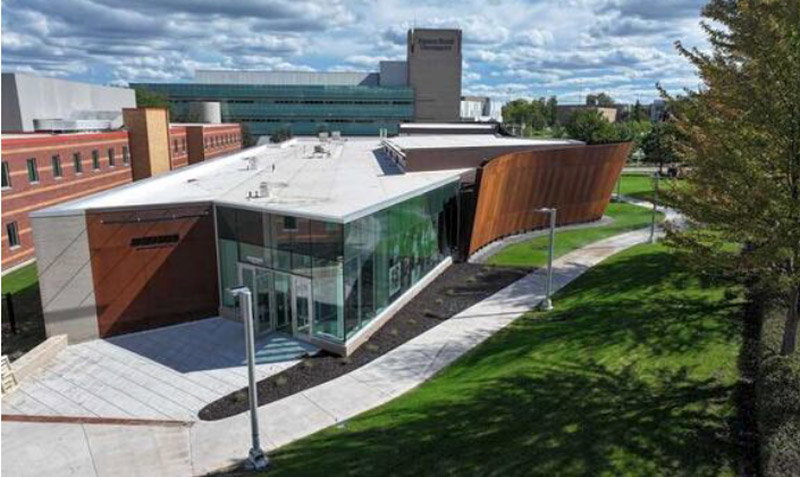
Ferris State University’s new Jim Crow Museum will house more than 30,000 artifacts, and the building itself will help tell the stories of objects of oppression and how people are working to heal and overcome.
The Jim Crow Museum — the first of its kind — is celebrating the grand opening of the standalone building near the entrance to the Big Rapids campus on Sept. 30 and Oct. 1.
The museum will be a one-of-a-kind resource that leaders say will be a space for teaching, learning, and meaningful conversations about race that inspire understanding, healing, and positive change.
The new, $22 million, 26,000 square-foot facility will help expand the museum’s ability to serve as an important resource for scholars and draw visitors from around the world.
The museum’s centerpiece is a 7,500-square-foot exhibit gallery with artifacts and information presented in context, telling the stories of people and the times and times, building on the museum’s themes: Witness, Understand, Heal.
Museum leaders worked with architects from Neumann/Smith Architecture in Detroit and Southfield, and Rockford Construction in Grand Rapids, to include elements outside and inside the building to help tell the impactful stories.
From the selected colors to the motifs of rivers, mosaics, and veils, these design elements help the museum teach more effectively about the Jim Crow period and its lasting impact.
“Our new museum will teach difficult truths, but also lifts up the stories of those who challenged hate through courage, advocacy, and lives marked by resilience and dignity,” says David Pilgrim, the museum’s founder and Ferris State’s vice president for diversity, inclusion, and strategic initiatives. “Our mission is to educate and inspire. The very building itself is a powerful tool to spark discussion and tell the story.”
The Jim Crow era was a prolonged period of state-sponsored racial segregation and disenfranchisement in the U.S., spanning from the late 19th century to the mid-1960s. Named after a derogatory minstrel show character, it enforced systemic white supremacy and treated African Americans as second-class citizens.
For 30 years, Ferris State has been the home of the Jim Crow Museum. It began in a modest 500-square-foot room in the Starr Building. Since 2012, it has been housed in a 3,500-square-foot space in the lower level of the FLITE building.
The facility includes state-of-the-art displays, interactive artifact explorer screens, a dedicated archive and research component, and increased capacity for school groups, faith communities, civic organizations, law enforcement, policymakers, and others.
In turn, the steel veil that wraps the museum speaks to the history and mission of the museum. The design is based on W. E. B. Du Bois’ conception of “the veil,” written about in “The Souls of Black Folk.”
Du Bois was a groundbreaking American sociologist, historian, writer, and civil rights leader who co-founded the NAACP.
In the museum’s lobby, the floor tile flows along as if it were a river. This was intentional. The Steel Veil almost flows as a river as well, giving it a dual meaning. Also, the sidewalk that runs along the side of the building bends like a river.
Rivers run deep in African and African American culture. They are connected with spirituality, identity, and lived experiences. Rivers also link Black Americans back to Africa. They are symbols of African heritage. The rivers are also symbols of challenges to overcome. The concept of “many rivers crossed” is evidence of the strength and resiliency of African Americans.
Inside, the color red depicts various facets of the Jim Crow era, including its presence in society, laws, violence, caricatures, and segregated spaces. The Citron yellow depicts the pushback from African Americans, whether individual or collective.
In the reflection space, the ceiling dome is inspired by art from the Harlem Renaissance era artist Aaron Douglas. The dome is pieced together as a mosaic of different shapes and colors. These mosaic representations — echoed in quilts, glass, and various other art forms — illustrate how African Americans have crafted beauty and unity in the face of adversity.
For more information, visit jimcrowmuseum.ferris.edu.