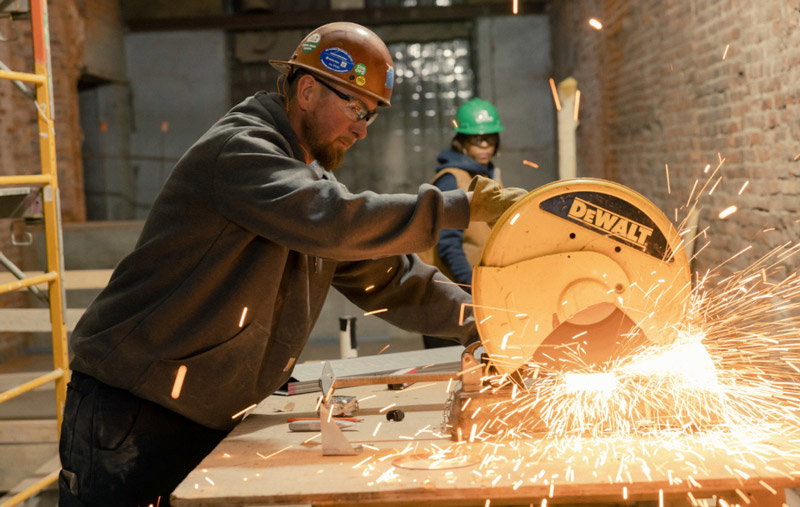
A report released by the Alliance for America’s Skilled Trades finds the U.S. will need to fill an estimated 1.7 million skilled trades openings each year through 2035, while training programs produce just 55 workers for every 100 needed.
The State of America’s Skilled Trades: A National Report examines 124 skilled trades occupations in all 50 states to identify where workers are needed and whether training is keeping pace. The report sets a new benchmark to support the next generation of the U.S. skilled workforce and help employers, educators and policymakers target training and investment.
This report is one of the first projects from the Alliance, founded in July 2026 by Ford Motor Co. and Carhartt in Dearborn, BlackRock in New York, and Google in California.
Among the findings in the report include:
- The nine states where demand for skilled trades workers outpaces supply are Arizona, Colorado, Delaware, Florida, Georgia, New Jersey, North Carolina, South Carolina, and Texas.
- 86 of 124 occupations are expected to add jobs or hold steady through 2035.
- By 2034: Arizona will need 29,000 electricians, Texas will need 86,000 auto mechanics, and North Carolina will need 19,000 carpenters.
According to the report, people are interested in the skilled trades but they may not know where to start. The first step toward becoming an electrician isn’t the same as the first step toward becoming a plumber, and it isn’t the same for an auto mechanic either.
Guidance counselors also face challenges helping students navigate these paths. One in four often recommend apprenticeship, just over half often recommend trade school, and nearly nine in 10 recommend a four-year degree — the path most students already know. A clearer first step is needed to help high school students explore careers in the skilled trades.
People are enrolling in skilled trades training programs, but only half finish. There is good news, however, the data clearly shows what works, according to the report.
High-quality apprenticeship programs have a completion rate of more than 90 percent. Getting students into the trades is only half the job. What prevents people from completing a program isn’t a lack of commitment; it’s practical barriers like transportation, childcare, and the need for a paycheck. Solving those problems will help more people start, and finish, their careers.
The Alliance also announced that it has added 14 new members: AT&T, Barton Malow, Blackstone, Cintas Corp., DEWALT, Dycom, The Hershey Co., ManpowerGroup, Meta, Microsoft, Milwaukee Tool, NVIDIA, Verizon, and Waymo.
“No single company can close the skilled trades gap alone,” says Jim Farley, president and CEO of Ford. “Training just 55 workers for every 100 needed puts economic growth at risk and leaves people without a clear path to a good career. These careers deserve respect. Employers, educators, and policymakers must work together to help people get the training, support and jobs they need to succeed.”
To help stakeholders build talent pipeline strategies in their communities, the Alliance also launched America’s Skilled Trades Dashboard, an interactive tool covering 124 skilled trades occupations in all 50 states with more than 5,000 state- and trade-specific profiles, offering new levels of insight in an easy-to-use, searchable interface.
The state- and trade-level detail in this dashboard is designed to help policymakers, workforce boards, colleges, and local leaders target solutions where they are needed, rather than relying on a single national figure.
The Alliance says it now spans an even broader cross-section of American industry — technology, telecommunications, construction, workforce solutions, and tool manufacturing — all working together to raise awareness of the trades and open more pathways to meaningful careers that strengthen families, communities, and the economy.
To explore the full report, visit skilledtradesreport.com.