
Photos shot on location in Detroit’s Gem Theater by Matthew LaVere
The 2023 class of 30 in Their Thirties is expanding businesses and opening new frontiers across multiple business sectors, including real estate, health care, food and beverage, manufacturing, retail, and commercial development. DBusiness magazine honored this year’s class at a special breakfast at the Daxton Hotel in downtown Birmingham. The keynote speaker was past 30s honoree Alexandra Clark, founder of Bon Bon Bon in Detroit.
Grant Burns // Paul Buscemi // Jesse Dhillon // Sandy Eisho // Dan Fayad
Jose Luis Flores // Dan Gallagher // Joe Giacomino // Jeff Glover
Myles Hamby // Matt Hylant // Bridget Joseph // Hass Khalife // Mario Kiezi Nick Leja // Frankie Moceri // Amber Myczkowiak // Dan Ngoyi
Shelby Oberstaedt // Clark Pattah // Steve Ryan // Jimmy Saros
Dr. Nishtha Sareen // Jake Schostak // Kevin Smith // Alain Squindo
Britton Steele // Simon Thomas // Emily Thompson // Abby Ward

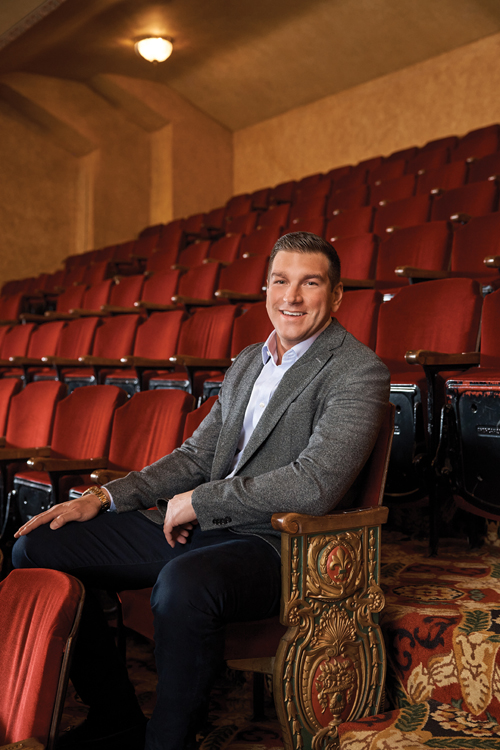
Grant Burns, 30
Co-Founder and CEO, Shield Security, Detroit
Employees: 120
Revenue: NA
College: Oakland University
Grant Burns was a rookie Detroit police officer in 2018 when he safely disarmed a mentally ill man coming at him with a knife.
His action earned him a precinct District Officer of the Year award from the police union, a rare honor for a freshman officer. Burns’ action also caught the attention of former Detroit Police Chief James Craig, who promoted him to his personal bodyguard unit.
Just months into the assignment, Burns drove Craig home after an engagement and was headed home himself when he stopped for a red traffic light. “I was the only one stopped there and I got hit from behind by a semi-tractor trailer,” he remembers. “It crushed the police car. The doors were off the car. I was knocked unconscious.”
A brain injury forced him into eight months of physical and speech therapy. The prospect of a disability retirement loomed. “I didn’t want to quit the department. All I ever wanted to do was be a cop,” he says.
In 2021, Craig announced his candidacy for governor. Sgt. Mark Oliver, in charge of Craig’s police bodyguard unit, owned a private security company in Southfield and invited Burns to join him in providing protection for Craig.
When Craig dropped out of the race, Oliver and Burns founded Shield Security in Detroit, and began serving the commercial sector.
“Mark and I, we spent every dollar we had on vehicles and radios, and we went three to four months with no pay. I remember having $300 in my bank account and my mortgage was due,” Burns says.
“We hire people full time; everyone gets 40 hours. We offer higher pay (than competitors), and we put recruits through training in a police-structured organization,” Burns says. “We have sergeants, and we have supervisors and managers above them.”
Burns says the 120-employee company has a wide range of clients, including the Woodward Dream Cruise, Detroit Lions Sunday tailgate parties, auto manufacturing facilities, and Detroit casinos.
Burns says the first client he landed was the upscale Morgan Waterfront Estates, adjacent to the Detroit River. “We still man the gate there for the neighborhood,” he says.
— Norm Sinclair
Paul Buscemi, 39
CEO, Carmela Foods, Fraser
Employees: 150
Revenue: $100M
College: Michigan State University
From the time he learned to walk, Paul Buscemi worked at his father’s party store. Founded in 1956 as a single store by his grandfather, Paul, today the Rose-ville-based business has 45 Buscemi Party Shops, most of which are in Macomb County. All are franchised and operated by a number of different owners.
“I’ve been in the food business all my life,” says Buscemi, CEO of Carmela Foods in Fraser. The latter business was founded by his mom’s brother, Anthony Tocco Jr., in 1992. At first, Tocco sold Colavita Extra Virgin Olive Oil, a business started by his uncle in New York City, to merchants across Macomb County.
“He was selling the olive oil literally out of the back of his truck,” Buscemi says. “It was one of the first cold-pressed extra virgin olive oils. Over time, he was asked by store owners to bring in more goods, and today we sell 25,000 specialty items in metro Detroit, outstate to places like the Grand Hotel on Mackinac Island, and in Cleveland, Columbus, and beyond.”
Carmela Foods operates from a 100,000-square-foot facility and, in addition to distributing items to Buscemi Party Shops, the business delivers goods to gourmet markets, grocery stores, restaurants, casinos, hotels, and country clubs. Such an array of customers came in handy when restaurants closed in March 2002 due to COVID-19.
“I’m glad we were so diversified, because when all the restaurants closed down, retail carried us through,” Buscemi says. “We were actually up in revenue in 2020. It was a good time for us to grow.”
Offering everything from organic beef to seafood, poultry and eggs from Amish farmers, artisan breads, family estate wines, pastas, sauces, and San Marzano tomatoes, Carmela Foods sources its inventory primarily from local and regional farmers, as well as companies across Europe and elsewhere, with an emphasis on Italian cuisine.
To help market the lineup and debut new products, Carmela Foods hosts two major food shows each year and invites all of its customers. In March, the company hosted its first show of the year at the MGM Grand Detroit.
“The show is one of the keys to our success. We get the customers in front of the vendors in a ballroom setting,” Buscemi says. “For Carmela Foods, we’re looking to expand more into Ohio, Indiana, and the Midwest.”
— R.J. King
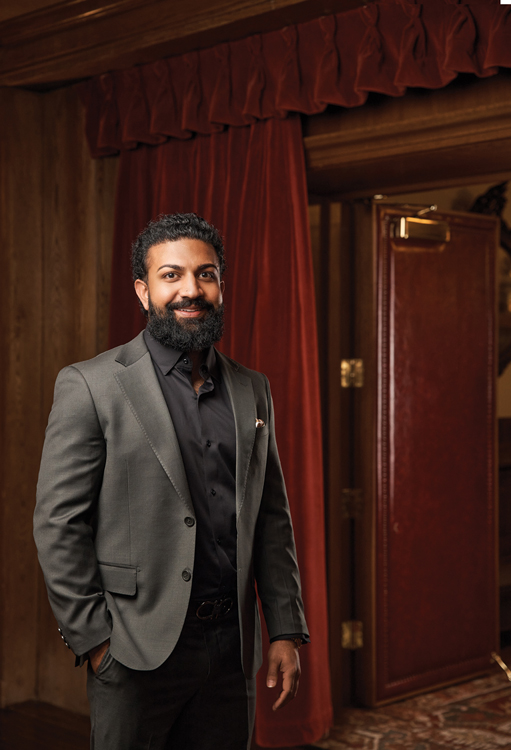
Jesse Dhillon, 31
Vice President, Lady Jane’s Haircuts for Men, Drink Roast, Woodward Sports Network, Birmingham
Employees: 1,200+
Revenue: NA
College: Michigan State University
His father’s act of neighborly kindness and his mother’s determination to raise her three sons to succeed, propelled Jesse Dhillon to the top job in a company with the most disparate entities — a national chain of hair salons, two coffee shops, and a digital sports network.
Dhillon, as vice president of Lady Jane’s Haircuts for Men, directs the day-to-day operations of more than 100 stores in 21 states. He also co-founded Birmingham Roast and Royal Oak Roast coffee shops, and supervises the fledging Woodward Sports Network, based in Lady Jane’s Birmingham headquarters. And in addition to those responsibilities, he’s a licensed real estate agent, consulting with eXp Realty.
Growing up, Dhillon’s family lived in Oakland Township, where his father, Paul, who owned two restaurants, built solid relationships with people in the community. Paul personally welcomed newcomers such as Chad Johnson — who with his wife, Jenny, and children had just moved from Boston to the neighborhood — in the early 2000s. Soon after making the move, Johnson acquired two existing Lady Jane’s stores in metro Detroit.
“My father took a full family dinner over (when the Johnsons moved in) and told Chad that if he ever needed anything, to just reach out,” Dhillon recalls.
The families grew close as Johnson revamped and standardized the store layouts and began expanding the operation around metro Detroit. He hired Dhillon’s cousin, Robby, a computer engineer, to develop the digital infrastructure system for the company.
At the time, Dhillon was a junior in high school. He went on to earn a business degree from Michigan State University and, following graduation, he joined Deloitte, a business consulting firm.
“My mom, Perminder, did everything she could to make sure my two brothers and I were given every opportunity possible (after my dad died),” Dhillon says. “We knew we didn’t want to let her down.”
In 2015, Johnson offered Dhillon a job. Knowing his reluctance to leave Deloitte, Robby encouraged his cousin to accept the offer to become finance director at Lady Jane’s. “There were 58 stores at the time,” Dhillon says. “We’ve doubled in size since my onboarding.”
Two years later, he was named vice president. From there, Dhillon developed the company’s headquarters in downtown Birmingham, which includes a coffee shop owned in partnership with Johnson, along with the sports network in which Johnson is a major investor. They opened the Royal Oak coffee shop in 2021.
Johnson now lives in south Florida. “We talk every day,” Dhillon says. “I run the day-to-day operations and manage all the departments in the company.”
— Norm Sinclair

Sandy Eisho, 31
Senior Vice President, Chief of Staff, Farbman Group, Southfield
Employees: 31
Revenue: $133.7M
College: Wayne State University
Ask Sandy Eisho if she’s “a rising superstar,” as claimed by a Connect Media commercial real estate 2021 Next Generation Award, and instead of a lot of razzmatazz she muses about her process improvement and “helping a number of individuals come together” at the Farbman Group in Southfield, a full-service commercial real estate company founded in 1976.
“Day to day, aside from client solutions, I’m overseeing administration,” says Eisho (pronounced “EE-show”). She speaks of wearing her “client-facing solutions hat” and poses a rhetorical question: “Who are you helping today?”
On the one hand, working for Farbman, which handles all facets of real estate transactions, operations, management, leasing, acquisition, and disposition “has given me a chance to grow and find my niche,” she says. On the other, her niche as senior vice president and chief of staff is more like a broad canyon with many arroyos, because “the role really does encompass a lot of different areas.”
Observing her ninth anniversary with the company in June, Eisho says it all started by accident while she was studying at Wayne State University in Detroit. She joined Farbman full time, doing financial analysis and administration, and led the company on several software implementations, including Workteam for goal-setting by staff.
Much of her attention goes toward strengthening client relationships. Being a “helpful partner” has a broad scope; a number of Michigan clients have portfolios in different states across the Midwest. “A lot of the focus is strengthening their experience with our company,” she says.
An example of a dream project, Eisho says, is found in Farbman’s creation, in late 2021, of Apex Mechanical Solutions, a business unit that focuses on providing efficient services for clients’ heating and cooling needs. “I would love to lead the transition of another new company under the Farbman Group,” she says.
Meanwhile, she’s started “giving back and helping where I can.” That means serving on the women’s committee of the Chaldean American Chamber of Commerce, the advisory board of Michigan Women Thrive, and being part of the Metro Detroit Best and Brightest. “I’ve found a lot of enjoyment and energy being a part of these boards,” Eisho says.
— Ronald Ahrens
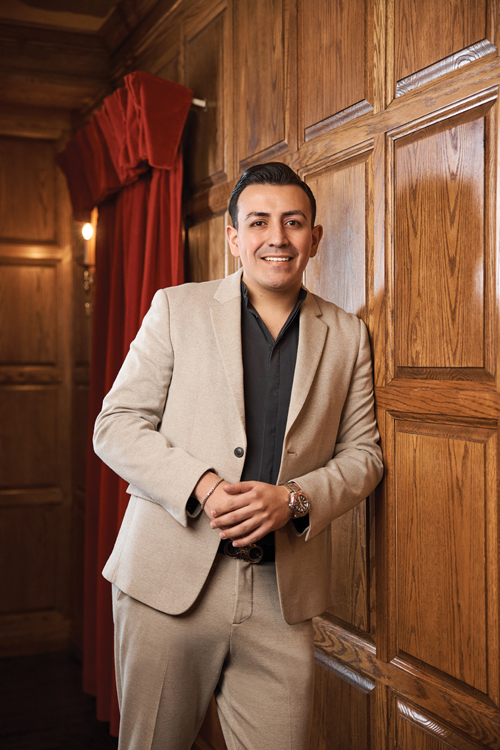
Dan Fayad, 31
General Manager Fairlane Town Center, Dearborn
Employees: 50
Revenue: NA
College: Henry Ford College
It’s all in the details.
At least, that’s Dan Fayad’s philosophy, and it’s how, in his first 16 months as general manager of Fairlane Town Center in Dearborn, he increased the mall’s occupancy to 94 percent from 71 percent.
“I oversee every single thing in the day-to-day operation,” Fayad says. “I’m very hands-on with my managers and directors. I like to be involved from the smallest to the biggest things.”
With 1.4 million square feet of retail space on 110 acres, Fayad calls Fairlane a “behemoth of a property,” which is why every detail matters. “If you’re not involved with even the smallest things, you’ll be out of touch,” Fayad says. “That’s how malls die.”
One of the most important details, he maintains, is the people.
“You’re only as good as the leadership on the ground and how in touch they are with the community,” Fayad says. “You get the best feedback from community members because they’re the day-to-day shoppers. You’ve got to get their input.”
A Dearborn native, Fayad says his genuine care for his community sets him apart as a retail manager. He began with Fairlane in 2011 when, at 19 years old, he became a security officer. Later, he rose to security director before being recruited to manage properties in Cleveland and San Francisco. Within a few years, he got the opportunity to return home, where he soon joined the Dearborn Area Chamber of Commerce and the Dearborn Education Foundation Board of Trustees.
“I’m very hands-on, not just with my work, but with the community, because (when managing) any shopping center, any mall, if you’re not a pillar in the community and involved in it, it doesn’t make any sense to do it,” he says.
One of his focus areas is local youth. He notes Dearborn is full of potential, as the eighth largest city in Michigan with the third largest school district. To provide more opportunities in neighborhoods, Fayad built a business incubator program similar to Detroit’s TechTown that serves the area’s youth and entrepreneurs with training and resources. Most recently, he welcomed 15-year-old Kassem Elkhechen’s new shoe store to Fairlane’s family of businesses.
“I started from nothing. I started as a security officer and became general manager,” Fayad says. “It’s just showing people you can do it if you put in the hard work and hours, and learn from your mistakes.”
— Calli Newberry
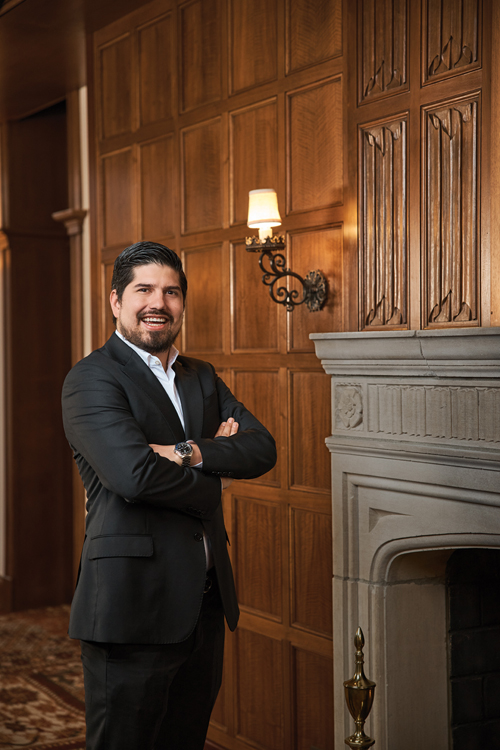
Jose Luis Flores, 34
CEO, Ancor Automotive, Troy
Employees: 50
Revenue: $12M
College: Tecnológico de Monterrey
When Jose Flores became CEO of Ancor Automotive in Troy early last year, the company had a familiar client base.
“We’re a very traditional company that’s been doing the same thing for 40 years. I saw a lot of opportunity,” Flores says. “I’ve always liked working for small- to medium-sized companies, because that’s where the change happens. You don’t have to go through a lot of layers to make things happen.”
And he was ready to make a change. After working for London Consulting Group in Nuevo Leon, Mexico, for several years, where he provided operational expertise across 10 different industries around the world, Flores was ready to settle down and become director of program management at Industrial Automation in Rochester Hills.
“That’s basically when my career skyrocketed. I went through five positions in five years,” he says.
Flores climbed the ladder at Industrial Automation until he found himself at a standstill. He had risen to the position of corporate director of operations, but the company’s leadership wasn’t near retirement. Two years later, he was contacted by a recruiter and, after months of negotiations, Flores took charge of Ancor in March 2022. As a young CEO, he says he faced a challenge leading older team members. He knew he needed to earn their respect, and he did so with results.
In the first four months, Flores helped acquire 60 new customers and develop two new products, which sparked new life into the company’s culture. Since then, he hasn’t slowed down.
“That boosted the morale of the company,” Flores says. “I’m a very energetic and dynamic leader. I’m always trying to find creative solutions to complex problems, and I do them in a fun approach so people get excited and want to tackle it.”
His latest project is a software innovation hub that’s working to expand Ancor beyond VIN-specific label solutions. Today, the team of developers is exploring ways to help manufacturers save time, money, and materials with programs such as the Monroney Editor, which allows on-site label editing and printing to reflect when equipment gets added to a vehicle.
“After 40 years of doing the same thing, we’re trying to break the status quo. I think the innovation hub is just the middle step for us to grow as a company,” Flores says. “I just want to get stuff done. I need to be working, because that’s part of the fun, and when you’re doing something you love, you don’t have to work a single day in your life.”
— Calli Newberry
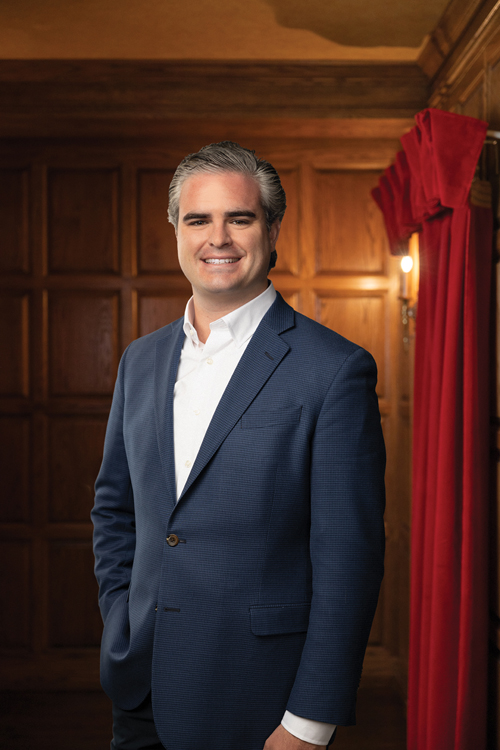
Dan Gallagher, 30
Associate Producer, Lockton Cos., Kansas City
Employees: 8,500
Revenue: $49M
College: Michigan State University
Dan Gallagher was doing well in commercial real estate and, at 29, wasn’t looking to move into a different industry. But early in 2022, he started hearing that several large insurance companies were looking to add talent who also had the ability to sell to the real estate market.
Although Gallagher was having success brokering real estate transactions at Avison Young, he was intrigued by the opportunity offered by Kansas City-based Lockton Cos. While Lockton had a strong presence in the Detroit area among industries including automotive, finance, and food, it was lagging behind in real estate and construction.
“I spent January and February 2022 interviewing back and forth between Kansas City and Detroit, and in March 2022 I came on board here,” Gallagher says.
Since then, he’s made significant inroads into the real estate and construction markets, and has helped Lockton grow its Michigan revenue to $20.8 million from its 2019 mark of $13.6 million. For that he credits his work ethic, Lockton’s support team and programs to help manage the accounts, and a strong mentorship effort.
“The Lockton model for producers is a very entrepreneurial model,” Gallagher says. “It’s your business, at the end of the day, and you run it the way you want to run it. They bring in the service teams to run that account for you, so I don’t have to be the technical expert. I have to know the fundamentals and do a good job on the producer side.”
He also calls on Lockton veterans based in both Kansas City and Detroit who can simply consult or, if needed, join him on calls and visits to clients.
Gallagher, who earned a business degree at Michigan State University, says the effectiveness of his personal efforts hinge on three things: Hard work is the first; being single with no kids is the second, because it allows him to completely immerse himself in his professional goals; and the third is being present in the community, which he does in part by volunteering with Detroit Public Schools Community District and the Capuchin Soup Kitchen, and through his involvement in institutions like the Detroit Institute of Arts Founders Junior Council and the Detroit Symphony Orchestra’s NextGen.
“For my position, about 50 percent of my time is learning what I’m talking about, and 50 percent is going out and winning new business,” he says. “But I also rebranded myself and found the right organization to make the move into a new industry.”
— Dan Calabrese
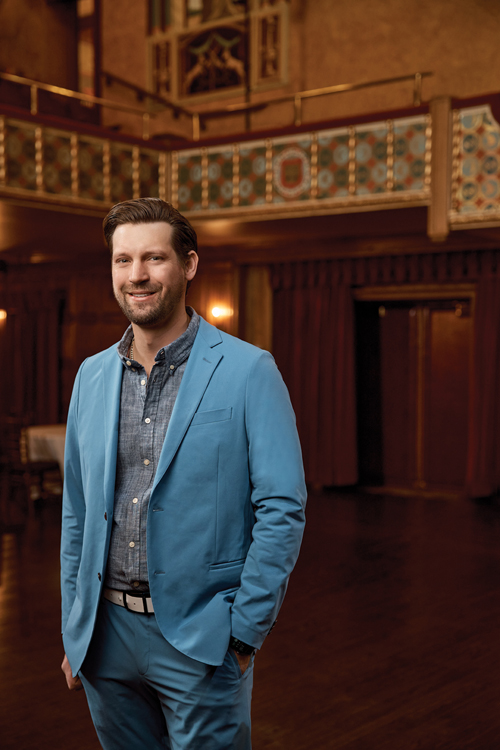
Joe Giacomino, 35
Chef and Co-founder, Four Man Ladder Hospitality, Bloomfield Hills
Employees: 100
Revenue: NA
College: Le Cordon Bleu College of Culinary Arts
Joe Giacomino has had a rather meteoric rise in the restaurant industry, from a dishwasher as a teenager in his hometown near Madison, Wis., to co-founder of the Bloomfield Hills-based Four Man Ladder Hospitality group in his mid-30s.
“When I was 16, one of the cooks at the restaurant I was working at asked me if I wanted to learn how to make an omelet,” Giacomini recalls. “I figured that was better than washing dishes, so I started doing that. When I was 18, I went to Le Cordon Bleu in Chicago.”
After graduating and doing a couple of internships, Giacomino landed a position at the now-closed Table Fifty-Two in Chicago. He also served as chef de cuisine at Quince Restaurant in Evanston, Ill., and at Jam Restaurant in Chicago. He closed out his Chicago era as executive chef of A10 Hyde Park. That establishment closed in 2018, two years after he came to metro Detroit, where his three business partners were raised.
“We’d been talking about doing our own thing for years,” he says. “Between the four of us, we’ve been part of opening 24 different restaurants for other people.
“They started talking about the resurgence in downtown Detroit and were really excited about it. I came up for a visit and I could sense there was something happening here, for sure. We found the space Grey Ghost is in and thought it was a good opportunity to get off the ground.”
After Grey Ghost came Second Best Detroit, and now Basan, which recently opened in the historic Eddystone Building near the northwest entrance to Little Caesars Arena.
With more corporate responsibilities, Giacomino’s time in the kitchen is waning. “We have great culinary teams at each location,” he says. “A lot of my day-to-day activities are in more of an advisory role.”
That advisory role is likely to expand — as he says the group’s goal is to grow, which shows that his instinct to make the move to the Motor City was the right one. “It was a little bit risky when we first made the move (to Detroit), but it’s turned out to be the best thing we could have done.”
— Tim Keenan
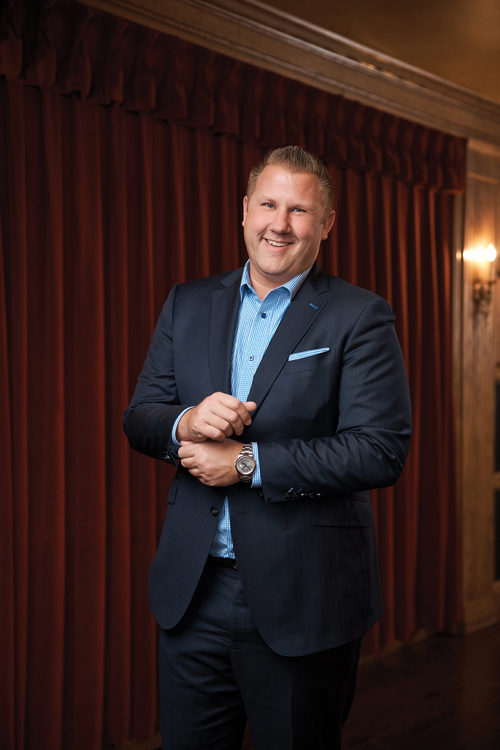
Jeff Glover, 38
Owner, Live Unreal Cos., Plymouth
Employees: 600 agents
Revenue: $38.5M
College: Attended Oakland Community College
While still a student at Novi High School, Jeff Glover sold overstuffed sofas at Art Van Furniture Inc. and says he was “pretty successful” at it. Noticing his acumen, another salesperson at the store suggested he try real estate.
“As soon as I turned 18, I went for my license,” Glover says. “I sold 32 homes my first year in the business.” He soon took on a managerial role with Coldwell Banker Schweitzer Real Estate, where he was “essentially a broker” in the company’s Livonia office. During his early 20s, he also recruited, trained, and coached agents.
“In January of 2009, I decided to open up my own shop,” he says. The move came just after the national economy took a wicked turn, but proof that he managed to thrive is seen in today’s Live Unreal Cos. (the name comes from the mission to live “unreal” experiences in order to deliver similar excitement to customers). Besides the high-volume Glover Agency, the holding company has six Keller Williams Realty Inc. franchises in Detroit and a seventh in Kalamazoo.
But there’s more: Glover’s shop is one-stop. Titleocity handles title and escrow work, Spotlight Staging & Design “deliver(s) magazine-worthy staging” of homes for sale, and Glover Group Property Management promises clients a “stress-free” experience. Glover U. is for coaching and training, and Live Unreal Media, a recent addition, provides photography and video services for in-house productions and for clients.
The marketing and media represent “an area of creativity I have that’s unique,” Glover says. A good example of how strong that knack is can be seen in the videos supporting Glover’s Heroes, a nonprofit organization that assists nurses and caregivers, teachers, first responders, and military veterans with the cleanup and renovation of properties.
With so many simultaneous enterprises, it’s natural to wonder if Glover has any spare time. “I definitely spend a good amount of time working, there’s no doubt,” he admits, but he says he also enjoys snowmobiling in northern Michigan, plays golf, and frequents the Detroit Yacht Club. It’s the same formula he wants for his employees: to love life and be proud of their company.
— Ronald Ahrens
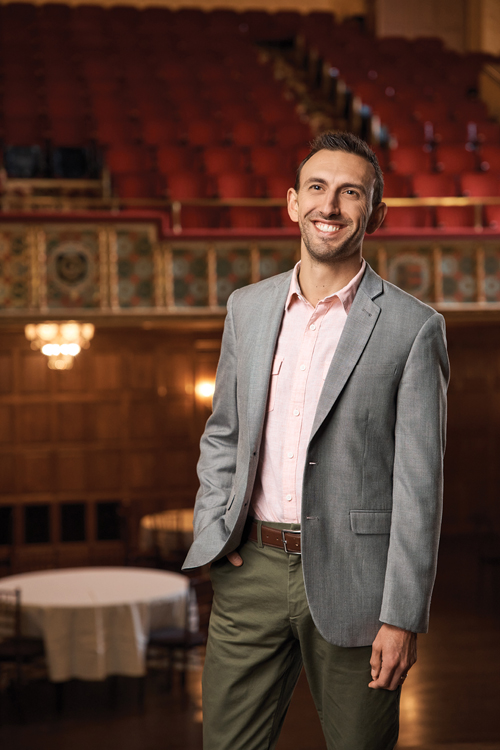
Myles Hamby, 34
Senior Development Manager, The Platform, Detroit
Employees: 11
Revenue: NA
College: University of Michigan
Before there was Silicon Valley, Milwaukee Junction in Detroit was considered the brain center of America. Streets such as Milwaukee, Baltimore, Piquette, and others, located in the greater New Center neighborhood, were the birthplace of mass production, the first moving assembly line, and the Ford Model T, among other innovations.
In a nod to that history, Myles Hamby, senior development manager for The Platform, a multifaceted real estate company in Detroit, is overseeing the conversion of a former Studebaker plant, originally built in 1920, into 161 units of workforce housing. Construction on the project, called Piquette Flats — part of a National Historic District — is set to begin this spring. The development is expected to open in summer 2024.
“There’s strong demand throughout Detroit for affordable housing,” says Hamby, who grew up in Southern California, where he earned a bachelor’s degree in global studies at the University of California, Los Angeles. “As the city seeks to grow its population, projects like Piquette Flats offer a great opportunity to enhance the quality of life.”
Before earning a master’s degree in urban planning at the University of Michigan in Ann Arbor, Hamby worked for a college Christian ministry in Kansas City, where he met his future wife. “After we got married, we moved to Detroit in 2012 when I attended U-M and she was going to Wayne State University (in Detroit),” he says. “I wanted to practice what I was learning in the classroom and apply it to the city.”
In addition to working as food access coordinator at Eastern Market, Hamby and two fellow students took on the redesign of two adjoining structures at Woodward Avenue and Baltimore Street (today Baltimore Station) as part of a final class project. From there, they pitched the project to Peter Cummings, principal of The Platform, and proceeded to offer 23 residential units (a third floor was added) and commercial offerings including a Huntington Bank branch.
“Peter went on to hire all three of us, and now we’re working on projects across Midtown and New Center,” Hamby says. “I have a passion for understanding the role land plays in providing vibrant properties and communities, and what should go on a particular piece of land. I also want to understand the social and justice implications, and how a development plays a positive role in economic development, promotes community engagement, and fits into the fabric of a neighborhood.”
— R.J. King
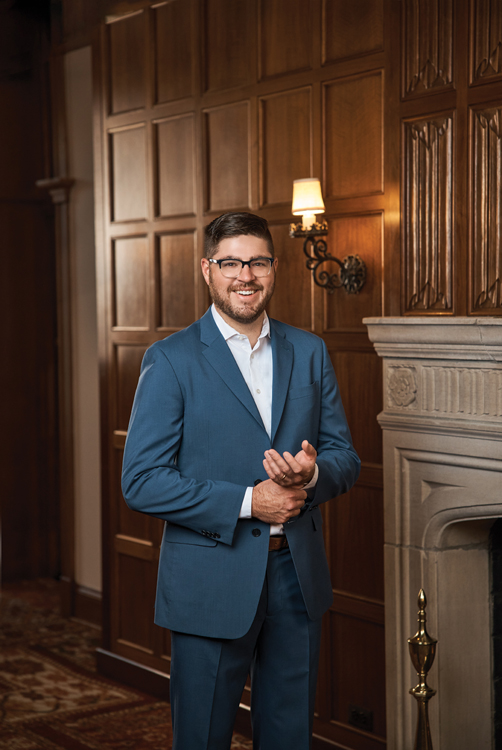
Matt Hylant, 34
Regional COO, Hylant, Ann Arbor
Employees: 265
Revenue: $70M
College: University of Michigan
At some point in the next 10 to 15 years, Matt Hylant expects to take over the family business, the Hylant insurance brokerage, from his cousin and current CEO, Bubba Berenzweig. “I think that’s definitely a goal of mine,” Hylant says. “Having the opportunity to operate the whole business at some point would be awesome.”
In the meantime, Hylant has his hands full managing Hylant’s Great Lakes Region. He’s tasked with molding six Midwest offices used to working on their own — Detroit, Grand Rapids, Elkhart and Fort Wayne, Ind., Indianapolis, and Chicago — into a cohesive unit.
“These days I’m focused on bringing consistency across that group of offices, which all operated fairly independently and differently from one another until about a year and a half ago,” Hylant says. “We’re making sure we’re working better together and making sure the teams have everything they need to support and grow the business.”
His second short-term goal is to expand the company into new markets around the country. Hylant, who grew up in Akron, Ohio, has his eye on northern Indiana, Iowa, and Wisconsin.
If Hylant makes a move into Wisconsin, it won’t be his first foray into the Badger State. After graduating from the University of Michigan, Hylant worked for Epic Software in Madison, where he managed the implementation of an electronic medical records system at eight national health care organizations and oversaw customer service.
Ultimately, he knew he would eventually join the company that his great-grandfather, Edward, started in 1935. “That was something I always planned to do,” he says.
Hylant hired in at the Grand Rapids office in 2014 as a client executive, responsible for the development and establishment of long-term customer relationships. In 2020, he became president of the Ann Arbor office, managing the day-to-day operations of the Domino’s Farms-based branch along with setting the vision for strategic growth, client retention, and team development.
In January of last year, he was appointed regional COO of the Great Lakes Region. If he does eventually become CEO of Hylant, he will be at the helm of one of the largest privately owned insurance brokerages in the nation.
— Tim Keenan

Bridget Joseph, 34
Design Manager LIFTbuild, Detroit
Employees: 4
Revenue: NA
College: University of Detroit Mercy
LIFTbuild, a subsidiary of Barton Malow, a large contractor in Southfield, is using its unique top-down construction technology on the Exchange residential tower in downtown Detroit to prove its concept. Bridget Joseph is help-ing to lead the way.
An architect by education and a designer by previous experience, Joseph was presented with an opportunity to get in on the literal ground floor with LIFTbuild, a company that constructs individual floors at the ground level and lifts them into position from top to bottom via pre-constructed elevator shafts.
“I had an interest in Barton Malow all along,” Joseph says. “They’re just a great company. When I interviewed, I interviewed with their virtual design and construction department. They thought I was a better fit for LIFTbuild and asked if I was interested. I was instantly intrigued and wanted to be part of it. I was really excited when I heard about it.”
In addition to being a design manager, Joseph is acting as a project engineer on the Exchange project, which is being erected on Gratiot Avenue near Greektown. As work is completed on the building’s interior, Joseph is responsible for managing cabinet, flooring, countertop, and custom millwork suppliers’ deliveries and work on-site.
“I wanted to be intimately involved with what was going on on-site,” says Joseph, who started her career working in Asia Pacific dealership design at Ford Motor Co. From there, she became a designer at Gittleman Construction in Farmington Hills.
Prior to joining Barton Malow in 2019 as a design specialist, then LIFTbuild in late 2022, she was a designer and project coordinator at LaSant Building Inc. in Northville, followed by a position as an architectural and design representative at Ciot Stone & Tile in Troy.
The former high school and college cheerleader and Detroit Tigers Energy Squad member says she wasn’t quite sure how her career would evolve. “Before joining LIFT-build, I felt unsettled,” she says. “When I joined LIFTbuild, it gave me a really clear future. As the company grows, the opportunities grow. The construction industry has so many facets. I never stop learning, and that’s important to me.”
— Tim Keenan

Hass Khalife, 34
Global Director, Marketing Technology Strategy and Solutions
General Motors Co., Detroit
Employees: 167,000 • Revenue: $156.7B
College: University of Michigan–Dearborn
After growing up in east Dearborn, where as a teenager he helped his father run an auto parts distribution business, Hass Khalife was part of a startup called Helium. The enterprise, which was acquired by Klick, helped clients design and develop digital products and services.
“At Helium, we loved building products, but not so much the business side, and we were fortunate to be acquired,” Khalife says. “It was a great experience because it provided a fast-paced approach to developing new products.”
Following work at two other online businesses, in 2021 Khalife joined Apple in Seattle, where he became global product lead of the company’s worldwide digital channel. There, Khalife and his team designed, built, and rolled out Apple’s content-as-a-service platform that delivered product and marketing content to the company’s global retail partners within minutes of new product introductions.
“As soon as Tim Cook (Apple CEO) announced a new product on stage, we would deliver all the product and marketing content to stores like Best Buy or Walmart almost instantly. It was a great job, and I was considering moving to Cupertino (Apple’s global headquarters in California), but my wife and I decided to move home to raise our kids and be closer to our families.”
In March 2022, Khalife joined Detroit-based General Motors Co., where he works at the automaker’s Warren Technical Center as global director, marketing technology strategy and solutions. Today, the former entrepreneur feels “like a kid working in a candy shop,” because in addition to assisting with new product launches, he and his 50-person team create custom digital content for individual customers.
“We personalize a customer’s experience with one of our apps, in emails, and on our websites,” says Khalife, who grew up in a family of engineers, many of whom worked for GM. “Based on your past history, we’ll send you content based on your age, driving habits, preferences, and other relevant information. You may even see a different home page than other people — again, based on your preferences.”
By modernizing the way GM markets to its customers in a privacy-first, personalized, and real-time manner, Khalife and his team “deliver personalized content that’s intentional, so it gives you a reason to engage with us.”
— R.J. King
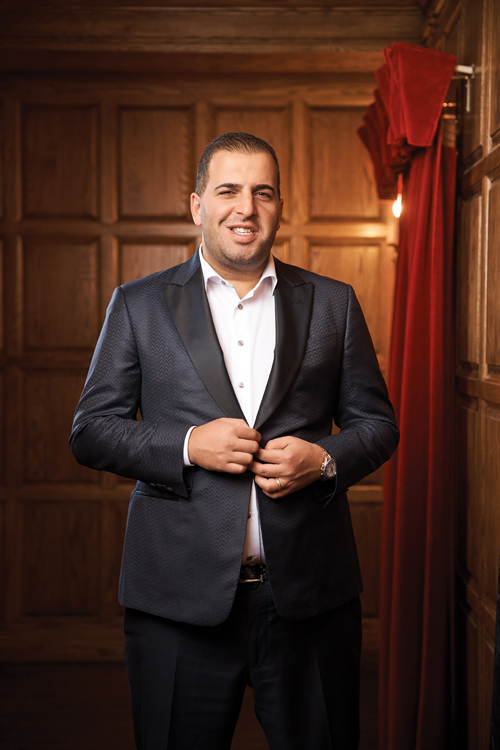
Mario Kiezi, 31
President, MKiezi Investments, Troy
Employees: 36
Revenue: NA
Mario Kiezi has many memories of the days when, as a 10-year-old, he would roam the corridors of the 1.5 million-square-foot Oakland Mall at 14 Mile and John R roads in Troy. His family owned an ice cream store in the mall in the early 2000s.
Kiezi’s acquisition of Oakland Mall last spring capped his career.
“We didn’t have babysitters, so I went to work with our family after school,” Kiezi recalls of his early days at the mall. “I would wander around Oakland Mall seeing the businesses, arcades, and fun places. I observed my family do business.”
Kiezi, founder and president of MKiezi Investments in Troy, says those experiences sparked his early interest in retail.
“People shopping for clothes in the mall is still viable, but it isn’t the future,” he asserts. “The future is sensory entertainment and family experiences. I promised myself I would wait one year before making any major decisions, so I could learn and understand the property and our guests.”
One year later, in March, he unveiled Choco Town, a chocolate-themed village wonderland — and the first of the sensory entertaining concepts he plans to introduce. It fills part of the mall’s former Sears space.
“When we opened it, I was kind of nervous. I didn’t know if people would come or not,” he says. “Then l was amazed to see families and kids running in the mall, running to the Sears entrance — such joy. I realized how easy it is in that location to bring families back to the mall, so my whole emphasis now is to bring in entertainment and sensory entertainment for families.”
Kiezi says culling ideas from his 7,000 social media followers is part of his strategy. “Some of (their suggestions) will be implemented into the mall,” he says. “Sometimes those ideas lead to further research, and we tweak them, and then we’ll implement them in the mall.”
Kiezi says he enjoys connecting with young people on social media.
“I often go live for up to two hours, and answer rapid-fire questions. I get 5,000 people who show up in a two-hour period,” he says. “You’d be surprised what a Shark Tank culture there is in the community. Today’s kids, they don’t want to be Spiderman. They want to be a businessman.”
— Norm Sinclair
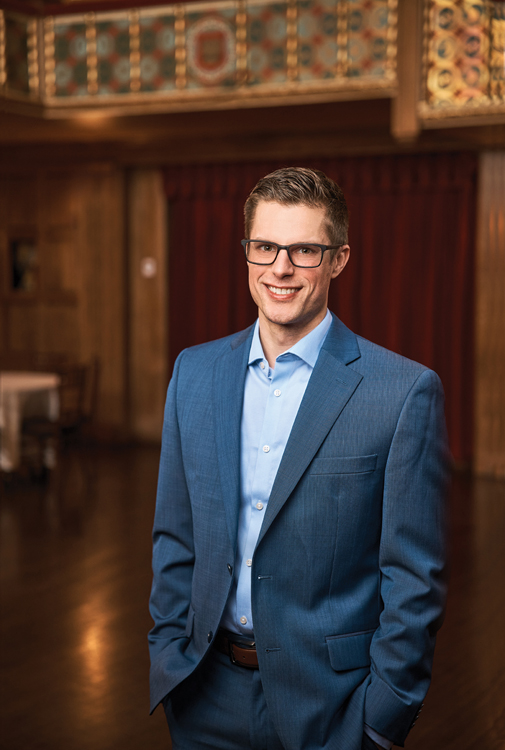
Nick Leja, 35
Franchisee: Disc Replay, Plato’s Closet, European Wax Center, Superior Fence and Rail, My Salon Suite, Novi
Employees: 800
Revenue: $50M+
College: Kettering University
Nick Leja takes business diversification seriously, and it shows in his approach to owning and operating franchise businesses. The Novi resident is a full or partial owner in Detroit-area franchises of Disc Replay, Plato’s Closet, My Salon Suite, European Wax Center, and Superior Fence and Rail.
It’s quite the array of enterprises. Whereas Disc Replay buys and sells video games, movies, and electronics, Plato’s Closet deals in resale clothing and accessories for teens and young adults. My Salon Suite and European Wax Center are more focused on personal pampering for customers, and Superior Fence and Rail, as the name suggests, is in a different realm entirely.
Despite the differences, there’s a common theme among the enterprises. “I like learning to run different companies and different styles,” Leja says. “With Superior Fence and Rail, everything we’d done before was brick-and-mortar retail, so I wanted the challenge of running more of a service-type business.”
He also gravitates to businesses some would characterize as boring. “I look for the kinds of businesses that aren’t super flashy and trendy,” Leja says. “While something like crypto, which is very trendy, might come and go, people are still going to need fences 10 years to 20 years from now.”
His various business ventures have helped Leja develop a philosophy about management that has to do with what kinds of employees deserve his attention.
“It used to be, if I had a team of people who were rowers — employees who were working to move the ship forward, who come to work and have a positive attitude — I used to kind of leave them alone,” Leja says. “Then there are the employees who … come to work and spread problems. I used to spend all my time trying to motivate them, and it’s a waste of time. It’s very hard to motivate them, and my rowers were disenchanted.”
Now he takes the opposite approach, spending more time paying attention to the positive employees. It works so well that his management philosophy has inspired two books: a short story called “The Dark Fairy,” which was published in 2022 and teaches individuals and teams how to be heard and understood, and the upcoming “Journey to Enya: A Story About Managing Teams.”
— Dan Calabrese
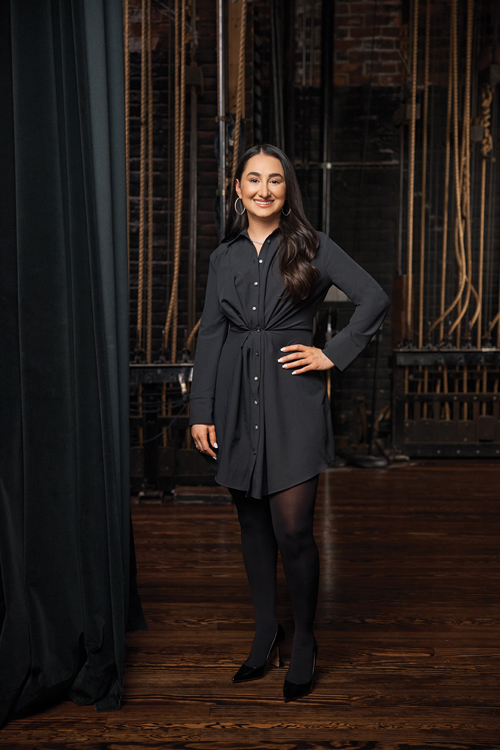
Frances “Frankie” Moceri, 30
Marketing Director, Moceri Cos., Auburn Hills
Employees: 200+
Revenue: NA
College: DePaul University
Growing up in metro Detroit, Frances “Frankie” Moceri looked up to her grandmother, also named Frances, who with her husband, Dominic, launched and built up Moceri Cos. in Auburn Hills. Since its founding, Moceri Cos. has created more than 60,000 residences made up of single-family custom manors, luxury apartments, and senior homes.
“My grandmother is a hard worker and my work ethic came from her,” says Moceri, marketing director of Moceri Cos. While her position centers on a single professional field, she also oversees media relations, branding, advertising, and website development — just as her grandmother oversaw multiple activities that ensured every home the company built was visually appealing inside and out.
After working in the family business on and off through high school, Moceri attended DePaul University in Chicago, where she earned a degree in advertising and public relations, with a minor in hospitality and real estate. “I always had in the back of my mind that I would come home and work with my family, but I wanted to get some experience working for other companies,” Moceri says.
Early on, she was a branding intern for Berkshire Hathaway in Chicago, followed by marketing and real estate positions with other established brands like Compass. She returned to metro Detroit in 2019 and, in addition to taking on numerous tasks, she earned her real estate license, followed by a broker’s license.
Now she’s embarking on a new endeavor, Moceri Real Estate, which will have its formal launch this summer. As the broker for the company, Moceri will provide real estate services to homeowners in metro Detroit. “I’m overseeing the rollout, the branding, and just about everything else,” she says. “It will be good for our current and future clients, help provide housing needs, and it fits with our brand.”
The good news is she has a veteran, seasoned team from whom to seek guidance and advice, including her grandmother, her father, Frank, and her two uncles, Dominic and Mario. She’s also joined by three other members of the family’s fourth generation, including her brother, Dominic F., and two cousins, Paul and Martha.
“It’s a fast-paced business, and that’s what I like,” Moceri says. “Our family is so close, and I remember showing off model homes when I was a teenager, (being) followed (on) social media, and dabbling in sales. I do all of that now, and more, including being involved in the design of new homes.”
— R.J. King
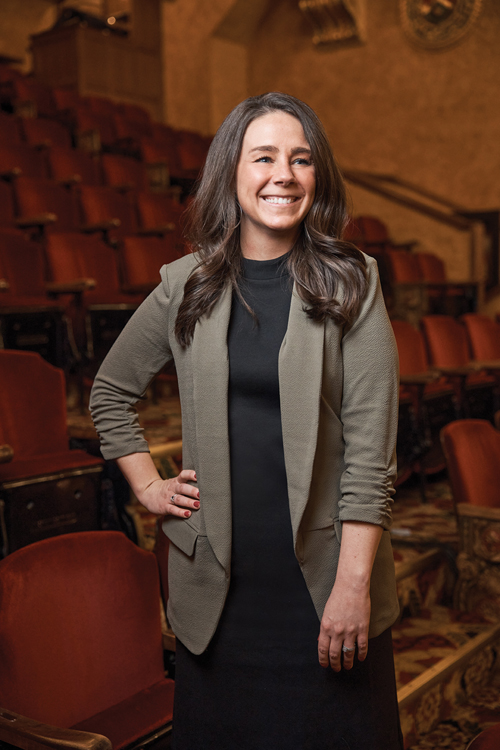
Amber Myczkowkiak, 34
Senior Director of Premium and Membership Development Detroit Pistons, Detroit
Employees: 88
Revenue: $92M
College: Trine University
Amber Myczkowkiak’s resume reads like the back of an NBA player’s trading card.
She spent eight years with the Indiana Pacers and a year and a half with the New Orleans Pelicans before joining the Detroit Pistons almost six years ago. “I’ve worked for all three ‘P’ NBA teams,” Myczkowiak says. “That’s my claim to fame.”
She started her front office career in sports as an intern in the sales and premium services department with the Pacers before moving to inside sales after she graduated from Trine University. While in Indiana, she met her husband, a field sales and marketing executive at General Motors Co. whose career path allowed her to tour around the NBA.
“I’ve been fortunate. As we’ve moved around the country with my husband’s job, I’ve been able to stay in sports and grow,” Myczkowiak says.
“When we moved to New Orleans, my management at the Pacers reached out to the Pelicans and a position was created for me with the (NFL) Saints and the Pelicans, since it’s the same ownership group,” she recalls. “A similar thing happened when we moved to Detroit. It was right at the time (when the team was) making the move from the Palace of Auburn Hills down to Little Caesars Arena, and there was a subset of suite holders that needed a service person.”
Since then, she’s become senior director of premium and membership development. In addition to directing the member and premium services platform, she also leads the premium sales department.
Myczkowiak says she appreciates her “extremely supportive” husband, who often has to take care of dinner and bedtime with the couple’s two young children while she’s at Pistons games and other events at Little Caesars Arena.
“I do feel an immense amount of pressure to make this work with a family, because women at some point leave the workforce to take care of the family,” she says.
“There aren’t a lot of women in leadership positions in the sports industry. Because of that, I do get calls about VP positions at other teams and it’s always a conversation at our house.”
— Tim Keenan

Dan Ngoyi, 33
CEO, Rock Connections, Detroit
Employees: 1,000
Revenue: NA
College: Wayne State University
Dan Ngoyi may lead hundreds of people, but when asked, he says he’s just a kid from the east side of Detroit connecting with people and solving problems.
“I just have a passion for diving toward the hard stuff and getting people to see that (ability) in themselves,” Ngoyi says. “I think every single favorite memory of my career is rooted in people and watching people grow.”
The Wayne State University graduate began his career with Detroit-based Rocket Cos. in 2013 as an associate recruiter with Quicken Loans (now Rocket Mortgage). Ten years and eight titles later, he’s now CEO of Rock Connections, which helps companies generate revenue by centralizing contact center services.
Before rising to the top, Ngoyi was vice president of talent acquisition at Rocket Central, a role he took on in 2020. “As an organization, we were growing tremendously,” he says. “We moved from being in-office to working remotely. My job was to redesign our entire (operational) system.”
To make it all work, he created a common understanding of problems and goals, and shared them with team members. As a result, the enterprise helped Rocket Cos. more than double its revenue from 2019.
“If you drive alignment, you can create an organization that moves faster and offers you the best chance for success,” Ngoyi says. “Even today, as CEO, I get to figure out how to strengthen our foundation, make us elite, and ensure that we’re communicating and creating great experiences for clients.”
That’s the basis for his favorite company mantra: Every client. Every time. No exceptions. No excuses.
“My goal is for every single time that somebody talks to somebody from Rocket, they’re blown away,” Ngoyi says. “I think that goes beyond just our external clients. When I think about how we, as leaders, treat our team members and the conversations that we have, we have that same obligation.”
He calls himself the guardian of the company’s culture, creating an environment that motivates and empowers people while still leaving room for fun.
“I’m learning that a lot of people with titles take themselves too seriously,” Ngoyi says. “One thing I’ve told my team is it’s not about who’s right; it’s about what’s right. When you have an environment where ideas are valued, you get the opportunity to create real change.”
— Calli Newberry
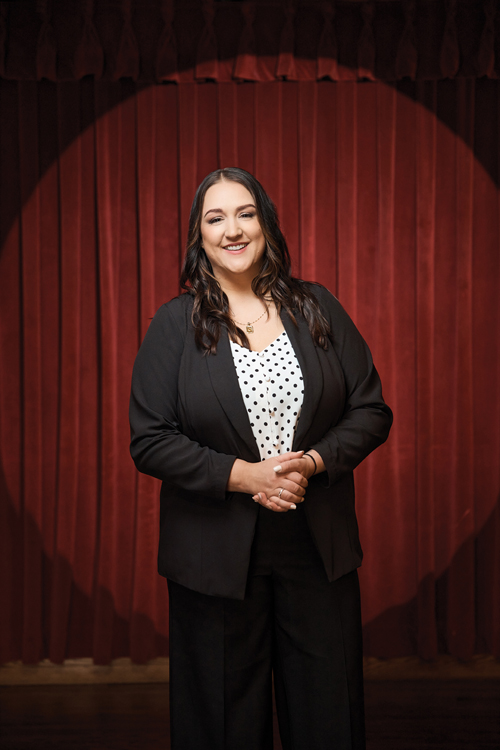
Shelby Oberstaedt, 35
Vice President of Operations, Mission Restaurant Group, Grand Rapids
Employees: 700+
Revenue: NA
College: Eastern Michigan University
Her journey took some unexpected turns, but there’s no doubt that Shelby Oberstaedt arrived exactly where she was meant to be.
Oberstaedt started out as a pre-veterinary student, eager to bring new knowledge back to her family’s horse breeding business. Two years into her studies, however, Oberstaedt’s family encouraged her to pursue a different career, as the economy began to decline and fewer people were breeding horses.
She pursued a teaching degree instead, and upon graduation from Eastern Michigan University in Ypsilanti, she took on a substitute teaching job to close out the school year.
“After three months, I realized I made a really big mistake — I didn’t actually like it,” Oberstaedt says. “What I really liked was the hospitality industry. I liked working with people, I loved the relationships I had built, and I just really enjoyed working.”
Oberstaedt had taken on a second job at Grizzly Peak Brewing Company in Ann Arbor, and that move laid the foundation for the rest of her career. One night after work, she expressed interest in a longer career in the industry to her manager. Within a few days, she was interviewing with the president of Mission Restaurant Group.
“It was field day at school, and I had mud all over when I showed up for the interview,” she recalls.
Regardless, Oberstaedt was brought on to help open and manage her first restaurant in 2012. “I ended up opening Lena Habana in downtown Ann Arbor, and started managing there,” she says. “During the opening, I found I really loved the training side.”
Over the past 10 years, before becoming Mission’s vice president of operations, she has opened and managed new restaurants, created training programs, led teams of people through the COVID-19 pandemic, and even helped host former President Barack Obama at the Jolly Pumpkin in Midtown Detroit.
Oberstaedt says the individual design and menu offerings at each of the 17 Mission restaurants makes her job both exciting and rewarding. She calls the company’s culture a “perfect blend” of positive energy for employees and customers alike.
“I never would’ve thought, when I graduated with an education degree, that this is where I would be,” she says. “Looking back, I wasn’t meant to be that fifth-grade teacher at field day. I like where I’m at, and I love what I do.”
— Calli Newberry
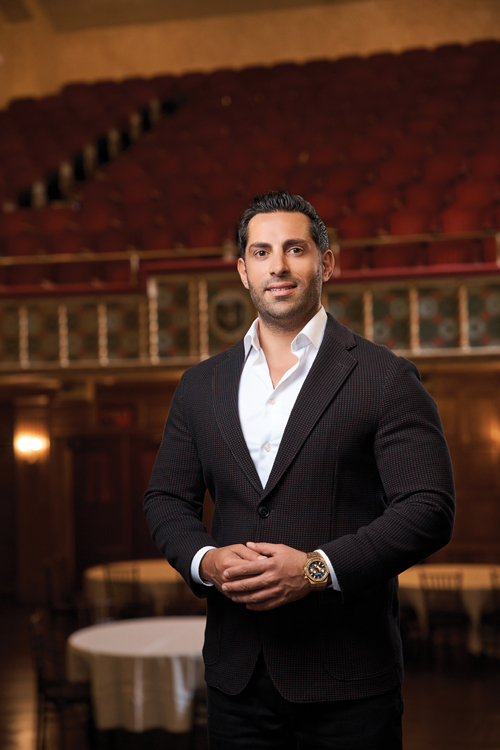
Clark Pattah, 35
Vice President, Pattah Development, Sylvan Lake
Employees: 150
Revenue: NA
College: Wayne State University
In 2010, shortly after graduating from St. Mary’s Preparatory High School in Orchard Lake Clark Pattah did what comes naturally in his family: He started his own business.
“I bought two used trucks from a guy who wanted to get out of the maintenance business and I started taking care of my family’s properties,” Pattah says. “Then I started maintaining our larger centers. My company now cleans the parking lots of all the major malls in the area.”
Pattah says his success with Eagle Eye Maintenance and his other commercial real estate ventures is based on an enduring tenet learned from his father, Sam, and three uncles: Build relationships that last throughout the years with everybody we know.
“Now we have 12 trucks; we do Walmart, Lowes, and the big national players because of those relationships,” he says. “I still have four of the drivers I started with way back when.”
His main focus, however, is commercial real estate development and investment. The family owns Pattah Development Co. in Sylvan Lake, which acquires and manages more than 2 million square feet of commercial space.
In 2006, the Pattah group acquired 16 closed Farmer Jack stores, converting some to their brand, Fresh Choice Markets, and repositioning the rest into drug stores, strip malls, and other businesses. His three older brothers operate the markets.
“I’m in the office handling the real estate with my Uncle Jerry, and he’s been around forever,” says Pattah, the father of three boys, all under 5 years old, who he helps raise with his wife, Vanessa. “Every broker knows who (my Uncle Jerry) is. He’s been a huge part of my life.”
Looking ahead, the company is developing six ground-up sites, including an entire block in Chicago for the U.S. Social Security Administration. This year they added Stadium Center shopping center in Port Huron and Glencoe Crossing Shopping Plaza in Ann Arbor to their roster of clients.
Pattah also co-founded Cosmos Salon Studios, which has nine locations where more than 300 cosmetologists — from hairstylists to Botox specialists — rent space. “We give our professionals an opportunity to own their own business instead of working for somebody else,” he says. “They have their own space with 24-hour access. It’s another brand of real estate.”
— Norm Sinclair
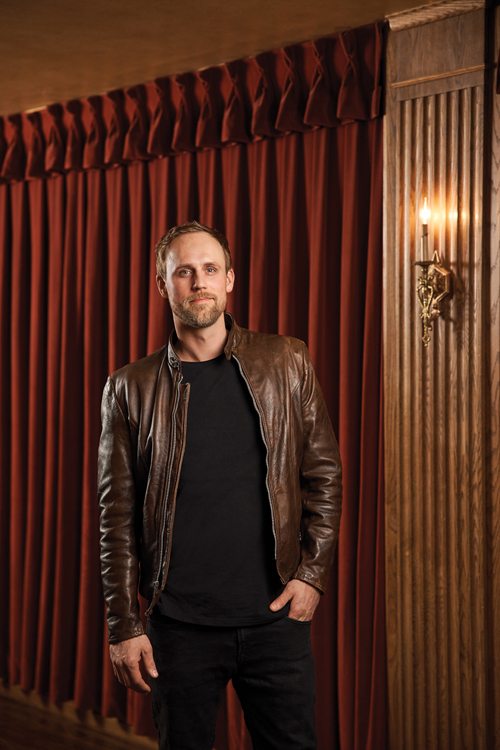
Steve Ryan, 37
Partner and Head of Operations, Detroit Steel Wheel Co., Detroit
Employees: 12
Revenue: NA
Detroit-born Steve Ryan spent most of his formative years in the Upper Peninsula, but he returned downstate as a young adult, believing the Motor City would be a better place to make a living. What he didn’t anticipate was the experience he had when working for a Tier 1 tool and die shop.
“I realized the way employees were treated was, for that company, just as an expendable part,” Ryan recalls. “They believed there was nothing the employee brought to them (other than) the fact that they made the CEOs and people like that money. I watched key people get let go for no reason. I was working 100 hours a week, and this wasn’t something I wanted to invest in.”
He decided to start his own company, and he knew he would only take on a partner who was in alignment with his vision. Enter Adam Genei, who teamed up with Ryan to launch Mobwheels. Initially, the partners focused on aftermarket treatments for custom cars, particularly black Lincolns, but eventually they wanted to create real wealth by introducing their own product. In 2013, they developed Detroit Steel Wheel, a large-diameter steel wheel that’s custom-built for each car.
While many people advised Ryan and Genei to utilize overseas manufacturing facilities for the product, they were determined to build Detroit Steel Wheels in Detroit — and find a way to make it affordable. “We continually invest in our infrastructure,” Ryan says. “We’ll go back monthly and ask, How can we do this better and cheaper without cutting out quality or sacrificing corners?”
It looks like a brilliant move today, considering the snarled supply chains between the U.S. and places like China. But it took a lot of commitment to make it work.
“When we started, there was one machine in the country that could even handle the product we make,” Ryan says. “Everything else was shipped overseas, and it was a real challenge to shore up domestic supply.”
The partners were committed to their vision, and today the company is hitting its 10-year mark in a strong position. For Ryan, who never went to college, the journey has inspired him to encourage students to pursue education in skilled trades. “Not everyone learns through a textbook,” he says. “It doesn’t mean you’re dumb. It just means you learn from a hands-on experience.”
— Dan Calabrese
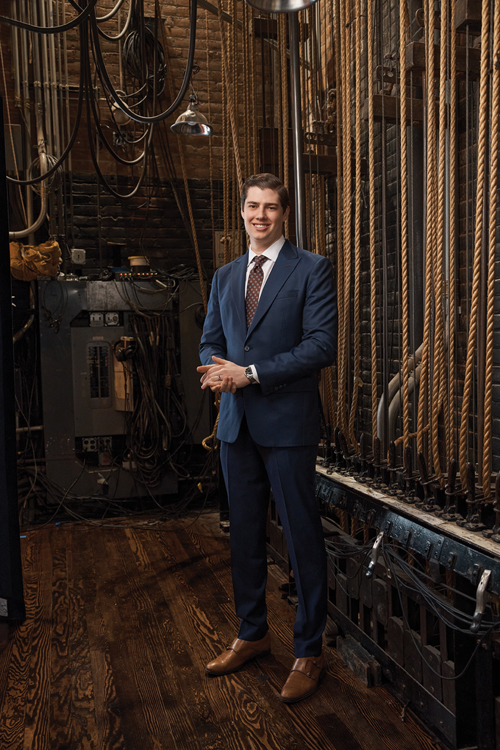
Jimmy Saros, 33
President and CEO, Real Estate, Grosse Pointe
Employees: 24
Revenue: NA
College: Brown University
Astar wide receiver in high school and college, Jimmy Saros didn’t dedicate his entire summers to preparing for the next season. Rather, he replaced roofs for his family’s business, Saros Real Estate in Grosse Pointe, and earned a real estate license when he was 18 years old.
“Growing up, my primary focus was athletics, but my dad worked seven days a week and I was very much around the business,” Saros says. “In 2012, right out of college (at Brown University), I joined Marcus & Millichap in New York City and became an investment real estate broker. It was like earning a business degree in and of itself.”
In 2017, he and his wife decided to return home, and Saros joined the family company full time. Two years later, he was running the majority of the operations, which includes residential and commercial real estate sales, leasing, and research and advisory services. At the same time, he launched D Land Group Property Management in Grosse Pointe, which today maintains more than 500 homes.
“When I took over all of the operations (in 2021), we brought on some new people, and I’ve been fortunate to surround myself with a very good team,” says Saros, who, over the last decade, has personally closed more than $400 million in transactions. “Coming from Marcus & Millichap, and seeing how they operated and what the structure was, I brought some of that back with me.”
Since he joined the company six years ago, Saros Real Estate has increased annual sales by an average of more than 40 percent. Along the way, he became the youngest member appointed to the Wayne County Building Authority, and he’s also the youngest commissioner on the City of Grosse Pointe Park’s Planning Commission.
“I love the competitive spirit of real estate, and I love supporting our team,” he says. “We have the right people in the right seats, we’ve hired some younger agents, and we have two support team members who each have been with us for more than 20 years. I also brought on a director of operations, who was my first hire. She’s been instrumental to our growth, and she allows me to focus on revenue- focused activities.”
— R.J. King

Dr. Nishtha Sareen, 39
Interventional Cardiologist and Medical Director, Women’s Heart Program
Ascension Michigan, Warren
Employees: 139,000
Revenue: $28B (FY)
College: University of Nevada-Reno
A recent Thursday for Dr. Nishtha Sareen started with a 4 a.m. call on the urgent case of a 50-something female heart-attack patient at Ascension St. Mary’s Hospital in Saginaw. As Sareen must remain within a 30 minutes’ drive from the hospital when on-call, she dashed in from her pied-à-terre less than 20 miles away in Frankenmuth.
“I did a heart catheterization on her, and what we found was that she didn’t have the blockage that you open up with stents,” she says. “What she had is something called microvascular dysfunction. It’s very interesting, because that’s the kind of heart disease that affects women disproportionately compared to men, particularly women of color.”
Testing for microvascular dysfunction is generally inadequate, so the chest pains may be misdiagnosed as anxiety or gastric distress, while patients bear increased risk of fatal heart attack or strokes. “We have failed as a medical community to recognize and treat it,” Sareen notes.
The practitioner has risen early since she was 3 years old and lived in Udaipur, India. Before school, her mother, Madhu Sareen, trained young “Nish” and her sis-
ters in two classical dances: Kathak and Bharatanatyam. “She instilled that disci-
pline in us early,” Sareen recalls.
Devendra Sareen, a pediatrician, got his daughter started in medicine. “He would bring me to his clinic and have me listen to these little children who had valve disease from rheumatic fever,” she explains.
After primary studies at the Rabindranath Tagore Medical College in India, she brought her dreams and passion to the United States. Today, as director of the women’s heart program at Ascension Michigan, where she splits time between the St. Mary’s cath lab and an office at Providence Park Novi, she’s opening new clinics this year in St. Johns, Saginaw, Kalamazoo, and — “I’m still working on it” — Macomb County, another underserved area.
“I hope, by 2025, we will be able to spread it nationally. Then we’re partnering with international organizations. Rotary is one of them. So that’s my dream project, by 2028, to have a global impact.”
The accomplishment will be as much the result of her parents’ and mentors’ actions, she says, as her own.
— Ronald Ahrens

Jake Schostak, 35
Founder, Catapult Concepts, Farmington Hills
Employees: 5
Revenue: NA
College: Indiana University
Jake Schostak could have simply joined the family business, Team Schostak Family Restaurants in Livonia, and had a fulfilling career. But he’s an entrepreneur at heart, so he decided to start something completely new — Catapult Concepts.
Launched last year with funding from Detroit Venture Partners and others, the virtual company markets its own brands — Cheese Steak Daddy and Pop’s Meatball Sandwich — which any commercial kitchen can prepare from so-called station-ready kits provided by Catapult.
Restaurants, hotels, bars, entertainment centers, and commercial kitchens looking to increase productivity and capture more sales can participate. More than 20 commercial kitchens currently are part of Catapult Concepts.
Customers place online orders from companies like Door Dash or Catapult’s own website. From there, the orders are routed to a partner kitchen where a courier picks up the finished product and takes it to the customer’s home. Catapult gets a percentage of each order.
“I found that there was an opportunity, now that there are delivery company drivers all over, for anybody to participate in these sales,” Schostak says. “We’re creating very profitable sales for these kitchens.”
Schostak has spent his entire life in the restaurant business, first growing up surrounded by his family’s interests, then working for restaurant companies in Chicago and Washington, D.C., after graduating from Indiana University. While in Chicago, he worked for Lettuce Entertain You, and in the nation’s capital he gained experience with Sweetgreen and Chipotle’s southeast Asian concept, Shophouse Kitchen.
He came back to work in the family business, and in four years had opened 15 Mod Pizza locations around Michigan, with more to come.
Relying on his experiences, Schostak saw the benefit of establishing a central company kitchen where the commissary staff cooks ingredients to exact specifications and makes menu items at scale before sending them out to partner kitchens via the station-ready kits.
“Our (participating) kitchens don’t even have to do extensive prep work,” Schostak explains. “They don’t have to add any labor to the schedule. These are truly incremental sales.”
Although Catapult Concepts started in metro Detroit, Schostak has a lofty goal for expanding his gastronomical startup beyond Michigan; the company opened an outlet in Toledo in March. “We want to be able to say that we have 1,000 kitchens that we’re working with and providing new sales for those businesses by 2030.”
— Tim Keenan
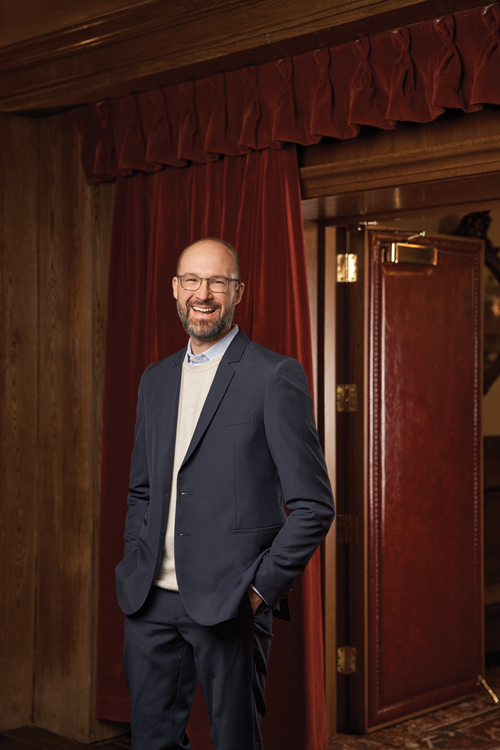
Kevin Smith, 38
Partner, Boston Consulting Group, Detroit Office
Employees: 10,254
Revenue: NA
College: University of Chicago
When Boston Consulting Group (BCG) partner Kevin Smith advises automotive OEMs and suppliers on strategy and operations, it comes from a man who’s dealt with his share of surprises in the business world.
Completing a bachelor’s degree in finance at Michigan State University and then landing his first job with Lehmann Brothers on Wall Street was a pretty strong start to a career in finance. At least it was in 2007.
When Lehmann Brothers declared bankruptcy 15 months later, Smith was out of a job. He quickly pivoted and helped establish a new private equity firm from the ashes of Lehmann.
“Things were going really well, the trajectory and the future were bright,” Smith recalls.
“But I started to ask myself a lot of questions. Was this really what I wanted to do for the rest of my life? Were there other challenges I wanted to experience?”
Soon after, Smith returned home to Detroit to help drive a unique entrepreneurial startup. Its mission was to produce and sell bicycles with automatic transmissions. The product was well-received, but distribution proved to be a problem.
“I spent a couple years building this business, doing the typical entrepreneurial hustle, and ultimately reached a point where we concluded it wasn’t happening as quickly as we had hoped,” Smith says.
Facing reality, Smith decided to enroll at the University of Chicago Booth School of Business, where he earned an MBA and gained considerable knowledge about the automotive industry and the world of consulting. It led him to BCG.
Another pivot came soon after. In 2018, Smith was providing consulting services to decision-makers within the auto industry when BCG loaned him to the Detroit Economic Growth Corp. to help lead the pursuit of a second national headquarters for Amazon (which landed in Washington, D.C.) and work on other economic development initiatives.
“My role at BCG allows me to engage with OEMs and Tier 1 auto suppliers all across the supply chain to solve the biggest problems they’re facing, and help them think about strategy for the next five to 10 years,” Smith says. “I’m also very involved with economic development all across the region, and my role at BCG enables me to do both.”
— Dan Calabrese
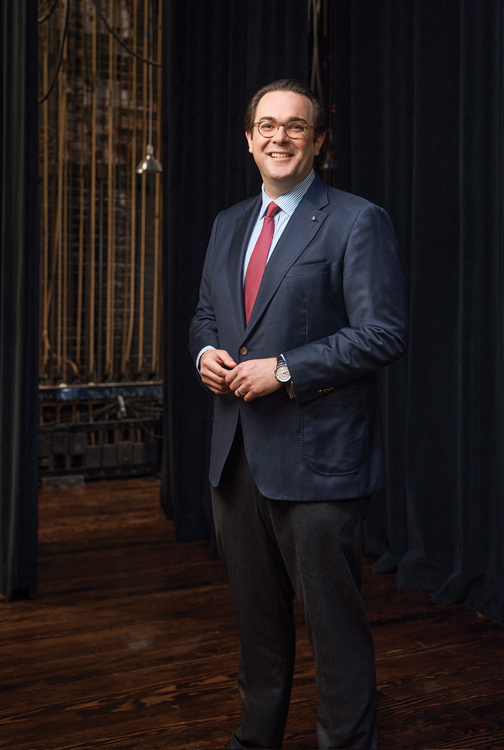
Alain Squindo, 37
COO, Broad Arrow Group; Vice President of Operations, Hagerty Marketplace,
Grosse Pointe
Employees: 70+
Revenue: NA
College: Georgetown University
In early March this year, when Alain Squindo returned to Grosse Pointe from The Amelia, a Concours d’Elegance classic car show near Jacksonville, Fla., he says he felt affirmed in the conviction that had led to launching Broad Arrow Group with partners in 2021. Broad Arrow had just presented The Amelia’s official collector-car auction as a fine-art experience.
“We did $31 million in sales, which we’re very pleased with, set a number of new world records, and are really, really happy with how things turned out,” Squindo says. Hot auction tip: Squindo suggests considering cars desired by “young-timers,” such as the 1991 Mercedes-derived AMG 6.0 “Hammer” coupe, which sold at The Amelia for $885,000, including fees.
On top of that, Broad Arrow announced its next auction will be June 10 at the Porsche Experience Center in Atlanta, as the official auction for Porsche’s 75th anniversary. “So that’ll be a lot of fun, as well,” he says. “We’re off to a pretty strong start.”
Formed by a group of RM Sotheby’s alumni, Broad Arrow was acquired in 2022 by Hagerty, the specialty insurance provider and automotive lifestyle brand from Traverse City. After an early stake of 40 percent, Hagerty took the remaining 60 percent of Broad Arrow last August in a $64.8-million stock transaction.
“We had a vision for wanting to be the premier marketplace for car enthusiasts,” Squindo says. He explains that Broad Arrow focuses on private sales, financing, and auctioneering high-end classic cars. “It forms part of Hagerty’s Marketplace, which also offers live auctions,” he adds.
Squindo is a Swiss-American whose family moved to Miami when he was 10 years old. His father and grandfather were car enthusiasts. “This industry really and truly is all I ever wanted to do,” he says. At Georgetown University in Washington, D.C., he combined his love of history with inspiration from David E. Davis Jr., the automotive editor, and wrote auction catalog entries.
He met his wife, Sunny, a Grosse Pointer, at Georgetown, and it was he who instigated the move back to Michigan. “Being in the classic car space and surrounded by automotive history, and the remnants, there’s no more perfect place for me to be, personally and professionally.”
— Ronald Ahrens
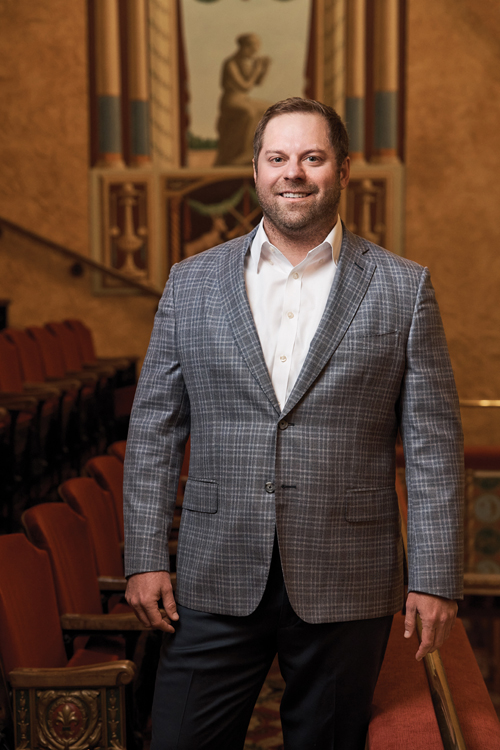
Britton Steele, 36
Founder and CEO, Provision Insurance Group,
Bingham Farms
Employees: 50
Revenue: $45M
College: Wayne State University
The modern game of tennis developed from handball matches popularized in England and France in the 12th century, and today millions of recreational players take to the sport for exercise and comradery.
“So many of my ties, and influential people who have made a difference in my life, are through the tennis community,” says Britton Steele, who played the sport at Michigan State University in East Lansing and Wayne State University in Detroit. “They’re good people — tennis people.”
After his days at MSU, Steele, whose aunt worked in human resources for Liberty Mutual Insurance, landed an internship at the company’s sales department in Chicago. When he returned to Detroit to pursue an MBA at Wayne State (and play more tennis), he stayed with Liberty. After completing business school at age 26, he started his own company.
“I just kind of wanted to do my own thing and felt there was opportunity in the marketplace,” Steele says. “I built the business deal by deal, guy by guy, salesman by salesman, to what we have today. It (insurance) is a great business. Very few young people are in the business. I really capitalized on that.”
Founding the Provision Insurance Group, his approach was to build a youth culture. “If you can make insurance fun, and put in a good environment, and allow people to create careers, young people will come to the business and succeed. There’s nothing sexy about it, but it’s a recession-proof, time-tested business. Each family has a large annual spend on it every year; everybody has to buy the product.”
Once Provision was well set up in the Detroit market, the next place it “needed to go” was Grand Rapids, where a branch opened three years ago. The market there was expanding, and things have been going “really well.”
Now Steele’s eyes roam over Michigan: “We’re looking at other deals to open additional offices,” he says.
In the shorter term, though, he looked southeastward. The former Liberty Mutual employee — and now a client — found himself at “a little dinner,” and the hosts said, “We’re taking you guys to The Masters in a few months.” Having had the tuneful TV jingle drummed into their heads, like everybody else, Steele says, “We were like, ‘Liberty! Liberty! Liberty!’”
— Ronald Ahrens

Simon Thomas, 39
CEO, DOBI Real Estate, Birmingham
Employees: 130
Revenue: $13M
College: Oakland University
Two decades ago, Simon Thomas went into Detroit to sell foreclosed homes for multiple banks. From there, he found his professional calling.
“I wanted to start making money immediately, so I got into real estate for the money and once I got into it I realized, man, this is a great profession, and I started taking it seriously,” Thomas says. “I stayed in it, and grew it to where we are today.”
By his third year selling homes and properties for various real estate companies, he hit $20 million in annual home sales. In 2018, he founded his own company, DOBI Real Estate in Birmingham’s Rail District, to put his own spin on a real estate brokerage.
“Our success is looking at agents as clients, not as a buyer or a seller,” Thomas says. “Our space, our training, our culture, and our staff is all geared around them. Our decision-making is supporting the real estate agent to be the most successful they can be. They have our unbelievable marketing team, where turnaround time is really fast — 24 to 48 hours. That’s why, in the last four to five years, we’ve grown to 110 agents.”
Instead of a traditional office building, DOBI operates in a compact, 4,000-square-foot space featuring the “pit,” where 20 or more agents can drop in and plug in laptops, a café where a second-year agent can network with a 20-year agent, a few traditional offices that are used as needed, and an outdoor patio.
“It’s a hospitality feeling versus just coming into an office. We’re making sure (agents) are always taken care of in a collaborative atmosphere that’s addictive,” says Thomas, whose family is in the hospitality business. “We actually have menus and food. We celebrate closings rather than just having the client come in, sit down, and sign papers,” he says.
Thomas is bullish on the local real estate market. He says high interest rates aren’t discouraging buyers whose mindset is to refinance when rates go down. “Houses are still selling very fast, but there aren’t that many for sale,” he says.
As the business grows, Thomas is actively seeking new sites for expansion. “The goal is to get five offices in five cities in the next five years with 1,000 agents,” he says.
— Norm Sinclair

Emily Thompson, 36
Director of Economic and Community Development, Wayne State University, Detroit
Employees: 7,700
Revenue: $941M
College: University of Michigan
While most people recognize that a public university is a source of high-level education, Emily Thompson sees more. She sees an “anchor institution” — the sort of entity everyone can be confident will be around in 20, 30, or 50 years. She also sees a major employer, a generator of community benefits, and a source of knowledge.
That makes Wayne State University in Detroit an ideal organization to impact the growth of the local economy, which is why Thompson finds it so natural to embrace her role as WSU’s director of economic and community development.
“We’re not a business that might, in 10 years, get up and move,” Thompson says. “We’re far too ingrained in our footprint and physical location.”
Thompson joined Wayne State in 2015, after taking on multiple roles in the office of then-U.S. Rep. John Dingell. At the same time, she earned a master’s degree in urban planning from the University of Michigan. From there, she worked for the Michigan Suburbs Alliance, where she learned how to work with multiple communities, and how to approach civic engagement and economic development differently.
“It was that nonprofit work that I would credit for my entrepreneurial spirit, which attracted me to Wayne,” Thompson says. “I was focused on the questions: How do you do what you want to do? And how do you fund what you want to do?”
One of her leading initiatives at Wayne State has been Transit Pass, a partnership with the university’s Parking and Transportation Division to provide free DART and MoGo passes to enrolled students and employees.
Thompson also led the 2022 development of the school’s Economic Impact Strategy, which contains specific goals and metrics for Wayne State to pursue with respect to economic impact on the region.
“In creating it, I often got the question, What does my work have to do with economic impact?” Thompson says. “Personally, I would love to get to the point where everybody at Wayne understands how their role connects to the impact of the university, they’re able to communicate it, and they’re excited about it.”
— Dan Calabrese
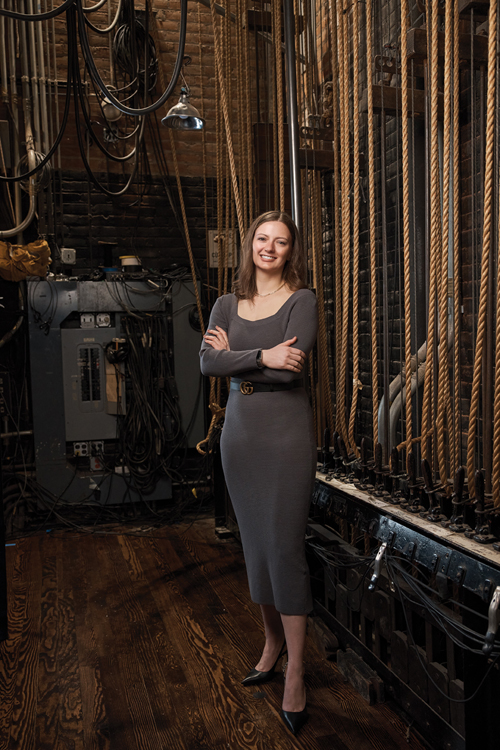
Abby Ward, 32
Divisional Director of Planning and Analytics, Flagstar Bank, Troy (Regional)
Employees: 4,764 (does not include NYCB)
Revenue: $2.9B (pro forma)
College: University of Michigan
Abby Ward began her career recording history, but now she’s helping make it at Flagstar Bank, which has its regional headquarters in Troy.
“I came to Flagstar after I started in accounting,” Ward says. “I wanted to become more involved in the forward-thinking aspect of business as opposed to accounting, where you’re often looking back on what happened in history and trying to record those events.”
Ward is the divisional director of planning and analytics at Flagstar Bank, a position she’s held for more than four years. Her analysis helped Flagstar through its recent merger with New York Community Bank; the new entity is the 24th largest bank in the country.
“Flagstar previously had 150 branches, but now that we’ve combined with NYCB, I support 400 branches,” she says.
Beyond the business of banking, Ward serves as a mentor for Flagstar’s intern program, and she’s a member of the bank’s Women’s Employee Resource Group Executive Committee. Right now, the committee is helping to implement the integration of NYCB’s branches.
“I think it’s important to make sure people feel heard and understood. These groups give people that opportunity,” Ward says. “Sometimes you may not feel comfortable going to your boss with something, but if you’re a part of the Employee Resource Group, you can find a group of people who can relate to the struggles or adversity you’re facing.”
Ward says she’s grateful for the support she’s received from Flagstar. Six weeks after having her second child, she returned to work during the COVID-19 pandemic to help with the Paycheck Protection Program. “I think that’s when I became really proud to work at Flagstar, after seeing how they showed up for the community and supported me having a young child,” she says.
She volunteered to distribute money to applicants, one of which happened to be an organization she had volunteered with in high school. “I wrote a note to the pastor about how wonderful it felt to be able to get them that money, and play a role in making sure they could continue through the pandemic,” says Ward, who also volunteers at the Grosse Pointe Public Library.
By donating her time to help the community, Ward says she’s serving as a role model for her children. “I’m proud to say they see their mom is really active in their community.”
— Calli Newberry