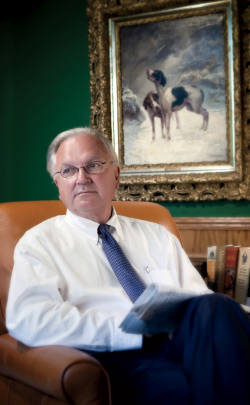
In the fall of 2006, Michael J. Biber, managing partner of a diversified Brighton real-estate company, assembled his banking team at Ireland’s Dromoland Castle following the Ryder Cup golf matches. Feeling uneasy about the booming economy in the United States, Biber and his management contingent wanted to review all aspects of the company’s portfolio in an intense, two-day summit.
The result: Despite the global economic meltdown in the fall of 2008, Biber’s commercial real-estate and recreational businesses across Michigan and around the country — Osprey Management Co. — are not only flourishing, but Biber and his team are aggressively cashing in on bargains in the troubled marketplace.
In fact, while many other real-estate companies are striving to hold their own, Osprey Management is coming off record 2008 results, with $90 million in revenue generated from nearly 5 million square feet of commercial real estate it owns and operates in Michigan, Florida, and North Carolina, as well as eight top-notch golf courses in the Great Lakes state. “We see this year as one of great difficulty, but a year of great opportunity, and we’re preparing for both,” Biber says. “We had the best year we ever had in 2008, and 2009 looks like we’re going to have a better year.”
But it hasn’t been easy maintaining momentum. “We have our share of doom and gloom here, for sure,” he says. “It is very hard right now. It’s very, very hard.
You have to work hard for everything. But we’re fortunate to have a lot of good properties, and very good people. We have gone through our cost-cutting. We cut many millions of dollars from our budgets to adjust to the world. The reality of the world today is cost-control, cost-containment, and being more efficient.”
The corporate fortune Osprey enjoys today is intertwined with Biber’s passion for golf. Biber, 64, learned the game from his father, a professional golfer who taught him about business. One lesson was to continually examine a company’s business model in relation to the local and national economy. That constant review process, conducted even in the best of times, led to the Dromoland diversion. “We took steps at that meeting that allowed us to avoid the tumult you see today,” he recalls. One of those steps was to get out of 250 million dollars’ worth of commercial-backed mortgage securities.
“We went from short-term to fixed debt,” Biber says. “We decided that the financial market was just too uncertain. We agreed the times were too good and there was a lack of appreciation of risk. People were paying huge amounts of money for things we didn’t see value in, and we saw that across the board. When I tried to find out what commercial debt obligations were being put into securitized form, it didn’t make sense to me. Even the bankers sat there and said, ‘This is going to end, and it’s going to end quickly.’ We changed our borrowing formula, changed our acquisition formula, and we hunkered down for hard times.”
Stabilizing the company’s debt proved providential. “As a result, we have a little less pressure than a lot of our compatriots do,” he says. “Our earnings and sales are up, but we still have an awful, awful lot of pressure to perform and to maintain. Money we used to borrow from the banks we now take out of cash flow, and that is just hard — but thank God our operations have improved. Our EBITDA (earnings before interest, taxes, depreciation, and amortization), believe it or not, is up 8 percent this year. Our funds from operation (the performance gauge for real estate companies) are up about 10 percent.
“Our properties division is functioning much better than can be expected in a difficult market,” Biber adds. “Lear Corp. (a large auto supplier in Southfield) is one of our tenants, and we’re still sorting through their bankruptcy. But we had planned on that, so we’re hoping that it will not have a major impact on our operations regardless of what they do.”
Biber says the Osprey Opportunity Fund the company started early last year proved to be fortuitous. “We are buying mortgage debt in the marketplace. We’ve done two major acquisitions, about $50 million. That, for us, is a big deal,” he says.
The company also is gearing up to take part in the U.S. Treasury Department’s program to partner with private investors to buy up bad assets from struggling banks. Under the so-called PPIP (public-private investment program), the Treasury is putting up $75 billion to $100 billion and will team with private investors to buy troubled assets from banks while backing loans and guarantees. “We’re out in the marketplace right now putting together a fund with third parties,” Biber says.
The Osprey story began 12 years ago when Biber and Mike Cottrell, the company’s chief financial officer, launched the company in the basement of a former flower shop in Brighton. “My wife found the building, an itty-bitty white building, about 2,000 square feet, at Main and Grand River. She said we should buy it, even though everyone told her it was haunted by a ghost,” Biber recalls. “We paid $300,000 for it and thought we were going to go broke. At the time, we were in a little bit of a recession, but we took a chance.”
The ghost may have proved to be a lucky charm. “Mike and I convinced each other that late at night we could see the ghost over where the dishwasher was,” Biber says. “The first year our gross revenue was about $1 million. We wanted to make about $180,000, and we wound up making $300,000.”
Another lesson gleaned from his father: Look for bargains rather than focusing on trophy properties at peak prices. That led to a flurry of purchases of eight distressed golf and ski properties at auction in the past five years — including the venerable Otsego Club & Resort in Gaylord — which has propelled Osprey’s recreation division into second place behind Boyne USA Resorts as the state’s largest golf club operator.
While Biber and Cottrell are Osprey’s established hands, Biber credits the company’s success to a close group of talented young managers, including his sons, Jason and Adam. The Young Turks, as he refers to them, are empowered to make tough decisions and can bypass Biber’s wishes — as long as they have a better idea and can defend their decision.
Another core reason for the company’s success, he says, is the 35-year association he enjoys with four families of investors — closely held partners who provide financial support for the company’s initiatives.
While the company still owns the flower shop, Osprey now operates from a 30,000-square-foot sleek glass and stone building that’s nestled next to a lake and woodlands at Brighton’s north end. “The building was run-down when we bought it, and the guys in construction wanted to tear it down and rebuild. I argued that we should renovate it to show (clients) what we can do with a crummy building, and for once I got my way,” says Biber, feigning frustration with his Young Turks.
The Osprey building is a daily testimony to the company philosophy of identifying distressed properties with potential that can be purchased for the right price. Once it secures a property, Osprey improves or rebuilds it into a profitable entity. That’s the formula it has used on office buildings it manages in Troy as well as in Sarasota, Tampa, and St. Petersburg; and in Charlotte, N.C.
Despite Michigan’s economic challenges, Biber believes the state is fertile ground for commercial real estate. One such opportunity was Osprey’s purchase of the Troy Officentre three years ago, a collection of three five-story interconnected buildings offering a combined 730,000 square feet of space at Big Beaver and Livernois. “It’s turned into one of my favorite acquisitions, and it represents a real commitment to Michigan and the opportunities that Michigan gives us right now,” he says.
Among the latest tenants is Kelly Services, which leased 30,000 square feet, while another building is home to the Michigan Golf Hall of Fame. Biber adds the company plans to make another acquisition in Troy shortly, and is eyeing Ann Arbor for future expansion.
On the resort front, Osprey’s move into golf and recreation may have been preordained, considering the game is a part of Biber’s DNA. His father, Walter Biber, was a longtime Michigan PGA professional and retired after 30 years as the head professional at the Kalamazoo Country Club. “Golf has been very, very good to me and my family,” Biber says. “Golf put food on our table, put our entire family through college, and allowed my dad to retire a successful man.”
Biber was just 5 years old when he began working for his father. “He handed me a broom and a dust pan,” Biber recalls. “Working at the club taught me the fundamentals of business — accounting and bookkeeping, ringing the cash register, balancing the books, (and) sending out statements. The game also teaches you ethics and honesty. You are on your own. It’s you, the ball, and a 7-iron.”
Even Biber’s competitors admire him. Jim Dewling, president and CEO of Milford-based Total Golf Inc., a management company that operates eight golf clubs in the region and the state, says Biber and Osprey have earned very high marks. “They have made a terrific contribution to the golf and business communities,” he says. “From a golf perspective, Biber is a very good businessman who has introduced improvements to the industry, and I hope he continues to promote the game the way he has.”
As an example, Osprey’s purchase at auction of the 70-year-old Otsego Club & Resort in Gaylord three years ago, coupled with major investments in improving the property, has turned a money-loser into a positive contributor to the bottom line.
“They went from a very substantive loss when we took it over to a more substantive contribution last year,” Biber notes.
The Otsego Club has a storied history. Originally known as Hidden Valley Resort, the Swiss Alpine-themed village of buildings was built by Detroit-area steel magnate Donald McLouth and opened as the country’s first private ski club in 1939. Former Ford Motor Co. general counsel Alan Gornick bought it in 1955, and sold it to his son, Keith Gornick, in 1981. The younger Gornick operated it until he sold it to Osprey at auction. Over the years, a social register of Michigan’s blue-blood families — Ford, Durant, Briggs, and Vlassic, to name a few — learned to ski and play golf there.
Osprey’s turnaround of the club is a good example of the way the company operates. “A few days after they took over, a couple of semis pulled in up front and they started unloading flat-screen TVs,” says longtime host Edwin Thorne. “Before they even touched any of the rooms, they threw out all the old televisions.”
Biber says adding flat-screen TVs was Osprey’s calling card to let guests and club members know the new owner was committed to transforming the resort into a modern, upscale attraction. Last winter, skiers were greeted by a completely renovated resort with brand-new ski facilities and equipment, and refurbished rooms. Meanwhile, the old Hilltop Lodge was demolished and replaced by a new structure, cast in the same Bavarian style, with eight luxury suites linked to a huge great room dominated by a towering stone fireplace.
“This is a classic example of me not getting my way in terms of Osprey’s management,” Biber points out. “I make a decision, I state my opinion, and I argue strongly for it, and everybody does exactly what they think is the right thing to do. I wanted to renovate the Hilltop, and the guys got up there and said, ‘We’ve got to completely redo it,’ and they were right.”
Osprey’s biggest change was in the ski operation. Because Otsego doesn’t have a mountain that could be built up vertically, the company turned the ski bowl that drops down to the Sturgeon River valley into what some ski experts now say is the best all-terrain snowboard park in the Midwest.
Biber says switching the focus to snowboarding and freestyle skiing was an effort to prevent families from leaving the resort for more challenging skiing at nearby resorts.
What’s more, Osprey signed former national snowboard champion Ryan Neptune and his Planet Snow Design team to handle the transformation. In the past two years, a giant new half-pipe run and several other new terrain runs doubled the resort’s snowboarding capability. The snowmaking system was also doubled, which allows Otsego to open earlier and close later.
“It’s changed the entire look and energy of the Otsego Club,” Biber says. “The kids are into it, and we have a lot more interest in new memberships.” A sizable amount of former members have returned to the fold, as well. In 2007, Otsego had 407; but in 2008, that number had grown to 586.
And although he claims he’s too old to be working so hard, Biber’s not through with Otsego just yet. “We expect to put another million dollars in it this year,” he says. “If I had to pick a reason for our success, I would say this: When things get tough, the tough stay up late.”
Osprey’s Recreational Properties
Wilderness Valley, Gaylord: Osprey’s improvements at Wilderness Valley include a renovated, Bavarian-style clubhouse, and a new wood deck and stone patio. The Wilderness Valley course was designed by Al Watrous, while the highly-rated Black Forest course was designed by Tom Doak. Osprey purchased the property in 2004.
Manistee National Golf & Resort, Manistee: The resort’s 42-room inn, restaurant, meeting space, indoor pool, and two 18 hole-courses were bought at an auction in 2003. Osprey renovated the rooms and added an outdoor pool. The Canthooke Valley course was designed by Gary Pulsipher, and Cutters’ Ridge was designed by Jerry Matthews.
Otsego Club & Resort, Gaylord: The oldest resort in northern Michigan, with 4,000 acres of land, was purchased at auction in 2006. The massive Tribute course — designed by Rick Robbins and former PGA player Gary Koch — and the smaller, old-style Classic course have been spruced up. In addition to renovating the accommodations, a clubby lounge with a bar and flat-screen televisions were added to the pro shop.
Medalist Golf Club, Marshall: The 6,965-yard course, designed by Bill Newcomb, was another auction purchase in 2003. The 275-acre setting of woods, rolling land, and marshes resembles northern Michigan. Osprey added a dining room and a pavilion for parties and outings.
Ridgeview Golf Course, Kalamazoo: In 1975, Mike Biber and his brother and sister bought the Ridgeview walking course near downtown Kalamazoo. Biber’s father, Walter, once worked there as the golf professional. The course was built in 1964.
Grand Blanc Golf & Country Club, Grand Blanc: Osprey took over management of the two-course complex in April 2007. The courses were designed by the father/son team of W. Bruce Matthews and Jerry Matthews.